A disinfectant can have the right active ingredients, the right EPA registration, and the right use case – and still fail on the surface. The reason is often simple: the product was wiped away before it had enough contact time to do its job. That is why surface disinfection dwell time explained is not a technical side note for facilities teams. It is a core part of whether a cleaning and disinfection program actually performs under inspection, audit, and daily operational pressure.
Thank you for reading this post, don't forget to subscribe!In high-compliance environments, this is where execution separates appearance from real pathogen control. A surface may look clean within seconds, but disinfection depends on chemistry remaining wet on that surface for the full labeled time. If the label requires 4 minutes, then 2 minutes is not close enough. From a compliance and risk standpoint, it is incomplete.
What dwell time actually means
Dwell time is the amount of time a disinfectant must stay visibly wet on a surface to achieve the kill claims listed on its label. You may also see this called contact time. In practical use, the terms are often treated the same, but the operating point is straightforward: the surface must remain wet long enough for the chemistry to inactivate the target organisms.
This matters because disinfectants do not work like instant cleaners. Their performance depends on concentration, surface compatibility, organic soil load, temperature, and time. Remove one of those variables, and results can fall short even when staff followed most of the process correctly.
For procurement officers and facility leaders, dwell time is also a documentation issue. If your SOP says a product is used for disinfection, but routine practice does not support labeled contact time, your process may not align with the product’s legal directions for use. In regulated settings, that gap matters.
Why surface disinfection dwell time explained matters in real operations
The operational challenge is rarely misunderstanding the label. It is workflow. Teams move fast. Rooms turn over quickly. Production areas cannot stay idle forever. Public spaces need to reopen. Under those conditions, staff may spray and wipe immediately because it feels efficient and looks finished.
The trade-off is that fast-looking work can reduce actual disinfecting performance. A surface that dries in 60 seconds cannot meet a 5-minute dwell time unless it is reapplied or applied more thoroughly. This is especially relevant in large open areas, warm spaces, air-conditioned airflow paths, and on porous or textured materials where liquids evaporate or absorb faster.
In healthcare, aviation, manufacturing, and government facilities, that gap has consequences beyond hygiene. It affects infection prevention protocols, audit readiness, employee safety expectations, and confidence in environmental services performance. A cleaning program should not depend on assumptions like, “We sprayed it, so it must be disinfected.” It should depend on repeatable process control.
The difference between cleaning and disinfecting
One reason dwell time gets missed is that cleaning and disinfecting are often blended into one step in people’s minds. They are related, but they are not identical.
Cleaning removes visible soil, residues, and some microbes from a surface. Disinfecting uses a registered chemical product according to label directions to kill or inactivate specified pathogens. If soil remains on the surface, the disinfectant may not contact organisms effectively. If the disinfectant is removed too soon, the kill claim may not be achieved.
That is why many facilities use a two-step approach in heavily soiled conditions: clean first, then disinfect. Some one-step disinfectant-cleaners are designed to handle both functions, but only when used exactly as directed. The label determines the requirement, not the convenience of the workflow.
Reading the label the right way
If teams want to improve outcomes, the label is the control document. Not the habit on the floor, not the assumption from a prior product, and not what another site does.
Start with the stated contact time. Then verify which organisms that time applies to. Some products have one dwell time for general bactericidal performance and a longer one for harder-to-kill viruses, fungi, or TB claims. That distinction matters if your facility’s protocol is tied to a specific pathogen risk profile.
Next, confirm the approved surface types and use locations. Hard, nonporous surfaces are common, but not every product is suitable for every material or environment. Then review whether pre-cleaning is required and whether rinsing is necessary on food-contact or other sensitive surfaces.
This is where disciplined product selection helps operations. A disinfectant with an excellent efficacy profile can still be a poor fit if the dwell time is too long for the setting, if the surface compatibility is limited, or if the workflow makes correct use unlikely.
Why dwell time fails in the field
Most dwell time failures come from ordinary operational friction, not negligence. The first issue is under-application. If the surface is only lightly misted, it may never stay wet long enough. The second is immediate wiping, especially when staff are trained to leave a polished, dry finish.
The third issue is environmental conditions. Heat, low humidity, ventilation, and direct airflow can all shorten wet time. The fourth is surface design. Textured, irregular, or absorbent areas may need a different method or product to achieve full coverage.
There is also a training issue. Teams may know the term “dwell time” but not connect it to visible wetness. If a product label requires 3 minutes of wet contact, the surface cannot dry at 90 seconds and still count. This sounds obvious in a classroom. It is less obvious during a fast turnover between occupants, shifts, or production cycles.
How to build dwell time into a compliant process
The most reliable approach is to treat dwell time as a process requirement, not a product footnote. SOPs should specify the product, the target surfaces, whether pre-cleaning is needed, the required contact time, and the application method that can realistically keep the surface wet.
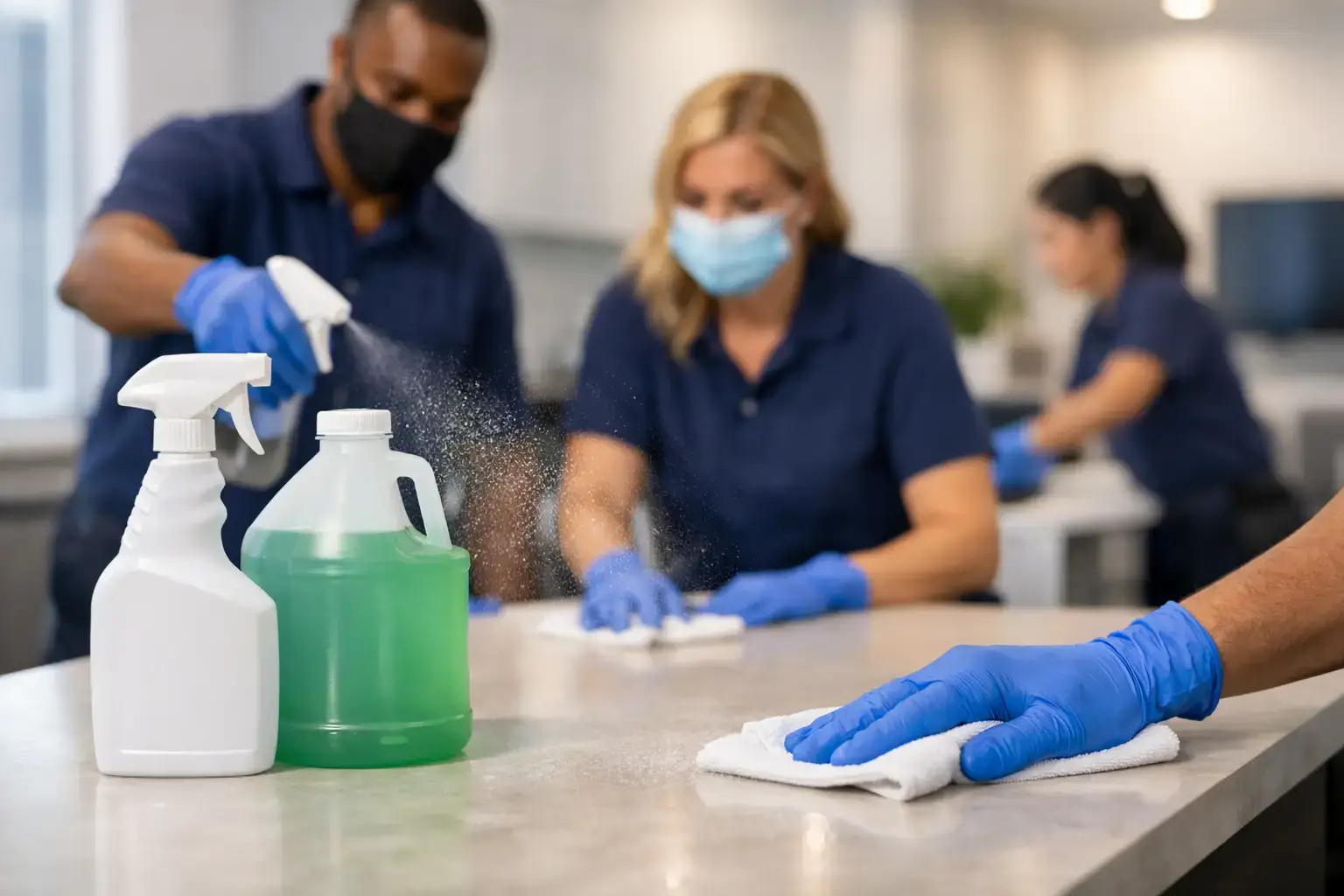
Training should be visual and practical. Staff need to see what sufficient coverage looks like on the actual surfaces they maintain. They should also know when reapplication is necessary because of early drying. This is one of those details that improves when supervisors validate technique in the field rather than only reviewing paperwork.
Product and format selection also matter. In some environments, ready-to-use sprays are effective and simple. In others, wipes improve consistency for smaller touchpoints, while electrostatic or other broad-coverage systems may support larger spaces when used within label directions. The right choice depends on surface area, turnover speed, organism risk, and worker safety considerations.
Facilities should also align dwell time expectations with scheduling reality. If a room must be returned to service in two minutes, a product requiring a much longer wet contact time may create chronic compliance failure unless the workflow changes. Good disinfection programs match chemistry to operations instead of expecting staff to overcome a poor fit every shift.
Surface disinfection dwell time explained for audits and procurement
For buyers and contracting teams, dwell time is part of evaluating product suitability, not just efficacy claims. A product may look strong on a specification sheet, but if its labeled contact time is impractical for your environment, your team may struggle to use it compliantly. That creates risk for both performance and documentation.
During product review, ask whether the contact time aligns with the facility’s sanitation cadence, whether the product supports the required claims for your sector, and whether SDS, technical data, and use directions support staff training and inspection readiness. The goal is not simply to buy a disinfectant. It is to buy one your operation can execute correctly.
This is especially relevant in environments where sanitation records, worker safety protocols, and documented use procedures matter as much as cleaning results. Veteran Commercial Cleaning serves buyers who need that kind of operational clarity because in critical facilities, a product is only as strong as the process around it.
The practical standard teams should follow
If you want a simple rule, use this one: if the surface did not stay wet for the full labeled time, disinfection was not completed as directed. That does not mean every area needs the same product or method. It means every area needs a realistic process that supports the product’s instructions.
For some facilities, that may mean changing application methods. For others, it may mean choosing disinfectants with contact times better suited to high-throughput spaces. In every case, it means training teams to recognize that visible wet time is not optional. It is the mechanism that turns a chemical claim into actual surface performance.
Clean appearance is easy to fake. Documented, repeatable disinfection is not. When teams respect dwell time, they protect more than surfaces – they protect the credibility of the entire sanitation program.