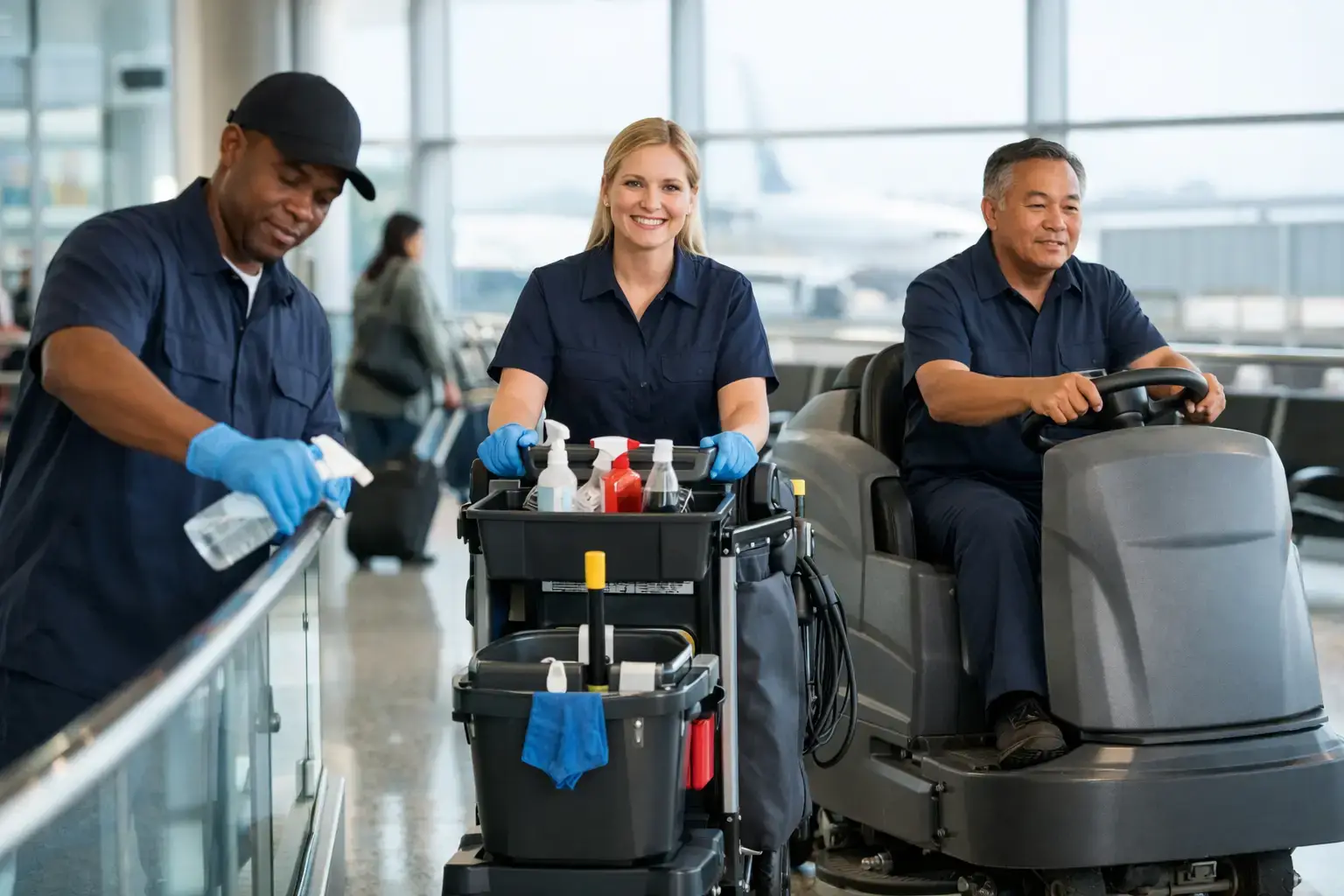
A terminal can look clean at 6:00 a.m. and lose that standard by 6:20. Rolling luggage, food traffic, restroom demand, fingerprint-heavy touchpoints, and round-the-clock occupancy make airports one of the hardest public environments to maintain. That is why choosing the best cleaners for airport terminals is less about finding a single strong chemical and more about building the right product mix for high-volume, high-compliance operations.
Thank you for reading this post, don't forget to subscribe!Airport cleaning teams work in a space where appearance, safety, and documentation all matter at the same time. A floor cleaner that leaves residue can create slip concerns. A disinfectant with the wrong dwell time can disrupt turnaround schedules. A restroom product that smells aggressive may trigger complaints in enclosed passenger areas. The right choice depends on the surface, the soil, the traffic pattern, and the operational window available to clean it.
What makes the best cleaners for airport terminals different
Airport terminals are not cleaned like standard offices. The soil profile is broader, the public exposure is higher, and the acceptable margin for failure is smaller. You are dealing with winter deicing residue tracked inside, oils and grime from baggage areas, food and beverage spills in gate seating, restroom contamination, and constant contact on kiosks, rails, armrests, and counters.
The best cleaners for airport terminals usually share five traits. They need to perform consistently on heavy and mixed soils. They need to support safe use across varied surfaces such as terrazzo, vinyl, stainless steel, glass, laminate, and plastic. They need to fit a realistic labor model, which means manageable dilution, clear instructions, and dwell times that crews can execute during active operations. They also need compliance support through SDS, technical data, and where relevant, disinfecting claims and certification documentation. Finally, they should reduce unnecessary chemical harshness where a safer formulation can still meet performance requirements.
That last point matters more than many buyers assume. In terminals, harsh chemistry can create as many problems as it solves. Strong odors, residue, surface damage, and worker exposure concerns all affect operations. Institutional performance does not require choosing the most aggressive option on the shelf. It requires choosing chemistry that is matched to the task.
Start with zones, not products
Facilities managers often get better results when they define cleaning chemistry by zone. A terminal is a network of different environments, each with its own risk profile.
Front-of-house concourses and gate areas usually benefit from neutral or low-residue daily cleaners for floors and hard surfaces, paired with a separate disinfectant strategy for high-touch points. In these spaces, finish preservation and public perception matter. A product that dulls floors or leaves visible film on seating and counters creates a quality problem even if it technically removes soil.
Restrooms need a different approach. Here, the cleaner has to address body soils, soap scum, hard water buildup, odor sources, and infection-control expectations. One product rarely handles all of that well. Daily restroom maintenance often works best with a combination of disinfecting cleaner for touch surfaces and fixtures, plus targeted chemistry for mineral deposits and stubborn buildup where needed.
Food service adjacencies and dining areas add another layer. These zones call for effective grease and spill removal without leaving slippery residue behind. Product selection must also respect the surface mix, since overpowered degreasers can haze finishes or shorten the life of materials.
Back-of-house support areas, baggage handling corridors, maintenance spaces, and employee break zones can tolerate more task-specific chemistry, but even there, overuse of harsh products tends to create avoidable safety and ventilation concerns.
The cleaner categories that matter most
For most terminal operations, the strongest programs rely on a controlled set of cleaner types rather than an oversized assortment. Neutral floor cleaners are the workhorses for daily cleaning in passenger areas because they remove common soils without attacking floor finish or leaving heavy residue. They are especially useful where autoscrubbers and frequent maintenance cycles are part of the plan.
Disinfectant cleaners are essential, but they need to be selected carefully. In terminals, the issue is not just kill claims. It is whether the product can be used correctly in live operations. If the dwell time is too long for the cleaning window, compliance breaks down in practice. If the product requires extensive rinsing on common surfaces, labor demand increases. The best fit is often the disinfectant that crews can actually deploy consistently on high-touch points, restroom fixtures, and other defined risk areas.
Glass and surface cleaners also deserve more attention than they usually get. Terminals have extensive glazing, polished metals, and reflective surfaces that amplify streaking. A poor-performing glass or multi-surface cleaner can make a recently cleaned area look neglected under bright lighting.
Degreasers have a role, especially in food service support zones, transportation equipment areas, and places where oils accumulate. But this is where discipline matters. A degreaser that is too aggressive for routine public-area use can damage surfaces and create slip risk if not fully removed.
Restroom descalers and acid-based specialty products may be necessary in hard water environments, but they should stay limited to clearly defined tasks. They are not substitutes for a daily maintenance cleaner and should be managed with stronger training and surface compatibility controls.
How to judge performance in a terminal setting
A cleaner can test well in isolation and still fail in an airport. Real performance is operational. The product has to support your staffing model, cleaning frequency, and facility constraints.
First, look at residue behavior. In a terminal, even slight residue builds fast because dust, grit, and passenger traffic are constant. Residue also affects appearance, especially on polished floors and black or dark-tone surfaces.
Second, review dwell time and method requirements. If a disinfectant needs a contact time that your overnight or daytime crew cannot realistically maintain, it is the wrong product no matter how strong the label looks. The same applies to products that require extra rinse steps in spaces where labor minutes are already tight.
Third, evaluate surface compatibility. Airport terminals include expensive materials and mixed finishes. One wrong chemistry decision can damage stone, strip protective coatings, haze plastics, or corrode metals. Buyers should expect clear technical guidance, not vague claims.
Fourth, consider odor profile. Clean does not need to smell overpowering. In enclosed, high-traffic public environments, strong fragrance or harsh chemical odor can generate complaints and negatively affect the passenger experience.
Compliance matters as much as cleaning power
For airport operators, tenants, and contracted service providers, documentation is not optional. The best cleaning programs are built on products backed by SDS sheets, technical specifications, and use instructions that stand up to review. If a supplier cannot clearly support product claims, training needs, and safe-use documentation, procurement risk goes up.
This is where institutional buyers should separate consumer-style marketing from true facility readiness. A terminal operation needs products that can be specified, repeated, audited, and defended. It also needs vendors that understand what happens after the order is placed – implementation, documentation, and ongoing consistency.
Environmentally responsible chemistry can be part of that equation, but only when it still performs in demanding settings. The right goal is not to buy the greenest-looking label. It is to source chemistry that reduces unnecessary harshness while still meeting sanitation, safety, and operational requirements.
Common mistakes when selecting airport terminal cleaners
One common mistake is trying to standardize the entire terminal around one product. That sounds efficient, but it usually creates trade-offs that show up as poor floor appearance, restroom complaints, or unnecessary surface wear.
Another mistake is over-prioritizing strength. More aggressive chemistry is not automatically more effective in public-facing spaces. Often it creates residue, odor, and material compatibility issues that increase labor instead of reducing it.
A third mistake is treating disinfectants as general-purpose cleaners for every task. Disinfectants have a defined role, but daily soil removal and appearance cleaning often require different chemistry. When teams use one product for everything, they usually compromise both sanitation and presentation.
Finally, some facilities underestimate training. Even the best product underperforms if crews do not use the right dilution, dwell time, equipment, and sequence. Product simplicity has real value in high-turnover or multi-shift environments.
Choosing the best cleaners for airport terminals with confidence
A strong airport cleaning program usually includes neutral daily cleaners for floors and general surfaces, targeted disinfectants for high-touch and restroom applications, controlled-use degreasers for heavier soils, and specialty products only where the surface and soil actually require them. That mix gives teams flexibility without creating chemical sprawl.
For procurement leaders, the better question is not which single cleaner is best. It is which supplier can support a terminal-wide strategy with documented products, operationally realistic use guidance, and chemistry suited to high-traffic public spaces. Veteran Commercial Cleaning aligns with that procurement mindset by focusing on institutional-grade performance, safer formulations where appropriate, and the documentation serious facilities expect.
The cleanest terminals are rarely the ones using the harshest products. They are the ones using the right chemistry, in the right zone, with the discipline to match performance to the mission.