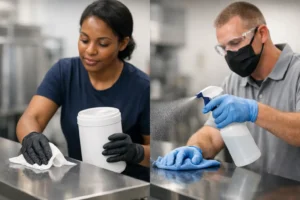
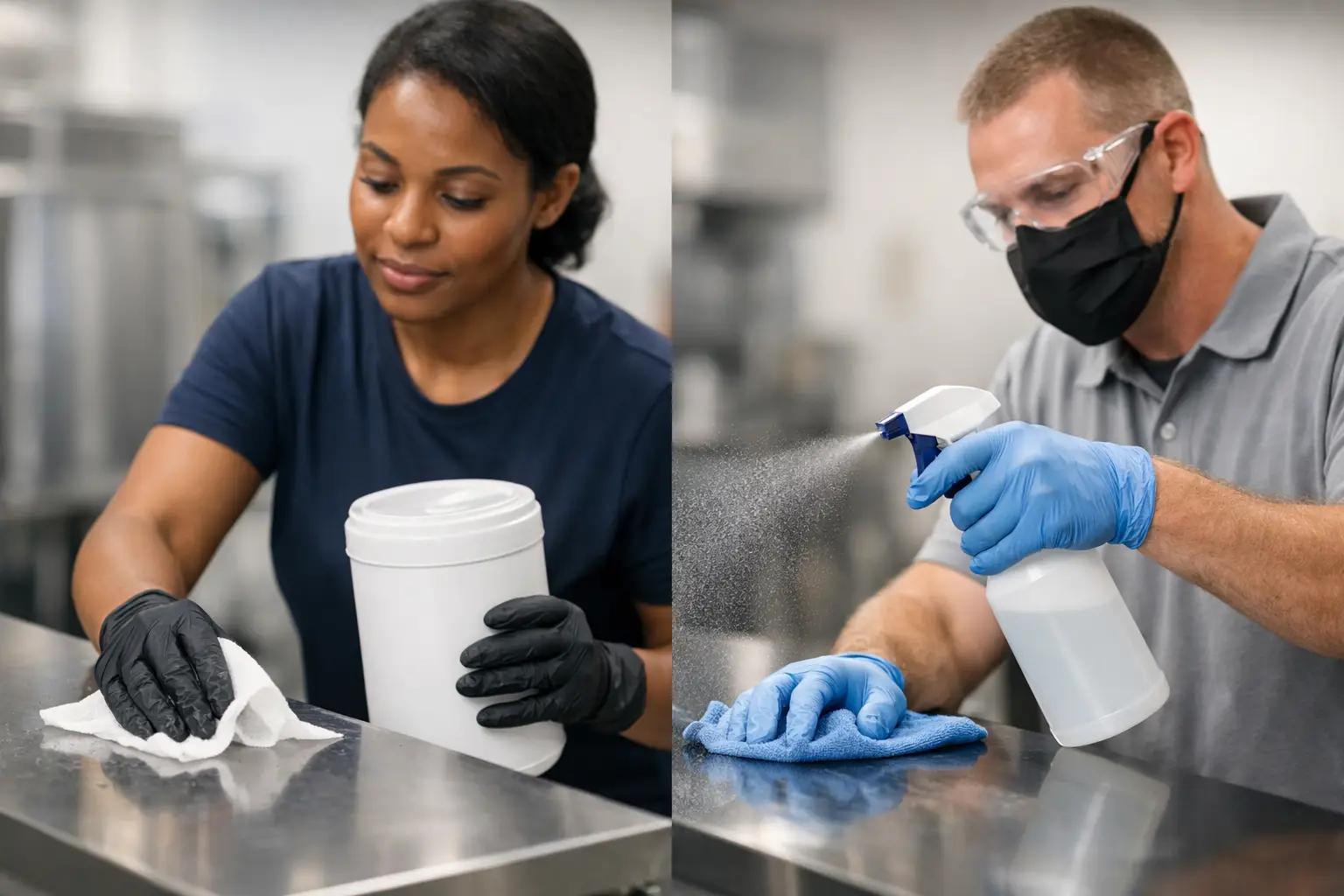
A missed touchpoint in a clinic, breakroom, hangar, or production line is rarely caused by bad intent. It usually comes from a process gap – the wrong product for the task, unclear dwell time, inconsistent application, or poor documentation. That is why the choice between industrial wipes vs spray disinfectants matters. In regulated environments, the format is not a convenience decision. It affects surface coverage, worker exposure, training requirements, waste streams, and whether your team can execute the same standard every shift.
Thank you for reading this post, don't forget to subscribe!Industrial wipes vs spray disinfectants: the real decision
For most facilities, this is not a question of which format is better in every case. It is a question of control. Industrial wipes give teams a premeasured, ready-to-use method that reduces mixing errors and supports fast response on high-touch surfaces. Spray disinfectants offer flexibility, broader area coverage, and in many cases better fit for irregular surfaces or larger cleaning zones.
The trade-off is operational. Wipes can improve consistency, but they may be less efficient for wide surface areas. Sprays can cover more ground, but only if staff apply them correctly, achieve the required wet contact time, and avoid overspray on sensitive equipment or adjacent surfaces. In high-compliance settings, those differences matter more than preference.
Where industrial wipes perform best
Industrial wipes are often the stronger option when speed, portability, and application control are the priority. Environmental services teams, maintenance crews, and frontline staff use them effectively for shared touchpoints like door hardware, handrails, keyboards, control panels, tabletops, and restroom fixtures. Because the chemistry is already loaded into the wipe, there is less room for dilution error and less need for secondary equipment.
That matters in facilities where multiple departments share sanitation responsibility. A wipe can be issued, used, and disposed of with less variability than a spray-and-cloth process. For procurement and operations leaders, that can translate into more standardized execution across shifts and locations.
Wipes also help in areas where aerosolization is a concern or where spray drift could create issues. Around electronics, aviation interiors, security stations, and dense equipment zones, a controlled wipe application can be safer and more precise than spraying liquid into a tight workspace.
Still, wipes are not automatic compliance insurance. Teams can misuse them by drying out the surface too quickly, using one wipe beyond its effective range, or failing to keep the surface visibly wet for the label-required dwell time. If the protocol says disinfect, the product still has to remain wet long enough to do the job.
Wipes support repeatability, but not every surface profile
Flat, frequently touched surfaces are where wipes shine. Large floor areas, wall sections, and heavily soiled machinery are different. A wipe may not carry enough solution to maintain wetness over a broad area, and physical debris can overload the wipe before disinfection is complete. In manufacturing or industrial maintenance settings, cleaning and disinfecting may need to be separated into distinct steps, especially where grease, dust, or residue are present.
Where spray disinfectants make more sense
Spray disinfectants are often the better choice when surface area, shape, or workflow calls for more adaptable coverage. Housekeeping teams cleaning conference rooms, exam spaces, locker rooms, transit seating, or nonporous equipment exteriors can treat larger zones more efficiently with sprays than with individual wipes.
Sprays also give facilities more flexibility in application methods. Depending on the label and the environment, teams may apply with trigger sprayers, pump systems, or paired cloths and mop systems. That can support broader sanitation programs without relying on a single format for every task.
In industrial and government settings, sprays are especially useful when the cleaning team needs to saturate seams, corners, undersides, or hard-to-reach contours that a wipe may skip. If applied correctly, a spray can achieve more complete wetting on complex geometries.
The limitation is execution. Sprays demand more from training, supervision, and process discipline. Staff need to understand distance from the surface, amount applied, compatible wiping tools, required PPE, ventilation needs, and contact time. Inconsistency at any of those points can compromise results.
Spray systems can introduce more variables
Every added step creates another place for error. If a concentrate is involved, dilution control becomes critical. If the product is ready to use, bottle labeling and secondary container management still matter. In audited environments, those details affect not just sanitation outcomes but documentation and inspection readiness.
Overspray is another practical issue. In healthcare, aviation, electronics-heavy offices, and secure facilities, drift onto adjacent surfaces may create material compatibility concerns or require added cleanup. A spray may be efficient, but only when the workspace supports that method.
Compliance, safety, and documentation considerations
For regulated buyers, the format discussion should start with the product label and the facility protocol. Disinfection claims, dwell times, approved surface types, required PPE, and disposal guidance are not interchangeable between products or formats. A wipe and a spray may target similar organisms while carrying different instructions for use.
That means procurement teams should evaluate more than kill claims. They should also review SDS documentation, technical data, use-site fit, worker safety considerations, and whether the product supports the facility’s training model. A product that performs well in a test environment can still be the wrong fit if it introduces preventable compliance risk on the floor.
Industrial wipes often reduce chemical handling, which can help lower exposure risk and simplify staff use. Spray disinfectants may support stronger workflow flexibility, but they can require tighter controls around ventilation, storage, and application technique. Neither format is inherently safer in every setting. Safety depends on formulation, use conditions, and staff adherence.
Facilities pursuing environmentally responsible cleaning programs should pay attention here as well. Safer chemistry is not just a branding point. It can affect occupant comfort, worker exposure, and the feasibility of routine use in enclosed or high-traffic environments. Veteran Commercial Cleaning emphasizes this balance because institutional performance does not require unnecessarily harsh formulations when the chemistry and application method are selected correctly.
How to choose between industrial wipes vs spray disinfectants
The best purchasing decisions usually come from matching product format to task category instead of trying to standardize the entire building around one method. Start with the surfaces that create the most risk or require the most frequent intervention. Shared touchpoints, staff workstations, patient-facing surfaces, control interfaces, and portable equipment often favor wipes because they support quick and consistent execution.
Then look at broader environmental cleaning zones. Large hard surfaces, room turnover cleaning, equipment exteriors, and spaces with irregular geometry may favor sprays if staff can maintain wet contact time and manage application safely.
The labor model matters too. If sanitation is handled by a dedicated EVS or janitorial team with formal training and supervision, spray systems may be practical across more use cases. If disinfection is distributed across operations staff, security personnel, nursing support teams, or maintenance technicians, wipes may produce more reliable compliance because the process is simpler.
Inventory control and waste handling should also factor into the decision. Wipes create a predictable, portable supply format, but they also create container and wipe disposal volume. Sprays may reduce solid waste in some programs, yet they can increase bottle management and refill control requirements. What works best depends on your facility’s actual operating conditions, not a generic preference.
A mixed-format program is often the strongest answer
Many high-performance facilities use both. Wipes cover rapid-response disinfection and high-touch routine tasks. Sprays handle larger-area cleaning and surfaces that need broader wetting. That split supports efficiency without forcing one product format into jobs it does not handle well.
The strongest programs also separate product selection from habit. If your team is choosing wipes because they are familiar, or sprays because that is how it has always been done, the process may be driving the product decision backward. A better approach is to define the surface, the risk level, the required disinfecting claim, the contact time, and the worker using it. Then choose the format that supports compliance under real operating conditions.
A cleaning product should make the correct procedure easier to repeat, not harder to enforce. If your current method leaves too much room for missed dwell time, overspray, inconsistent dilution, or incomplete coverage, that is the signal to reassess the format. The right answer is the one your team can execute correctly every day, under pressure, without cutting corners.