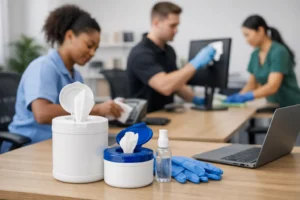
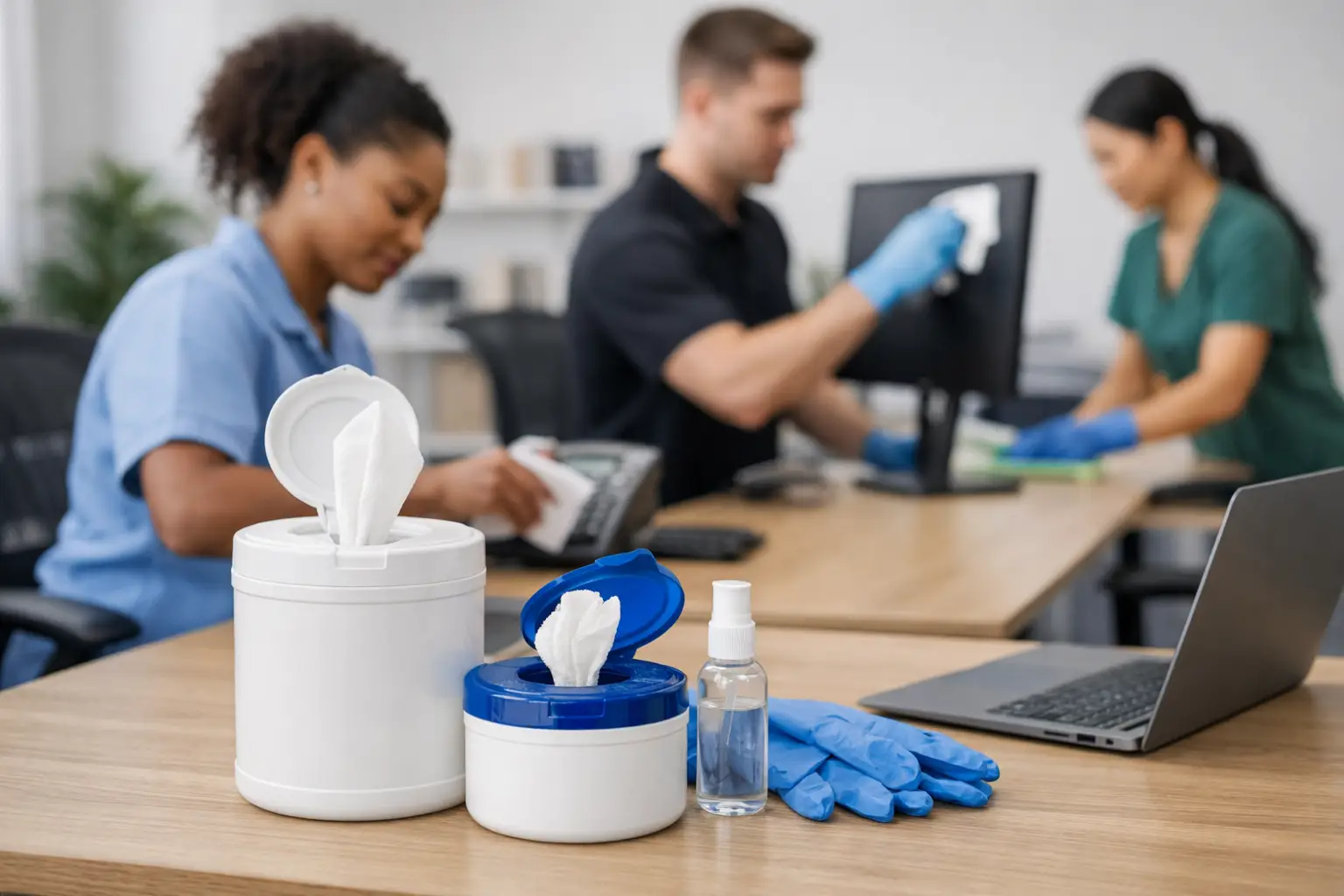
At 8:15 a.m., the break room table, elevator buttons, shared keyboards, and reception counter have already had more contact than most people realize. Choosing the best disinfecting wipes for offices is not a minor supply decision. In many facilities, it is part of infection control, workforce safety, audit readiness, and day-to-day operational discipline.
Thank you for reading this post, don't forget to subscribe!Office environments may look low risk compared with hospitals or manufacturing floors, but touchpoints add up fast. A standard administrative space can include shared phones, conference tables, copier panels, door hardware, restroom fixtures, and visitor-facing counters. In mixed-use facilities such as government buildings, airports, healthcare administrative suites, and industrial front offices, those surfaces serve a constant flow of employees, contractors, and the public. Wipes need to do more than smell clean. They need to perform consistently under real operating conditions.
What makes the best disinfecting wipes for offices
The right wipe starts with verified disinfectant performance, but efficacy alone is not enough. Buyers should look at the full operating profile: contact time, surface compatibility, residue, packaging durability, worker safety, and documentation. A wipe that kills quickly but damages screens, leaves sticky residue, or lacks clear technical support can create as many problems as it solves.
For most office settings, the best products balance broad-spectrum disinfection with practical daily use. That usually means an EPA-registered disinfectant wipe with a realistic dwell time and a formula suitable for common hard, nonporous surfaces. If teams are expected to wipe a conference room between meetings or sanitize a reception desk throughout the day, a product with a 10-minute contact time may be less useful than one that performs faster when used according to label directions.
Material quality matters too. Thin wipes tear, dry out, and lead to uneven coverage. In high-traffic facilities, the wipe substrate should stay intact across larger surfaces like desktops and armrests without bunching or leaving lint behind. Institutional buyers also tend to prefer canisters or packaging systems that hold up in janitorial carts, closets, and public-facing stations.
Efficacy is only the starting point
A disinfecting wipe should be selected based on the organisms and use cases that matter to your facility. General office sanitation needs are different from a healthcare-adjacent administrative suite or a manufacturing office connected to production traffic. The label must support the intended application, and the product should align with your internal cleaning protocols.
That is where procurement and operations teams need to stay disciplined. A consumer wipe marketed for convenience may be acceptable for light-duty use, but it may not meet the documentation expectations of regulated or contract-driven environments. Facilities with compliance obligations often need access to SDS sheets, technical data, EPA registration details, and clear use instructions that support training and standardization.
This is also where trade-offs come into focus. A stronger active chemistry may provide broad kill claims, but it can raise concerns around odor, residue, or routine worker exposure. A milder formula may improve user acceptance and surface compatibility, but only if it still meets the required disinfection standard. The best choice depends on where the wipe is being used, who is using it, and how often.
Surface compatibility can make or break the decision
Offices contain more sensitive surfaces than many supply lists account for. Laminates, plastics, touchscreen panels, finished wood veneers, coated metals, and electronics-adjacent equipment can all react differently to repeated chemical exposure. A wipe that works well on restroom hardware may not be the right option for workstation equipment or conference room technology.
That does not mean every office needs multiple wipe types, but it does mean buyers should avoid assuming one product fits every surface. If your teams are cleaning reception counters, glass partitions, and shared monitors, surface compatibility should be reviewed early, not after visible wear appears. Residue is another practical issue. In customer-facing or executive spaces, streaking and film buildup can become a constant complaint, even when disinfection performance is solid.
For high-compliance buyers, this is why product vetting should include both efficacy claims and real-use compatibility. Documentation is part of the decision, but so is operational evidence from the environments you manage.
Choosing wipes for different office risk profiles
Not every office operates at the same level of exposure. A small private office with limited visitors may need a straightforward disinfecting wipe for shared surfaces and routine housekeeping support. A large commercial office with open seating, hoteling workstations, and frequent visitors will usually need a product designed for repeated daily use across many touchpoints.
Healthcare administrative offices, public-sector buildings, transportation hubs, and manufacturing support offices often sit in a middle zone where the workspace is administrative, but traffic patterns and risk tolerance are much higher. In these settings, wipe selection should reflect the broader facility standard, not just the appearance of the office area.
That is especially true when one supply decision affects multiple departments. Standardizing on a wipe that can move across offices, common areas, and certain shared support spaces can simplify training and inventory control. But standardization only works if the product is realistic for each environment. If users avoid it because of odor, harshness, or poor wipe quality, compliance drops fast.
What procurement teams should verify before ordering
For serious buyers, the evaluation process should be structured. The best disinfecting wipes for offices are not simply the ones with the most marketing claims. They are the ones that fit your facility requirements, user behavior, and compliance expectations.
Start with EPA registration and confirm the use pattern on the label. Review contact time, approved surface types, precautionary statements, storage guidance, and whether the product supports your cleaning frequency. Then review the technical package. SDS access, specification sheets, and consistent labeling are basic requirements in institutional settings.
It also helps to consider supply continuity. A wipe may test well in a pilot, but if replenishment becomes inconsistent, teams substitute ad hoc products and protocol control starts to weaken. Buyers responsible for government, military, healthcare, or industrial environments typically need a supplier that understands documentation, fulfillment discipline, and order consistency, not just product descriptions.
Environmental profile should also be part of the review, but with the same operational rigor. Safer chemistry is valuable when it reduces unnecessary harshness for workers and occupants. Still, environmental positioning should never come at the expense of verified performance. The strongest products in this category are the ones that support both responsible chemistry and institutional expectations for efficacy and safety.
Common mistakes when selecting office disinfecting wipes
One common mistake is choosing based on fragrance or brand familiarity instead of label fit. Pleasant scent may improve acceptance, but it tells you little about disinfection performance, residue behavior, or compatibility with your facility standards.
Another is ignoring contact time. Staff often wipe and walk away, assuming the surface is disinfected immediately. If the product requires a longer wet time than your cleaning routine allows, the disinfecting claim may not be achieved in practice. That is not a product failure alone. It is a mismatch between product design and workflow.
Teams also run into problems when they use disinfecting wipes as a substitute for all cleaning. Heavy soil, grease, or visible buildup can reduce effectiveness. In office break rooms, shared kitchens, or industrial admin spaces with dust migration, pre-cleaning may still be necessary before disinfection. The label and the environment should drive the protocol.
How to build a wipe program that actually holds up
A wipe program works when the product, the placement, and the training align. If canisters are stored far from the point of use, people skip the step. If the wipe is too harsh for frequent use, they use less of it. If instructions are unclear, everyone develops their own method.
Operationally, offices do best when wipes are placed at clear touchpoint zones such as reception, conference rooms, shared desks, print stations, and break areas. Custodial teams and occupants should understand which surfaces are appropriate, how long surfaces must remain visibly wet, and when a different cleaning method is needed. That level of clarity matters more than adding more products.
For organizations that need a procurement-ready approach, suppliers should be able to support more than a basic product transaction. They should provide the technical materials needed for review, standardization, and internal approval. That is particularly relevant in facilities where infection control, safety committees, ESG initiatives, or contract officers all have a stake in what gets purchased.
Veteran Commercial Cleaning serves buyers who need that higher level of supply discipline, especially in environments where sanitation documentation and performance standards carry real operational consequences.
The right wipe should make your program easier to enforce, not harder to explain. When the product matches the workflow, the surfaces, and the compliance standard, daily disinfection becomes a reliable control instead of a recurring weak point.