A missed restroom check in an airport does not stay a small issue for long. In a terminal, one clogged fixture, one empty dispenser, or one wet floor can turn into a customer complaint, a safety event, and a documented operations failure within the same hour. That is why an airport restroom cleaning program example has to be more than a cleaning checklist. It needs to function as an operational control system.
Thank you for reading this post, don't forget to subscribe!For airport facilities teams, contract managers, and procurement leaders, the real question is not whether restrooms are being cleaned. The question is whether the program is structured to hold up under peak passenger volume, irregular surges, regulatory scrutiny, and public visibility. A workable program balances appearance, sanitation, labor discipline, supply continuity, and defensible documentation.
What an airport restroom cleaning program example should include
A credible airport restroom program starts with risk classification. Not every restroom in an airport carries the same traffic, dwell time, or service demand. Restrooms near security checkpoints, baggage claim, gate clusters, international arrivals, food courts, and employee corridors all behave differently. If the program treats them the same, performance usually breaks down where traffic is highest.
A strong framework groups restrooms into service tiers. High-volume public restrooms may require continuous day porter coverage or checks every 15 to 30 minutes. Moderate-use restrooms may run on 60-minute inspection intervals. Low-traffic administrative or back-of-house restrooms can follow a scheduled service model with supplemental response as needed. This tiering matters because labor allocation drives outcomes more than the written standard alone.
The next element is a written scope of work that separates routine care from restorative work. Routine tasks include fixture wipe-down, trash removal, touchpoint disinfection, floor spot cleaning, replenishment, and immediate hazard correction. Restorative work covers grout detail, hard water treatment, partition cleaning, wall washing, drain treatment, machine scrubbing, and periodic deep sanitation. When these are blended into one vague expectation, routine service often consumes all available labor and the restroom degrades over time.
Sample operating model for terminal restrooms
An effective airport restroom cleaning program example usually combines fixed schedules with condition-based response. In practice, that means the team follows set inspection intervals but is also dispatched through radio, app, or work order when traffic spikes or a deficiency is reported.
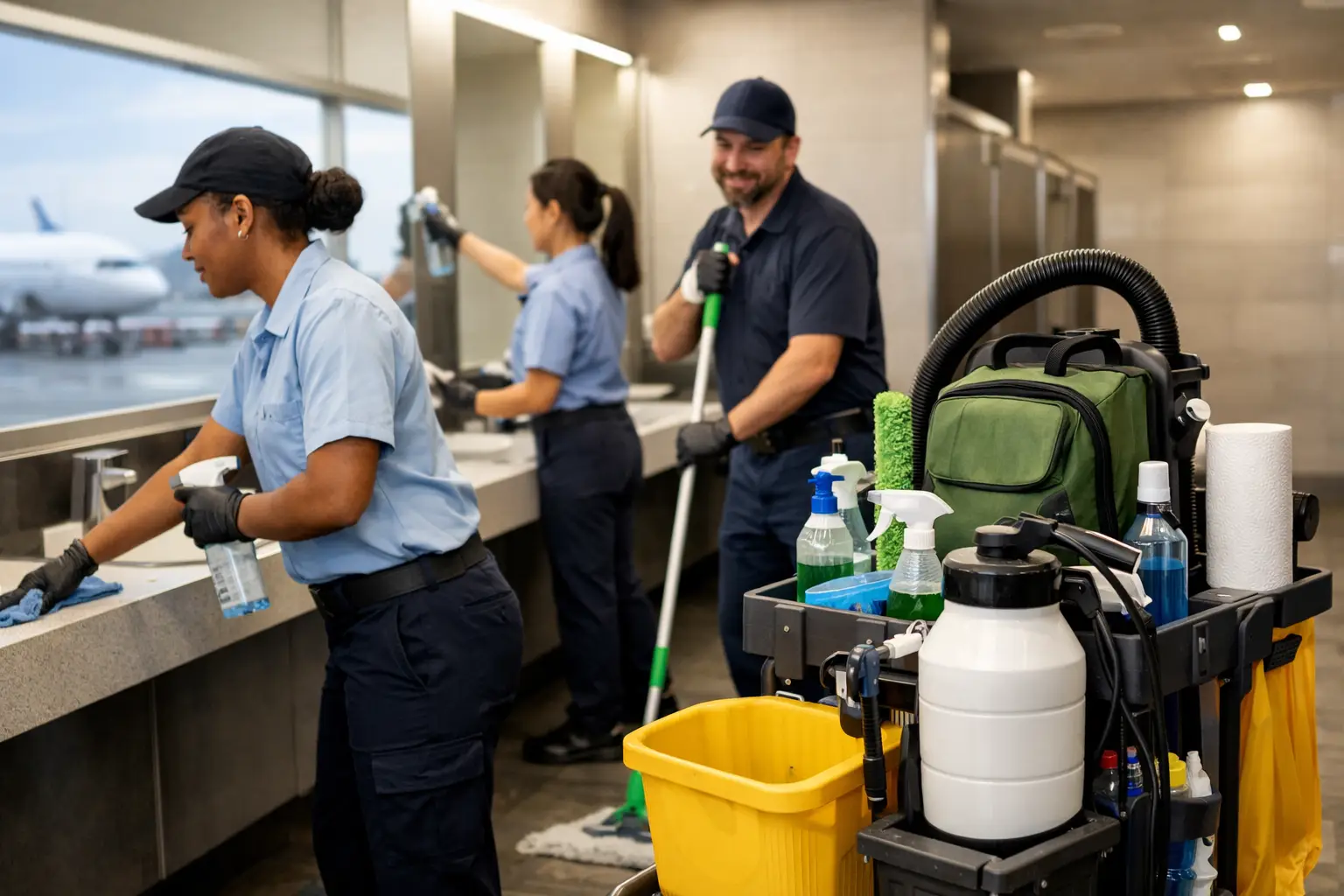
For a high-traffic terminal restroom, the day shift may begin with a pre-opening detail clean. That includes full fixture sanitation, mirror and partition cleaning, floor cleaning, drain inspection, dispenser refill, and a documented readiness inspection before passenger flow increases. During operating hours, attendants or porters complete recurring checks focused on consumables, visible soil, touchpoint disinfection, odor control, and floor safety. A second, more thorough service is often scheduled during lower-volume periods to reset the space before the next surge.
Overnight, the program shifts from appearance maintenance to restoration. This is the right window for machine scrubbing, descaling, polishing stainless surfaces, pressure-assisted spot treatment where appropriate, and addressing defects that cannot be resolved during active use. The trade-off is straightforward. Heavy daytime intervention disrupts passengers, while waiting too long for restorative care reduces appearance standards and can shorten surface life.
Staffing and accountability
Airport restroom performance is rarely a product issue alone. It is usually a staffing and supervision issue. A program works when responsibilities are defined at the shift, zone, and individual level.
In most airports, restrooms are assigned by zone so attendants can move quickly within a terminal section rather than lose time traveling between distant locations. Each zone should have a clear roster, inspection frequency, escalation path, and supervisor review schedule. Supervisors need to verify more than completion. They should check quality, stock accuracy, safety conditions, and whether the work log matches actual restroom conditions.
Cross-training matters here. Staff should know the difference between routine disinfection, body fluid response, slip hazard correction, and maintenance escalation. If a toilet is repeatedly out of service, cleaning staff should not be left to manage a maintenance issue through repeated wipe-downs and signage alone. The program has to define when cleaning ends and facilities repair begins.
SOPs that hold up under audit
Standard operating procedures should be specific enough that a new team member, a contractor, or an auditor can understand exactly what acceptable service looks like. Generic statements like clean and sanitize all surfaces do not help much in a high-compliance environment.
A better SOP defines the sequence of work, dwell times where applicable, PPE requirements, chemical dilution or ready-to-use standards, approved tools by surface type, and sign-off requirements. It should also identify restricted practices. For example, oversaturation around electrical fixtures, improper mixing of chemicals, or using abrasive tools on specialty finishes can create risk that is avoidable with clear instruction.
Documentation should be simple enough to sustain. Airports often overbuild forms and then struggle with completion accuracy. A short digital or paper inspection log that captures time, employee ID, deficiencies found, corrective actions taken, and supervisor verification is usually more useful than an oversized checklist no one completes honestly.
Cleaning chemistry and surface protection
Airports need sanitation performance, but they also need chemistry that fits enclosed public spaces, mixed materials, and frequent use. Harsh products can damage finishes, create odor complaints, or increase worker exposure concerns. On the other hand, weak chemistry can leave biofilm, mineral buildup, and recurring odor sources untreated.
The best choice depends on the task. Daily touchpoint disinfection may require one protocol, while descaling urinals, treating grout, or removing soap residue may require another. The program should align products with surface compatibility, contact time requirements, ventilation conditions, and documentation standards such as SDS availability and technical specifications. That is especially relevant in airports where procurement, safety, and environmental review may all be involved in approval.
Veteran Commercial Cleaning supports this kind of structured approach by focusing on institutional cleaning programs and documentation-ready chemistry suited for high-compliance facilities.
Inspection standards that actually predict complaints
Many restroom programs fail because they inspect for what is easy to see instead of what passengers notice first. A restroom can appear recently cleaned and still generate complaints if dispensers are empty, odors persist, stall locks fail, or the floor feels unsafe.
Inspection standards should score a few operational categories consistently: fixture cleanliness, touchpoint sanitation, floor condition, consumable stock, odor control, equipment function, and safety hazards. Some airports add passenger-facing quality indicators such as first impression at the entry, mirror clarity, and visible debris near sinks and urinals. That is useful because public perception often forms in seconds.
Trend review is just as important as the score itself. If one restroom repeatedly fails on odor or dispenser availability, the answer may not be more frequent cleaning. It may be a ventilation issue, a supply placement problem, or unrealistic interval timing based on actual traffic.
Common failure points in an airport restroom cleaning program example
The most common breakdown is treating all hours the same. Airport traffic is uneven. Early departures, weather disruptions, delayed arrivals, and event travel all create spikes. If staffing stays flat while demand changes, service quality drops predictably.
Another weak point is poor handoff between shifts. A restroom that looks acceptable at 2 p.m. can become a problem by 4 p.m. if the incoming team does not know which fixtures are already marginal, which supplies are running low, or which maintenance tickets are still open.
There is also a compliance risk when teams rely on memory instead of documented procedure. In a public facility, undocumented work often gets treated as incomplete work. That matters for contract oversight, internal reporting, and any review following an incident or complaint.
How to use this example in procurement or program design
If you are building or rebidding an airport restroom program, use the example as a framework rather than a rigid template. The right inspection frequency, staffing model, and chemistry package depend on terminal size, traffic volume, fixture counts, union conditions, airport authority requirements, and whether the work is self-performed or contracted.
What should stay consistent is the structure. Define restroom tiers. Separate routine and restorative scope. Match labor to traffic patterns. Write usable SOPs. Require documentation that can survive review. Build in supervisor verification. Align cleaning chemistry with both sanitation goals and surface safety. That combination gives procurement and operations teams something they can measure, defend, and improve.
A restroom program in an airport is never judged only by what the cleaning team intended to do. It is judged by what passengers encounter, what supervisors can verify, and what records can prove when questions come up. Build the program for those three tests, and it will perform when traffic and scrutiny are both high.