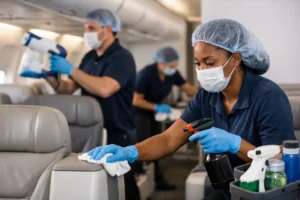
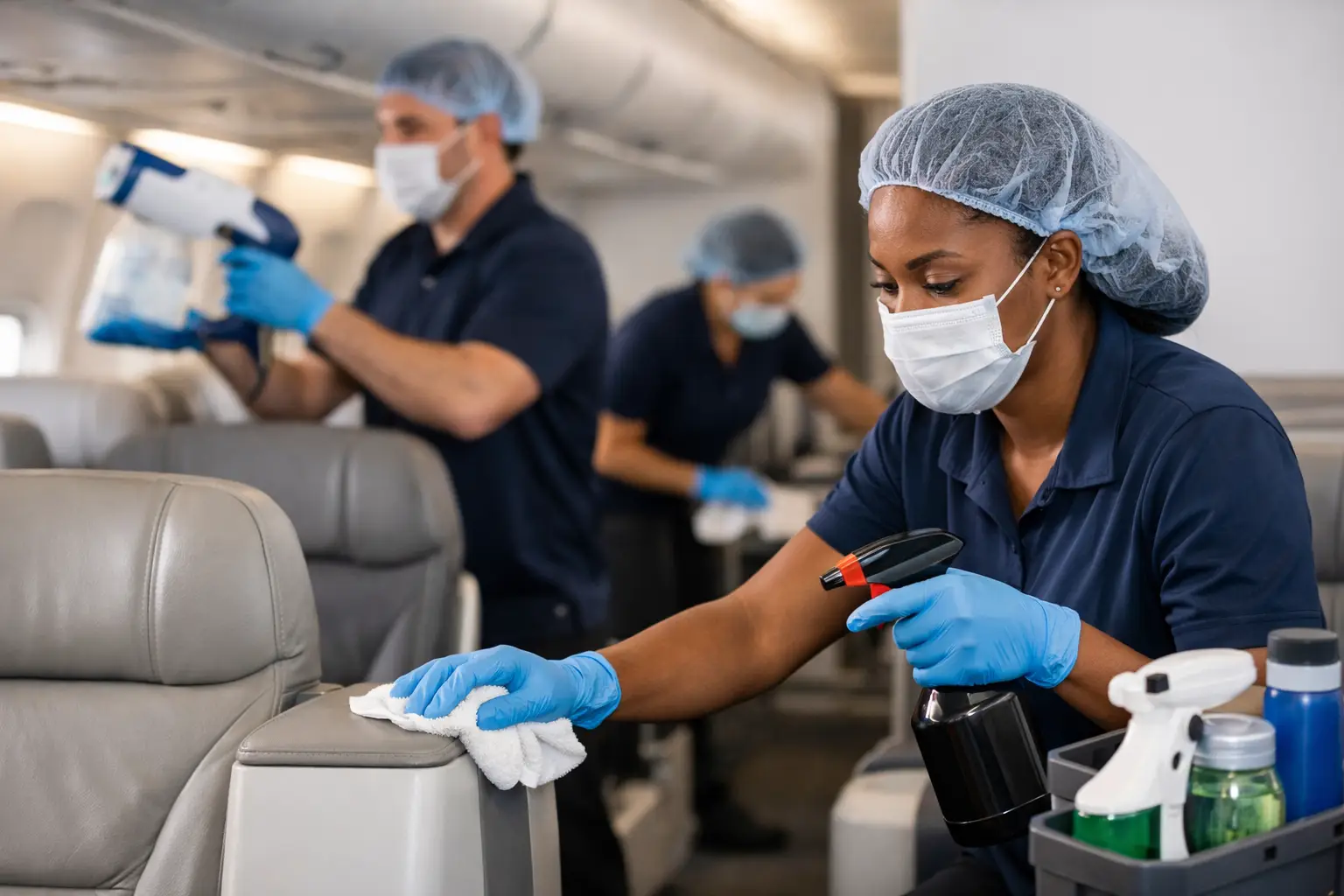
A coffee spill in row 12 is easy to see. The residue on a tray table latch, seatbelt buckle, armrest seam, or lavatory touchpoint is where risk builds. In aviation, knowing how to clean aircraft interiors safely means balancing sanitation, material compatibility, worker protection, and aircraft readiness at the same time. If one part of that process is overlooked, the result can be surface damage, unnecessary chemical exposure, documentation gaps, or delayed return to service.
Thank you for reading this post, don't forget to subscribe!Why aircraft interior cleaning requires a different standard
Aircraft cabins are not cleaned like offices, schools, or retail spaces. Interior components include coated plastics, laminates, fabrics, leather, electronic interfaces, galleys, lavatories, and high-touch hard surfaces packed into a confined environment. Many of those materials are sensitive to aggressive chemistry, oversaturation, or improper application methods.
That creates a real operational trade-off. A cleaner may be effective on soil and pathogens, but still be the wrong choice if it leaves residue, accelerates wear, affects cabin air quality, or lacks the documentation a regulated facility expects. For procurement teams and operations leaders, safety is not only about disinfection performance. It is also about whether the process supports OSHA-aligned worker safety, internal SOPs, material preservation, and maintenance coordination.
In practical terms, safe aircraft interior cleaning starts with controlled chemistry, clear task sequencing, and documented procedures. It should never rely on improvisation.
How to clean aircraft interiors safely without damaging surfaces
The safest process begins before any product is sprayed or any wipe touches a cabin surface. Teams need to identify the target soils, the surface types involved, the occupancy or turnaround schedule, and any manufacturer or operator restrictions that apply to interior materials. That front-end assessment reduces one of the most common causes of damage – using a strong general cleaner where a surface-specific product and lighter dwell time would have done the job.
Dry removal comes first whenever possible. Loose debris, dust, crumbs, and particulate matter should be removed by controlled vacuuming or dry wiping before wet cleaning begins. This keeps grime from turning into slurry and limits the need for repeated chemical application.
Once dry soil is removed, use the least aggressive chemistry that will achieve the required result. For general interior maintenance, that often means a cleaner or disinfectant appropriate for hard nonporous high-touch points, applied in a way that controls moisture. Saturating seat controls, inflight entertainment components, switch areas, vents, or seams increases the chance of damage. In most cases, applying product to a cloth or wipe rather than directly onto the surface offers better control.
Dwell time matters, but so does residue management. If the selected chemistry requires a specific contact time for sanitizing or disinfecting claims, the surface must remain visibly wet for that period unless the label or technical guidance states otherwise. At the same time, crews should avoid excess liquid that can wick into cushions, stitching, or electronic housings. Safe cleaning is often about precision rather than volume.
After treatment, surfaces may need a clean water wipe or a secondary dry wipe depending on the product used, the finish of the material, and the operator’s interior appearance standards. This is especially important on touch surfaces where residue can affect feel, appearance, or long-term coating performance.
Prioritize high-touch zones, but do not treat every material the same
Cabin interiors have concentrated risk points. Tray tables, armrests, seatbelt buckles, call buttons, overhead bin handles, lavatory fixtures, door hardware, galley work areas, and crew touchpoints deserve focused attention because they combine frequent contact with difficult cleaning geometries.
Even so, standardizing the process does not mean treating every area identically. A lavatory hard surface can usually tolerate a different protocol than a leather seat, fabric panel, acrylic partition, or touchscreen. Overgeneralizing here is where many cleaning programs fail.
For soft surfaces, the question is not simply whether they look clean. Teams need to consider moisture control, drying time, odor retention, and whether the chemistry is suitable for fabrics or leather finishes. For clear plastics and displays, the wrong product can haze the surface or degrade visibility over time. For metal fixtures, repeated exposure to incompatible formulations can lead to spotting or finish deterioration. Safe cleaning depends on matching method to material, not forcing a single product across the entire cabin.
Worker safety is part of how to clean aircraft interiors safely
Aircraft interior cleaning protocols should protect cleaning personnel as deliberately as they protect cabin materials. Crews often work under time pressure, in tight spaces, and around residues that may include body fluids, food waste, and unknown contamination. That makes training, PPE selection, ventilation awareness, and chemical handling discipline non-negotiable.
Product labels, SDS documentation, and technical specifications should guide dilution, required protective equipment, first-aid measures, and incompatibility warnings. This is particularly important when multiple products are in use across galleys, lavatories, seating areas, and spot-treatment tasks. Cross-mixing or decanting into unmarked containers creates unnecessary exposure and compliance risk.
Ventilation is another point that gets underestimated. Even lower-harshness chemistry should be used with awareness of enclosed airspace and crew exposure. Applying more product than needed does not improve outcomes. It increases drying time, raises the chance of residue, and can create avoidable inhalation concerns for workers and returning occupants.
For supervisors and procurement officers, this is where documentation matters. A safe interior cleaning program should be supportable with current SDS sheets, product instructions, training records, and task-specific procedures. In regulated and public-facing environments, undocumented cleaning is a weak position.
Build the process around compliance and repeatability
A compliant cleaning result is not just a clean-looking cabin. It is a repeatable outcome supported by approved chemistry, trained staff, and clear records. That is especially relevant for airports, government operators, contract service providers, and any organization managing multi-site or high-frequency cleaning activity.
The strongest programs define who cleans what, with which product, at what frequency, and under which verification standard. They also distinguish between routine appearance cleaning, targeted sanitizing, body-fluid response, and deeper restorative work. Combining all of those tasks into one generic procedure usually leads to either under-cleaning or material stress.
Repeatability also depends on procurement discipline. When teams substitute chemicals based only on availability, they introduce variation in dwell times, PPE requirements, residue characteristics, and material compatibility. Standardization reduces that risk. Veteran Commercial Cleaning supports buyers in high-compliance settings by focusing on professional-grade cleaning solutions backed by the documentation institutional teams need to evaluate safety and fit.
Common mistakes that create risk in aircraft cabins
The most common mistake is using an unnecessarily harsh cleaner for routine soils. Stronger is not always safer, and in aircraft interiors it often creates more downstream problems than it solves. Finish damage, discoloration, residue buildup, and odor complaints can all come from overpowered chemistry.
Another frequent issue is spraying directly onto surfaces with seams, electronics, or ventilation openings. Controlled application is usually the safer method. Teams also run into trouble when they skip pre-cleaning and attempt to disinfect visibly dirty surfaces. Soil interferes with performance and increases wipe burden.
There is also a process mistake that shows up in rushed turnarounds – treating contact time as optional. If a product is selected for sanitizing or disinfecting performance, crews have to follow the use instructions that support that claim. Anything less creates a gap between what the team thinks happened and what actually happened.
Finally, many organizations underestimate the value of material testing. Even when a product is documented and suitable in general, spot testing on an inconspicuous area is a disciplined step when finishes, aging interiors, or specialty materials are involved.
A safer aircraft cleaning program is built upstream
If you want better outcomes in cabin cleaning, the answer is rarely to push crews harder on the back end. The answer is to improve the system upstream. That means selecting chemistry with the right compliance profile, training crews on application control, aligning SOPs to cabin materials, and requiring documentation that stands up to internal review.
Aircraft interiors ask for discipline. The best cleaning programs respect that by using methods that protect passengers, crew, assets, and operations all at once. When the process is built correctly, safety is not a separate objective from cleanliness. It is the standard that makes cleanliness sustainable.