A factory floor tells you quickly whether a sanitation program is working. You see it in oil film near production lines, residue in grout, dust migration at thresholds, and slip hazards that appear halfway through a shift. Choosing the best products for factory floor sanitation is not about buying the strongest chemical on the shelf. It is about matching soil load, surface type, traffic pattern, safety requirements, and documentation standards to products that perform consistently under real operating conditions.
Thank you for reading this post, don't forget to subscribe!For procurement teams and facility leaders, that decision carries more weight than appearance alone. Poor product selection can create worker safety issues, interfere with production, damage floor finishes, complicate audits, and leave sanitation gaps that show up in inspections. The right product mix supports cleaner floors, safer movement, and more defensible compliance records.
What the best products for factory floor sanitation need to do
Factory floors are not a single cleaning category. A warehouse pick path, a food-adjacent production area, a machining zone, and a maintenance bay all create different sanitation demands. That is why the best products for factory floor sanitation usually work as a system rather than a one-bottle answer.
At minimum, those products need to remove the soils your operation actually generates. In many facilities, that means a combination of grease, hydraulic fluid, rubber marks, metal fines, tracked-in dirt, and occasional biological contamination. A product that handles light soil well may fail under heavy petroleum residue. A disinfectant that meets contact-time requirements may not be the right first step if the floor has not been cleaned thoroughly beforehand.
The strongest programs also account for worker exposure, indoor air considerations, rinse requirements, compatibility with scrubbers or mop systems, and the need for SDS sheets and technical documentation. For regulated and high-compliance environments, that paperwork matters almost as much as the cleaning result.
Start with industrial degreasers, not disinfectants
On many factory floors, grease removal is the first operational priority. If oils and embedded residue remain on the surface, disinfection becomes less reliable and routine maintenance gets harder with every cycle. Industrial degreasers are often the backbone of a floor sanitation program because they break down the films that trap dirt and create slip risks.
The best degreasers for factory use are strong enough to cut through petroleum-based and food-processing soils but controlled enough to avoid damaging the substrate or leaving hazardous residue behind. Eco-conscious chemistry has improved substantially in this category. Buyers no longer have to assume that lower-harshness formulas mean lower performance. In many facilities, modern industrial degreasers can deliver institutional cleaning results while supporting safer handling and more responsible environmental profiles.
That said, there is a trade-off. Heavy-duty degreasers may require dwell time, mechanical agitation, or a follow-up rinse to deliver the expected result. Facilities with sealed concrete, epoxy coatings, or specialty flooring should verify compatibility before standardizing any product across multiple zones.
Where degreasers perform best
Degreasers are especially useful in manufacturing cells, loading areas, maintenance corridors, and around equipment bases where oils accumulate gradually and become part of the floor itself. In those settings, routine use often prevents the need for more aggressive corrective cleaning later.
Disinfectants matter, but only in the right sequence
Disinfection is a critical part of sanitation in many facilities, particularly where cross-contamination risk, employee density, or hygiene-sensitive processes are involved. But disinfectants are not a substitute for cleaning. They work best after visible soils and residues have been removed.
For factory floor sanitation, the right disinfectant should align with the facility’s risk profile. In some environments, broad-spectrum efficacy and documented kill claims are essential. In others, the priority may be a safer daily-use chemistry with practical contact times that operations teams can consistently follow. If the required wet-contact time is unrealistic for a high-traffic aisle, compliance on paper may not match reality on the floor.
This is where disciplined product selection matters. Procurement teams should look beyond label headlines and evaluate application method, drying behavior, residue potential, and required PPE. A disinfectant that is technically effective but operationally difficult will not hold up in a busy plant.
Floor cleaners for daily maintenance keep sanitation sustainable
Not every shift calls for a heavy degreaser or a disinfectant cycle. Daily floor cleaners play an important role by removing routine soil without overloading the environment with stronger chemistry. For large facilities, this category often determines whether sanitation stays manageable over time.
The best daily cleaners for factory floors work well in autoscrubbers and manual systems, leave minimal residue, and support frequent use without dulling the surface. They are especially valuable in mixed-use spaces where soils vary by zone and where teams need one dependable cleaner for repeated maintenance passes.
A common mistake is using a product designed for corrective cleaning as the everyday standard. That can create unnecessary chemical exposure, longer dry times, and avoidable wear on floor coatings. Daily maintenance cleaners are not less serious products. They are what make a sanitation program repeatable.
Wipes and spot-cleaning products fill the operational gap
Large-scale floor cleaning gets most of the attention, but sanitation failures often begin with small missed events. Leaks, drips, overspray, tracked residue, and localized contamination can spread quickly when they are not handled at the point of occurrence. Industrial-grade wipes and targeted spot-cleaning products help close that gap.
In facilities where response speed matters, wipes can support immediate cleanup of grease transfer on equipment surrounds, railings, and adjacent floor edges. They are not a replacement for full floor sanitation, but they reduce the chance that a minor spill becomes a slip incident or a broader housekeeping issue.
The key is using wipes with the right chemistry for the task. A general surface wipe may not be appropriate for oily soils, while a stronger solvent-based wipe may be unnecessary for routine use. Product discipline matters here as well.
Sanitation systems matter as much as the chemistry
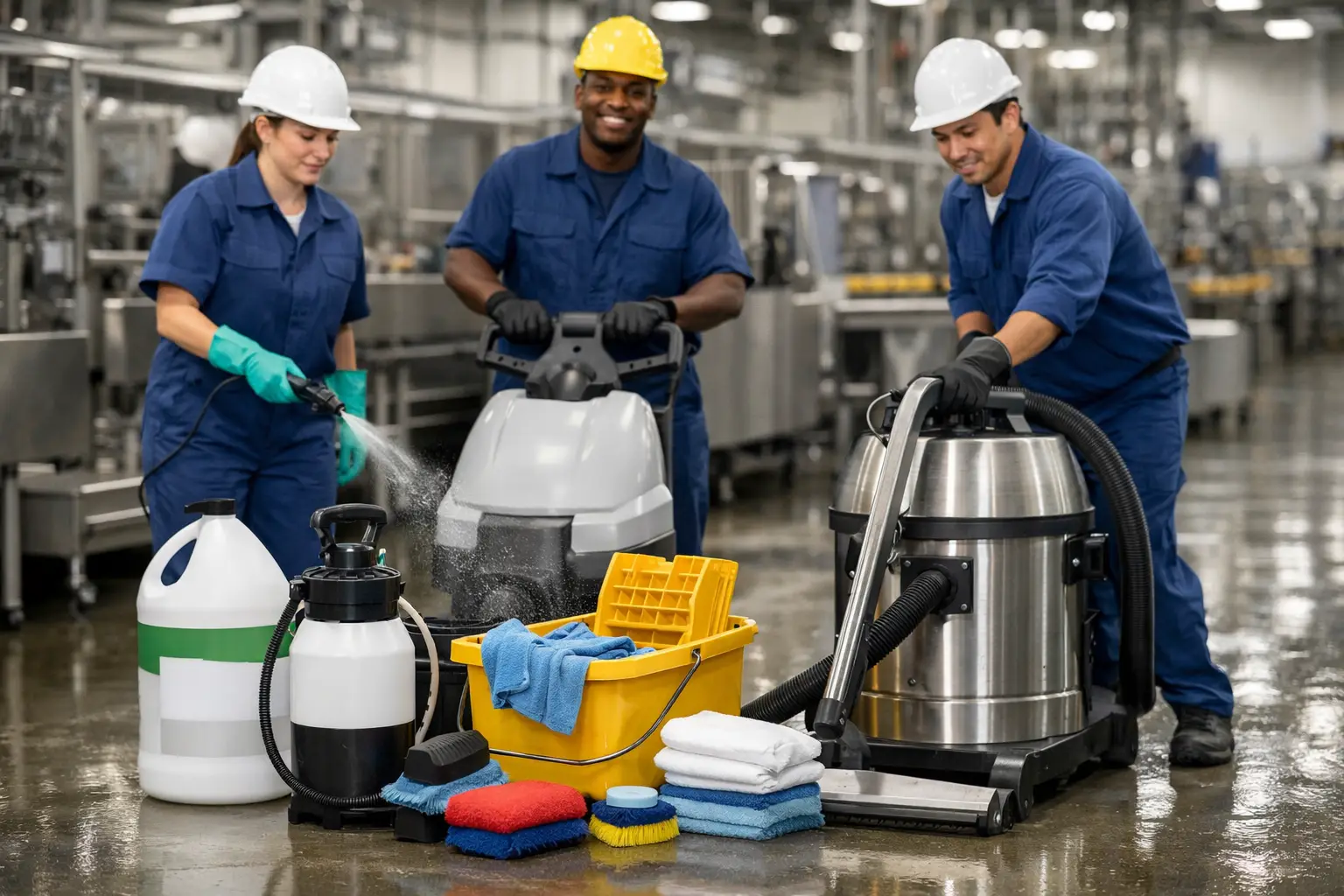
The best products for factory floor sanitation do not perform in isolation. Their effectiveness depends heavily on the delivery method. Mop buckets, pump sprayers, foam systems, autoscrubbers, and controlled dilution systems all affect dwell time, coverage, worker consistency, and waste.
For larger operations, dilution control is particularly important. Over-concentrating a floor cleaner can leave residue and create safety concerns. Under-diluting can lead to poor cleaning performance and failed expectations. Systems that standardize mixing reduce variability across shifts and simplify training.
Application method also affects documentation and audit readiness. A sanitation product with clear instructions, defined dilution ratios, and supporting technical specifications is easier to implement consistently across departments. That matters in government, manufacturing, healthcare-adjacent, and aviation environments where procedures are expected to be repeatable and defensible.
How to evaluate products before standardizing them
A smart evaluation process starts with the floor itself. Concrete, sealed concrete, epoxy, urethane, and tile do not respond the same way to chemical exposure or agitation. Then assess the actual soil profile. Many sanitation programs fail because teams buy for the worst-case event and ignore the most common daily condition.
Next, review safety and compliance needs. That includes SDS availability, technical data, storage requirements, employee handling considerations, and any site-specific standards tied to your operation. Buyers in federal and regulated environments should be especially careful here. Documentation gaps slow approvals and create avoidable procurement friction.
Field testing is worth the effort. Trial products in a high-soil zone and a routine-maintenance zone. Watch not only for cleaning power, but also for residue, odor, rinse burden, and how easily teams can use the product correctly under time pressure. The best-performing chemistry on paper is not always the best operational fit.
Common mistakes when choosing sanitation products
One of the most common errors is relying on a single product for every condition. That usually leads to compromise. Either the product is too mild for heavy soils or too aggressive for routine daily use. Another mistake is selecting based only on immediate cleaning strength while ignoring substrate compatibility and worker safety.
Facilities also run into problems when they treat compliance documentation as an afterthought. In high-accountability settings, product effectiveness and procurement readiness need to travel together. Veteran Commercial Cleaning serves buyers who need both, especially when institutional performance has to align with safer chemistry and documentation standards.
Finally, many teams underestimate training. Even an excellent floor sanitation product can underperform if dilution, dwell time, or application sequence is inconsistent. Products should make the work easier, but the program still has to be clear.
Building a product mix that fits the facility
Most factory floors benefit from a layered approach: a daily floor cleaner for routine maintenance, an industrial degreaser for heavy soil and corrective work, a disinfectant where sanitation claims are required, and wipes or spot treatments for immediate response. That mix covers the full operating cycle without forcing one product to do every job.
The right combination depends on your environment. A plant with frequent oil exposure may lean heavily on degreasing performance. A cleaner assembly environment may prioritize residue control and safer indoor use. Multi-use facilities often need zone-based selection rather than one standardized product across the building.
The best buying decisions usually come from asking a simple operational question: what will this product allow our team to do, correctly and consistently, every day? If the answer includes safer floors, cleaner surfaces, manageable training, and documentation that stands up to review, you are choosing from a position of control rather than guesswork.
A clean factory floor is never just about appearance. It reflects whether the operation is disciplined enough to support safety, compliance, and performance at the same time.