A missed disinfectant contact time can turn a completed cleaning round into a compliance gap. For environmental services leaders and facility managers, healthcare disinfectants are not a generic supply category. They are a controlled part of infection prevention, worker safety, asset protection, and operational readiness.
Thank you for reading this post, don't forget to subscribe!The right product must do more than leave a surface looking clean. It must be appropriate for the target pathogen, used on the correct surface, applied at the labeled dilution, and left wet for the required contact time. It also needs to fit the realities of a busy facility where staff must clean patient areas, restrooms, high-touch equipment, public spaces, and support areas without disrupting care or creating avoidable chemical exposure.
What Healthcare Disinfectants Must Deliver
Healthcare facilities operate under a higher standard because the consequences of poor sanitation can extend beyond appearance or customer satisfaction. A product selection decision affects infection-control practices, employee safety procedures, training requirements, and documentation available during inspections or incident reviews.
An effective disinfectant program starts with a basic distinction: cleaning and disinfection are related, but they are not the same task. Cleaning removes visible soil and organic material that can interfere with a disinfectant’s performance. Disinfection uses an antimicrobial product on a pre-cleaned surface according to its label directions. In areas with heavy soil, skipping the cleaning step can reduce the reliability of the entire process.
The product label is the operating instruction. It identifies the organisms a product is registered to control, approved surfaces, dilution directions when applicable, personal protective equipment requirements, and contact time. A facility should never assume that a disinfectant effective against one organism is suitable for every infection-control need.
Choosing Healthcare Disinfectants by Risk and Use Area
A single facility may need more than one chemistry or delivery format. The best choice depends on the setting, the surfaces being treated, the level of contamination risk, and the work practices of the cleaning team.
High-touch and patient-care surfaces
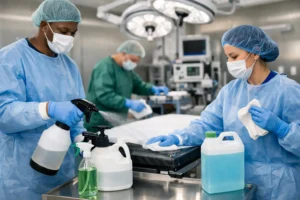
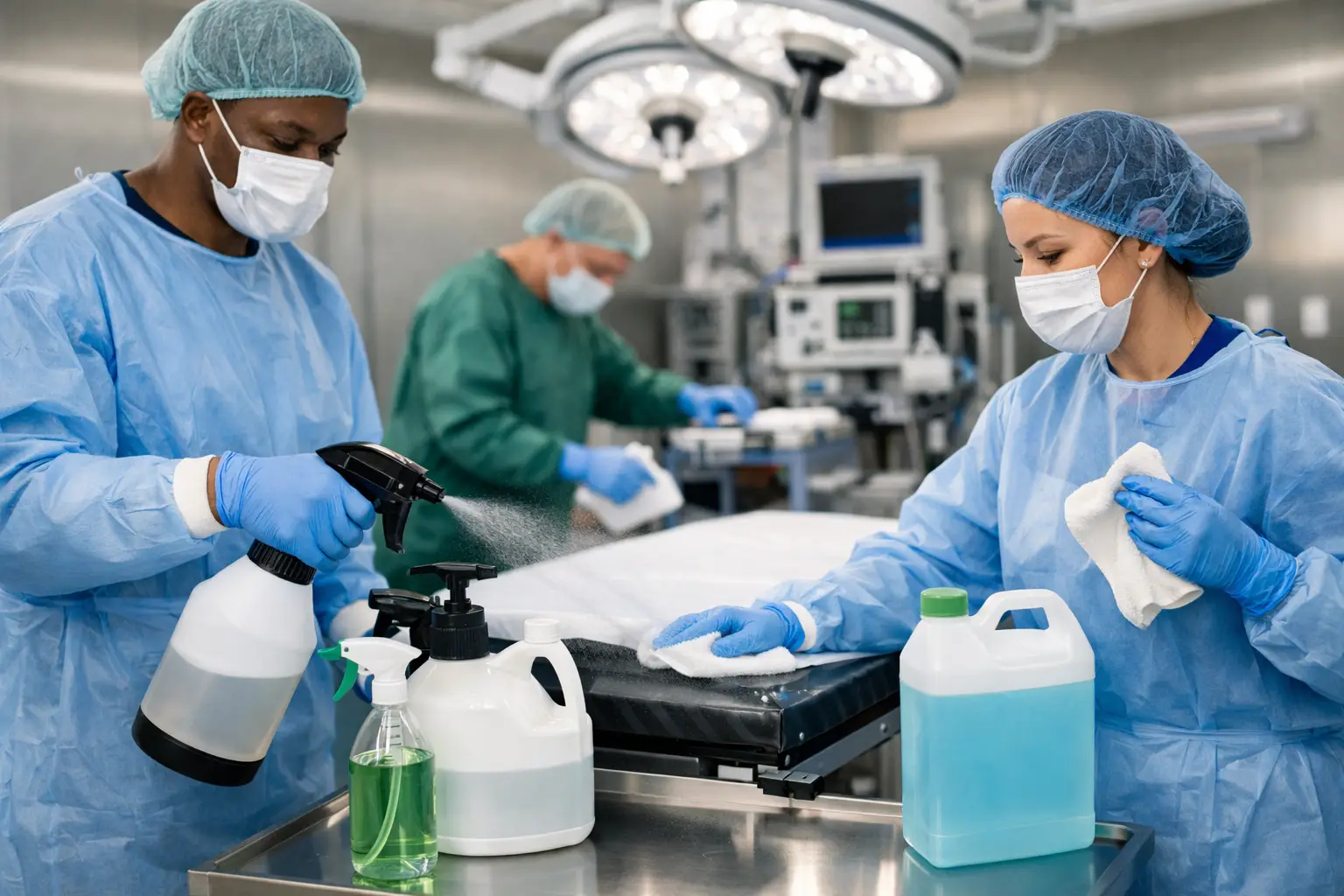
Bed rails, call buttons, door hardware, light switches, counters, waiting-room furniture, and restroom fixtures receive frequent contact throughout the day. These surfaces require a disinfectant that staff can apply consistently between scheduled terminal cleaning cycles. Ready-to-use sprays and wipes can support speed and control, provided workers use enough product to keep the surface wet for the full labeled contact time.
Convenience matters, but it should not replace process discipline. A wipe that dries before the required dwell time may not deliver the label-level result. Teams should be trained to use additional product when necessary, particularly on larger surfaces.
Sensitive equipment and finished surfaces
Healthcare environments include plastics, coated metals, display screens, upholstery, flooring, and specialty equipment that can be damaged by incompatible chemicals. A product may have strong antimicrobial performance yet be unsuitable for a particular surface material.
Before standardizing a disinfectant, review compatibility guidance from the equipment manufacturer and the disinfectant label. Test uncertain applications in an inconspicuous area when permitted. Damage to seals, screens, finishes, or protective coatings can create expensive replacement cycles and may introduce new cleaning challenges.
Restrooms, public areas, and support spaces
Public restrooms, break rooms, receiving areas, administrative offices, and visitor spaces still need a dependable sanitation plan, even if their risk profile differs from clinical zones. Product selection should account for soil load, odor control needs, surface types, and the ability to complete work safely during occupied hours.
This is where institutional cleaning programs benefit from matching products to the task instead of relying on one unnecessarily harsh chemical for every surface. Responsible chemistry can support safer daily cleaning practices while maintaining the performance standards the facility requires.
The Label, Contact Time, and Documentation Matter
Procurement teams should evaluate disinfectants as documented systems, not isolated bottles or cases. The documents associated with a product can be as operationally important as the product itself.
At minimum, buyers and facility leaders should verify:
- EPA registration and label claims relevant to the facility’s required use cases
- Safety Data Sheets that support hazard communication and worker training
- Technical data covering dilution, application method, contact time, and compatible surfaces
- Packaging and format information that supports storage, dispensing, and waste procedures
- Batch, lot, and expiration controls where the facility’s policy or regulatory obligations require them
EPA registration does not mean a product can be used without limits. The registration and label establish the specific conditions under which antimicrobial claims apply. If a facility needs activity against a particular pathogen or category of pathogen, that claim must be confirmed on the current label rather than assumed from brand familiarity or general product descriptions.
Contact time deserves special attention. This is the amount of time a treated surface must remain visibly wet to achieve the stated disinfection claim. It may differ by organism. A product with a longer contact time can be a sound choice in a controlled terminal-cleaning process, while a faster-acting option may better support high-turnover areas. Neither is automatically superior. The practical question is whether staff can reliably execute the required procedure.
Safer Chemistry Still Requires Controlled Use
Environmentally responsible chemistry has a meaningful place in healthcare and institutional cleaning, but responsible purchasing should avoid vague environmental claims. A lower-odor or less harsh formulation can improve the work environment and reduce some handling concerns, yet every disinfectant still requires proper storage, labeling, training, and use according to its Safety Data Sheet.
Facilities should consider the full operational impact of a product: employee exposure, ventilation needs, residue, fragrance sensitivity, surface compatibility, packaging waste, and transportation or storage requirements. This evaluation is especially relevant in occupied healthcare spaces, where patients, visitors, clinicians, and cleaning personnel may have different sensitivities and exposure patterns.
A safer formulation is not a reason to weaken the process. Staff still need clear instructions for dilution, application, contact time, personal protective equipment, spill response, and disposal. Consistency protects workers and gives leadership a defensible standard for quality assurance.
Build a Disinfectant Program That Staff Can Execute
The strongest product choice will fail if it creates a process too complicated for daily conditions. A practical program gives environmental services teams clear zone assignments, defined products, accessible dilution controls, and inspection criteria that supervisors can verify.
Start by mapping the facility into cleaning-risk categories. Identify patient-care areas, restrooms, high-touch public spaces, food-adjacent areas, offices, maintenance spaces, and equipment zones. Then assign products and procedures based on the risk, surface type, and frequency of use. This reduces ad hoc substitutions that can create compatibility issues or leave staff unsure which label directions apply.
Training should demonstrate what proper use looks like in real conditions. That includes removing soil before disinfecting, fully wetting surfaces, observing contact time, changing wipes before they become ineffective or spread contamination, and avoiding cross-use between different areas. Visual job aids can help, but they should reinforce the product label and facility protocol rather than replace them.
Quality checks should focus on execution, not only inventory. Supervisors can observe whether surfaces are being cleaned before disinfection, whether staff have adequate product on hand, whether dispensing equipment is functioning, and whether required documentation remains current. When procedures change because of an outbreak, new equipment, or a revised risk assessment, retraining should follow immediately.
Procurement Considerations for Healthcare Facilities
For healthcare buyers, vendor reliability includes more than product availability. A qualified supplier should be able to support the documentation needed for purchasing review, safety programs, and operational deployment. That may include current Safety Data Sheets, technical specifications, regulatory information, and clear product-use guidance.
Standardization can simplify ordering and training, but it should not force every department into an unsuitable product choice. The most effective approach often combines a core set of approved disinfectants with defined exceptions for sensitive equipment, specialized surfaces, or high-risk procedures. This balances procurement control with the practical needs of environmental services and clinical operations.
Veteran Commercial Cleaning supports critical facilities with professional-grade cleaning and sanitation solutions designed around performance, documentation, and responsible chemistry. For buyers managing institutional requirements, the goal is not to purchase the strongest-sounding product. It is to establish a disinfectant program that workers can use correctly, auditors can verify, and facility leaders can depend on when conditions demand consistency.
The next useful step is to review the disinfectants already in use against actual surface needs, label claims, and staff workflows. A smaller, well-controlled product program often delivers better sanitation outcomes than a crowded supply closet full of products no one can confidently apply.