A waiting room can look orderly and still carry the highest-touch surfaces in a healthcare facility. Check-in counters, chair arms, door hardware, tablet screens, pens, elevator buttons, and restroom fixtures are used continuously by patients, visitors, and staff. Selecting the best cleaners for healthcare waiting rooms is therefore not a matter of choosing the strongest chemical on the shelf. It is a controlled decision about soil removal, disinfection, surface compatibility, worker safety, and documentation.
Thank you for reading this post, don't forget to subscribe!For facilities teams, the right program must perform under real operating conditions: short turnover windows, mixed surface materials, occupied spaces, vulnerable populations, and strict infection-prevention expectations. A product only supports compliance when staff can apply it correctly, consistently, and according to its label.
What the Best Cleaners for Healthcare Waiting Rooms Must Do
Healthcare waiting rooms need more than a general-purpose cleaner. The most effective approach separates the job into two connected functions: cleaning and disinfecting. Cleaning removes visible dirt, oils, fingerprints, food residue, and other soils that can interfere with a disinfectant. Disinfecting uses an EPA-registered product according to its labeled directions to address specified pathogens on hard, nonporous surfaces.
In many cases, a cleaner-disinfectant can simplify the process, provided the surface is not heavily soiled and the product label allows the intended use. Where soil is visible, staff should clean first, then apply disinfectant for the full labeled contact time. Skipping that step may leave the facility with a surface that looks clean but has not received the intended disinfection treatment.
The best choice is rarely one product for every task. A disciplined waiting-room program often uses a small, compatible system: a daily cleaner for routine soils, an EPA-registered disinfectant for high-touch hard surfaces, a glass or screen-safe cleaner for displays and glazing, and an appropriate restroom product. This reduces misuse while giving environmental services teams the right chemistry for each area.
Start With Risk, Not Marketing Claims
A healthcare waiting room has different risk zones. The reception desk and payment terminal may receive hundreds of touches per day. Upholstered seating may require fabric-safe maintenance rather than liquid disinfection. A children’s area presents added concerns around toys, shared objects, and accidental chemical exposure. Restrooms require a distinct protocol because they combine high moisture, organic soil, and frequent contact.
Before selecting products, map the room by surface type and touch frequency. Facility leaders should identify hard, nonporous surfaces such as laminate counters, sealed chair arms, metal fixtures, plastic partitions, and vinyl seating. They should also identify sensitive surfaces, including electronic screens, acrylic barriers, unfinished wood, specialty coatings, and fabrics. Product labels and manufacturer guidance should drive the final compatibility decision.
This assessment also prevents over-disinfection. Saturating low-touch decorative surfaces throughout the day can waste labor, damage finishes, and increase chemical exposure without improving infection-prevention outcomes. Focus effort where patients and staff actually interact with the environment.
Select EPA-Registered Disinfectants for High-Touch Areas
For hard, nonporous high-touch surfaces, an EPA-registered hospital disinfectant is generally the central product category to evaluate. Procurement teams should confirm the product’s EPA registration, labeled use sites, pathogen claims relevant to facility policy, dilution instructions, contact time, personal protective equipment requirements, and storage conditions.
Contact time is one of the most overlooked operational details. A disinfectant must remain visibly wet for the time listed on its label to achieve its stated efficacy. If a product dries in 30 seconds but requires several minutes of wet contact, staff need a method that keeps the surface wet long enough, such as sufficient application or a compatible wipe system. Faster contact times can be useful in busy spaces, but only if the product is suitable for the target surfaces and cleaning staff can reliably follow the directions.
Ready-to-use disinfectant wipes are particularly practical for reception counters, check-in kiosks, chair arms, and other small high-touch surfaces. They support controlled dispensing and reduce dilution errors. Their limitation is scale: wipes may not be the most efficient choice for broad floor areas or heavily soiled surfaces, and they should not be used past their intended coverage capacity.
Concentrated disinfectants can support larger facilities when dilution control, trained staff, and documented procedures are in place. The trade-off is that incorrect dilution can reduce performance, create residue, or increase worker exposure. Closed-loop dilution systems and clearly labeled secondary containers help maintain consistency.
Choose Safer Chemistry Without Lowering the Standard
Environmentally responsible chemistry belongs in healthcare cleaning, but sustainability claims should never replace performance documentation. The goal is to select products that deliver required cleaning and disinfection results while reducing unnecessary harshness, strong odors, residue, packaging waste, or avoidable exposure risks.
Low-odor formulations can make a meaningful difference in occupied waiting rooms where patients may have respiratory sensitivities, migraines, nausea, or anxiety. However, low odor is not itself proof of safety or efficacy. Review the Safety Data Sheet, technical specifications, EPA label where applicable, and any relevant third-party certifications. These documents allow facilities to evaluate hazards, ventilation needs, material compatibility, and proper handling.
Avoid treating bleach as the default answer for every waiting-room surface. Bleach-based products may be appropriate in specific protocols, but they can discolor fabrics, corrode certain metals, damage finishes, and create strong odors. The right decision depends on infection-control policy, surface type, pathogen risk, and the product’s approved use directions. A well-designed program uses the least aggressive chemistry that still meets the required standard.
Build the Process Around Real Workflows
Even the right product fails when the process is unrealistic. Waiting-room cleaning should be scheduled around occupancy patterns and assigned by zone. High-touch surfaces may need attention several times during operating hours, while detailed cleaning can occur during lower-traffic periods or after closing.
Staff should clean from cleaner areas toward dirtier areas and use fresh cloths or wipes often enough to prevent cross-contamination. Color-coded microfiber systems can help distinguish restrooms from public seating areas and reception spaces. Microfiber is effective for soil removal, but it must be laundered and managed correctly. A contaminated cloth carried from one zone to another defeats the purpose of a controlled cleaning process.
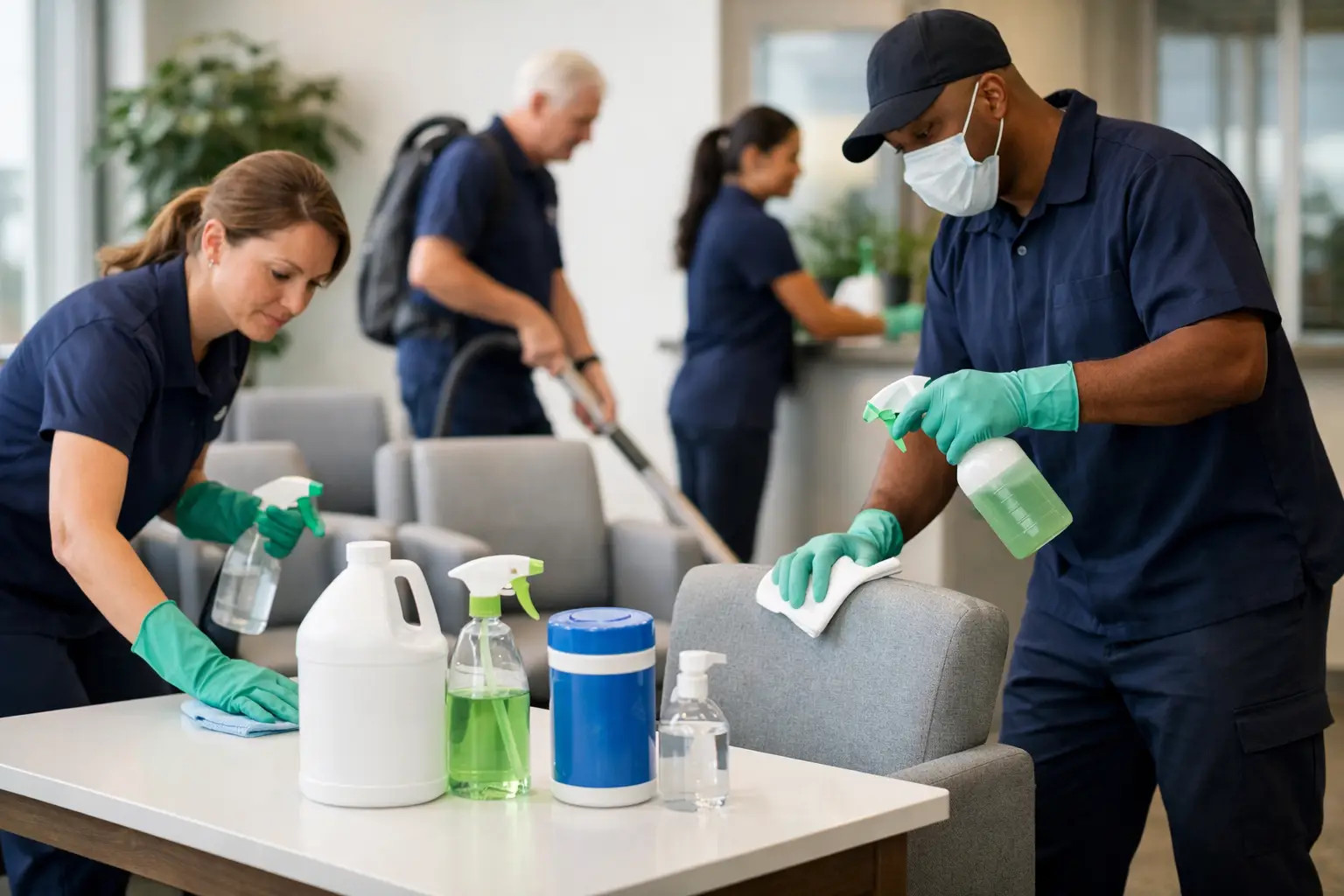
A practical high-touch routine should cover door handles, push plates, counters, card readers, check-in kiosks, chair arms, call buttons, light switches, railings, shared pens, and restroom touchpoints. For electronics, apply product to a compatible cloth rather than spraying directly into openings or screens unless the equipment manufacturer specifically permits it.
Documentation Is Part of the Cleaning System
Healthcare and institutional buyers need more than product names. They need evidence that supports procurement, training, safety, and audit readiness. Maintain current Safety Data Sheets, technical data, EPA registration information for disinfectants, dilution instructions, and staff training records. Keep product labels accessible at the point of use and ensure secondary containers are labeled according to workplace requirements.
Cleaning logs can be useful when they reflect actual work rather than becoming paperwork for its own sake. A simple record of routine high-touch cleaning, restroom service, periodic deep cleaning, and supervisor verification creates accountability. It also gives operations leaders a way to investigate issues, adjust staffing, and demonstrate a consistent process when questions arise.
When evaluating a supplier, look for one that can provide product documentation, technical guidance, and dependable institutional fulfillment. Veteran Commercial Cleaning supports this procurement-focused approach by emphasizing professional-grade sanitation solutions and the documentation critical facilities require.
Train for Technique, Not Just Product Recognition
A label is only effective when the user understands it. Training should cover dilution, contact time, surface compatibility, required protective equipment, wipe and cloth use, spill response, storage, and what to do when a surface is heavily soiled. Supervisors should also reinforce the difference between cleaning, sanitizing, and disinfecting, since these terms are often used loosely but have different purposes and label requirements.
Short, repeatable instruction is often more effective than a one-time annual presentation. Demonstrate the process on actual waiting-room surfaces. Ask staff to explain the contact-time requirement back to the trainer. Review common failure points, such as wiping a disinfectant dry too soon, reusing a visibly soiled wipe, mixing chemicals, or using a product on an unapproved surface.
The strongest waiting-room cleaning program is not defined by a single bottle. It is built from appropriate products, clear procedures, trained personnel, and documentation that holds up under review. When those pieces work together, the waiting room communicates something patients notice immediately: this facility takes their safety seriously.