A production floor can appear orderly while still carrying the conditions that cause a safety incident, contamination event, equipment failure, or failed audit. This guide to manufacturing floor hygiene focuses on the controls that make cleanliness repeatable: defined responsibilities, suitable chemistry, documented procedures, and verification that matches the risks in each area.
Thank you for reading this post, don't forget to subscribe!Floor hygiene is not simply a janitorial concern. In a manufacturing environment, it supports worker safety, product quality, regulatory obligations, asset reliability, and uninterrupted production. The right program has to work around shift changes, forklifts, raw materials, washdown needs, and the realities of a busy facility.
Start With a Manufacturing Floor Hygiene Risk Map
A single cleaning schedule for an entire plant usually creates gaps. Receiving docks, production lines, maintenance bays, locker rooms, break areas, restrooms, and shipping lanes have different soils, traffic levels, and compliance exposures. Treating every area the same can waste labor in low-risk spaces while leaving critical points under-controlled.
Begin by walking the facility with operations, safety, quality, and environmental health personnel. Identify where contaminants enter, where they can travel, and where they could affect people, products, or equipment. Forklift tires may bring moisture and debris from a loading dock into production. Leaks near hydraulic equipment can create slip hazards. Fine dust can settle along pathways and enter sensitive process areas.
Assign each zone a risk level and define the required cleaning frequency, method, and acceptance standard. High-risk zones may require cleaning between shifts or after a specific production event. Lower-risk storage areas may need a less frequent but still documented schedule. The goal is not maximum cleaning everywhere. It is targeted control where the operational consequences are highest.
Separate Cleaning, Sanitizing, and Disinfecting
These terms are often used interchangeably, but they serve different purposes. Cleaning removes visible soils, oils, residues, and loose debris. Sanitizing reduces certain microorganisms on appropriate surfaces to a defined level. Disinfecting is intended to destroy or inactivate specified pathogens when used according to the product label and required contact time.
On most manufacturing floors, effective cleaning is the first requirement. A disinfectant applied over oil, dust, or accumulated grime cannot perform as intended. In facilities with food-contact processes, healthcare-related production, controlled environments, or identified pathogen concerns, sanitation and disinfection requirements may be more stringent. Those decisions should be based on the process, applicable regulations, product labels, and site-specific quality requirements.
Overusing disinfectants is not a substitute for a hygiene program. It can increase chemical exposure, create residue concerns, and add unnecessary cost and labor. Select institutional-grade products that fit the soil load, surface type, equipment compatibility needs, and environmental objectives of the site. Keep Safety Data Sheets, technical data, dilution instructions, and applicable certifications available for employees and auditors.
Match Chemistry to the Soil
Manufacturing soils are rarely generic. A light dust condition calls for a different approach than machining fluid, carbon residue, adhesive, food oil, or tire marks. Using the wrong cleaner can leave a slick film, damage a floor coating, or force repeated rework.
Degreasers are typically necessary in maintenance and equipment areas where lubricants and oils accumulate. Neutral cleaners may be a better fit for routine cleaning on sealed floors and finished surfaces. Where sanitation is required, the selected sanitizer or disinfectant must be compatible with the surface and used at the correct dilution and dwell time. Eco-responsible chemistry can reduce unnecessarily harsh exposures, but performance claims should always be supported by the product documentation and the actual application method.
Build Procedures Around Production Reality
A cleaning procedure that conflicts with production will be bypassed. Coordinate hygiene tasks with line downtime, shift turnover, maintenance windows, and traffic patterns. Define exactly who performs each task, which tools and chemicals they use, where waste is disposed of, and how the work is verified.
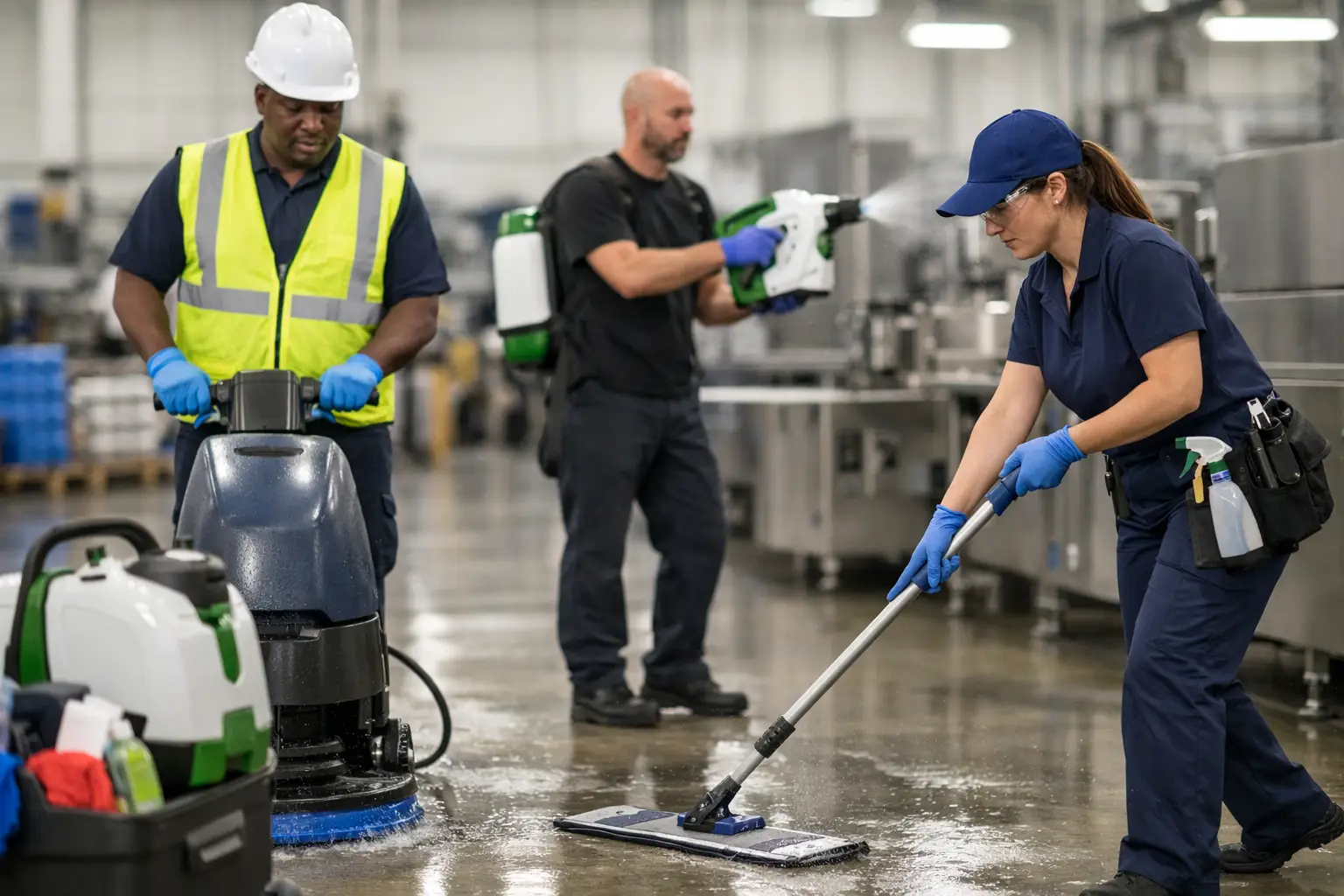
Start with dry removal when practical. Sweeping, vacuuming, and controlled dust collection remove loose debris before wet cleaning spreads it into corners, drains, or adjacent work areas. Wet methods should follow with appropriate cleaner dilution, mechanical action, and sufficient recovery of water and residue. Leaving floors wet after mopping or washdown increases the chance of slips and can spread contaminants through foot and vehicle traffic.
For wet operations, use clearly marked caution controls, restrict access when necessary, and confirm that drains are functioning as intended. Drain maintenance deserves special attention in facilities that use washdown. Organic buildup, sediment, and standing water can become recurring hygiene and odor problems if they are addressed only after a failure.
Color-coded tools can help prevent cross-contamination between restrooms, break areas, production zones, and high-care spaces. The system only works, however, when tools are stored cleanly, replaced when worn, and used consistently. A dirty mop head or neglected floor scrubber redistributes soil rather than removing it.
Control the Common Failure Points
Many floor hygiene issues are not caused by a lack of effort. They result from missed details in the program. Watch for these recurring weaknesses:
- Chemical dilution is guessed rather than measured, leading to poor results, residue, or unnecessary exposure.
- Spills remain in place while teams wait for a scheduled cleaning cycle instead of using a defined response process.
- Cleaning tools move between incompatible zones without cleaning, storage, or color-control practices.
- Floor scrubbers, mop stations, and waste containers are not maintained, allowing them to become contamination sources.
- Records show a task was completed but do not confirm the result or document corrective action when standards were not met.
A spill-response process should be visible, understood, and fast. Employees need to know how to isolate the area, select the right personal protective equipment, use compatible absorbents or cleaning materials, dispose of waste correctly, and notify the appropriate supervisor. Special handling may be necessary for chemicals, oils, biological materials, or other regulated substances.
Train for Consistency, Not Just Completion
Training should explain why each procedure exists, not only what employees must do. When teams understand that an oily walkway creates a forklift and pedestrian hazard, or that a poorly cleaned transfer point can affect product quality, compliance becomes more practical.
Train employees on chemical labels, dilution equipment, contact times, personal protective equipment, wet-floor controls, equipment operation, and incident reporting. Supervisors should also be trained to recognize failure patterns, such as repeated residue in a specific aisle or recurring water near a drain. These observations often reveal an upstream equipment, process, or traffic-control issue.
Refresher training should follow process changes, chemical changes, audit findings, seasonal conditions, and incident trends. Contractors need the same clarity as in-house teams. A facility remains responsible for the hygiene outcome even when cleaning duties are outsourced.
Verify Results and Keep Audit-Ready Records
A completed checklist is useful, but it is not proof that the floor is clean or safe. Verification should combine visual inspections with practical checks appropriate to the area. That may include checking for residue, standing water, odor, dust accumulation, drain condition, or recurring slip hazards. In controlled or regulated environments, the site may also use environmental monitoring or other validated testing methods.
Document the date, time, zone, task, responsible employee, chemical used, and any corrective action. Digital logs can improve accountability, but paper records can also be effective when they are legible, controlled, and reviewed. What matters is that the record shows what happened, whether the standard was met, and how deviations were resolved.
Review hygiene data with safety, quality, and operations teams. If the same area repeatedly fails inspection, increase scrutiny before simply increasing cleaning frequency. The root cause may be a leaking machine, poor drainage, unsuitable floor finish, uncontrolled foot traffic, or a procedure that does not match the work being performed.
Make Hygiene a Daily Operating Control
The strongest programs make floor hygiene part of normal production discipline. Operators report spills early. Supervisors inspect critical areas during routine rounds. Maintenance corrects sources of recurring contamination. Procurement teams maintain access to documented, compatible cleaning supplies rather than substituting unverified materials when inventory runs low.
For facilities balancing performance with safer chemical practices, the standard should be clear: choose cleaning systems that meet the actual soil, sanitation, and documentation requirements without adding unnecessary harshness. A clean manufacturing floor is not a cosmetic finish. It is visible evidence that the facility controls the details that protect people, products, and operations every day.