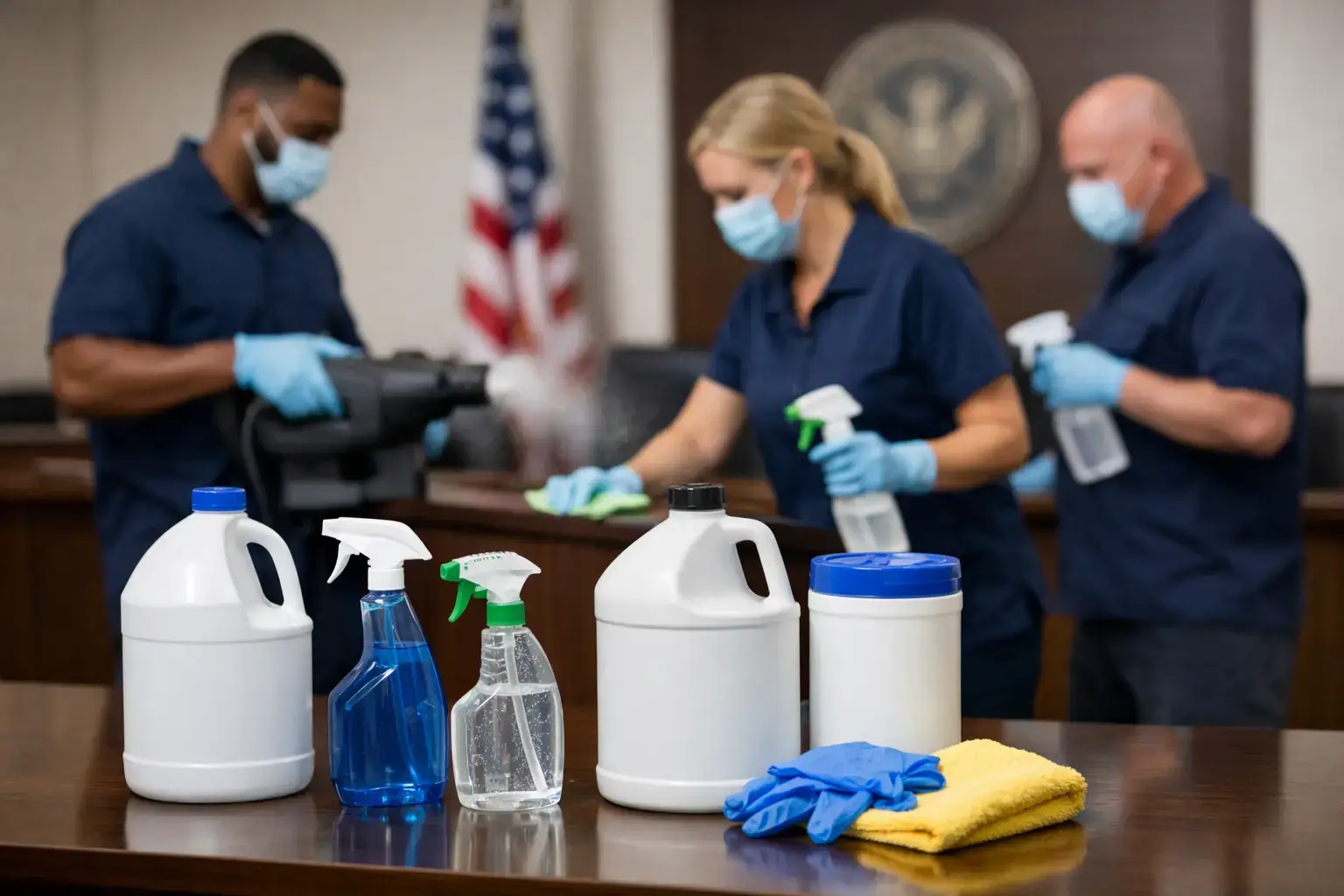
A courthouse lobby, public health clinic, airport office, fleet garage, and administrative building do not share the same soil load, touch patterns, or operating constraints. That is why selecting the best disinfectants for government facilities is not a matter of choosing the strongest-looking chemical on a shelf. It is a procurement and operations decision that must account for pathogen claims, surface compatibility, employee safety, documentation, and the ability to execute the cleaning program consistently.
Thank you for reading this post, don't forget to subscribe!For facilities teams, the right disinfectant is one that performs as labeled under real working conditions – with the correct dilution, contact time, application method, and training behind it. A product can have an impressive label and still fail operationally if it leaves residues on public-facing surfaces, damages equipment, requires impractical dwell times, or creates unnecessary exposure concerns for custodial staff.
What Government Buyers Should Evaluate First
Government facilities face a wide range of public contact and compliance demands. High-traffic public counters, restroom fixtures, elevator controls, break rooms, interview rooms, medical spaces, vehicles, and secure work areas all require different cleaning frequencies and application approaches. The first question should not be, “What kills the most?” It should be, “What risk does this product need to control in this setting, and can our team use it correctly every day?”
Start with the product label and its approved antimicrobial claims. A disinfectant should be registered for its intended use and supported by current technical documentation. Procurement teams should verify the organisms listed on the label, required contact time, approved surfaces, dilution instructions where applicable, precautionary statements, and storage requirements. For contracts and audits, the Safety Data Sheet, technical data sheet, and manufacturer documentation should be readily available and aligned with the product being purchased.
This matters because “disinfectant” is not a single performance category. Some products are designed for routine hard-surface disinfection, while others carry more specific claims that may be relevant to healthcare-adjacent environments, response protocols, or facilities with elevated exposure risks. Selecting beyond the documented label claim adds risk rather than protection.
Best Disinfectants for Government Facilities by Use Case
The best choice depends on the area being maintained, the surfaces involved, and the team’s ability to follow the process. A single product may support many routine applications, but high-compliance sites often benefit from a controlled system of compatible cleaners, disinfectants, wipes, and dispensing practices.
Public Areas and Administrative Buildings
For lobbies, waiting areas, offices, conference rooms, restrooms, and shared workstations, buyers should prioritize broad hard-surface disinfectants that are practical for routine use. The product should have clear directions, a manageable contact time, and compatibility with common facility materials such as sealed countertops, painted surfaces, plastic fixtures, metal touchpoints, and finished flooring.
In these spaces, appearance and user experience matter. Excessively harsh chemistry may leave odors, sticky residues, discoloration, or damage that generates tenant complaints and increases maintenance costs. A responsible formulation can support strong institutional performance while reducing unnecessary chemical burden in occupied public spaces.
Healthcare and Public Health Environments
Clinics, medical offices, public health departments, and treatment areas require tighter alignment between disinfectant claims and infection-control procedures. Here, surface disinfection must be treated as part of a defined protocol, not a general cleaning task. Staff need to understand which surfaces require pre-cleaning, how long surfaces must remain wet, and when to change wipes or cloths to avoid moving contamination from one area to another.
The right product should support the facility’s documented cleaning procedures and be compatible with medical-adjacent surfaces and equipment manufacturers’ instructions. High-touch points such as exam tables, check-in counters, door hardware, seating arms, and restroom fixtures deserve special attention. For these locations, convenience matters, but evidence and procedure matter more.
Fleet, Transit, and Aviation Support Areas
Government fleet operations, transit facilities, and aviation support spaces present a different challenge: frequent touchpoints, variable environments, and surfaces that may include vinyl, plastics, painted metals, electronics housings, and durable flooring. The best disinfectant program combines routine cleaning with targeted disinfection of steering wheels, control surfaces, door handles, radios, fueling-area touchpoints, shared tools, and crew spaces.
Surface compatibility should be verified before widespread rollout. A disinfectant that is effective on a hard, nonporous surface may not be appropriate for sensitive finishes, display screens, or specialty coatings. Facilities should avoid assuming that a product safe for a restroom is automatically suitable for cockpit-adjacent equipment, vehicle interiors, or communications devices.
Maintenance Shops and Industrial Government Facilities
In garages, maintenance areas, public works operations, and manufacturing-like settings, disinfectants must work within a broader soil-control program. Grease, oils, dirt, and production residues can interfere with disinfection when surfaces are not cleaned first. In practical terms, a disinfectant is not a substitute for an industrial degreaser or general-purpose cleaner.
The workflow should be clear: remove visible soil and heavy residue first, then apply the disinfectant according to label directions. This two-step approach is especially important for shared tools, break rooms, restrooms, locker areas, and high-touch controls where industrial soil can reduce effective surface contact.
Efficacy Is Only One Part of Performance
A disinfectant label may describe what a product can do under tested conditions. Operational performance depends on whether staff can reproduce those conditions. The most common breakdowns are rushed contact times, incorrect dilution, spraying into the air instead of applying to the surface, using dry or overloaded wipes, and treating dirty surfaces as though they were already clean.
Contact time deserves particular attention. If a label requires a surface to remain visibly wet for a stated period, staff need an application method that can achieve that result without overusing product or creating slip hazards. Ready-to-use formats can improve consistency in some applications, while concentrated products may make sense where trained teams use controlled dilution systems. Neither format is automatically better. The right choice is the one that fits the site’s labor model, storage capacity, training level, and documentation requirements.
Environmental considerations also belong in the evaluation. Lower-harshness chemistry can help support indoor air quality goals, reduce unpleasant odors, and improve day-to-day usability for staff and occupants. However, “eco-friendly” should never be treated as a substitute for verified disinfectant claims. Government buyers should seek both: responsible chemistry and documented performance for the intended application.
Documentation Supports Compliance and Continuity
Disinfectant procurement should be defensible long after the order is placed. Facility managers and contracting professionals need documentation that supports safe use, employee training, inventory control, and inspection readiness. At a minimum, maintain current SDS sheets, product labels, technical specifications, dilution instructions, and applicable certifications or regulatory records.
Documentation also protects continuity of operations. When shifts change, contract custodial teams rotate, or an incident prompts review, written procedures make it easier to confirm that the product was used as intended. A facility should be able to answer basic questions quickly: What was used? Where was it approved? What contact time was required? Was the product diluted correctly? What protective measures were specified?
This is particularly relevant for government buyers working through formal purchasing channels. A supplier should be prepared to provide accurate product information, support evaluation requirements, and help purchasers distinguish between routine-use products and products intended for specialized protocols. Veteran Commercial Cleaning approaches this work with the same discipline expected in high-compliance environments: performance claims should be supported, documentation should be accessible, and safer chemistry should not come at the expense of operational control.
Build a Program, Not a Product List
The strongest disinfectant program assigns products by task and trains staff around the actual workflow. Restrooms, public touchpoints, break rooms, healthcare-adjacent areas, fleet interiors, and industrial support spaces may each need different cleaning frequencies or application tools. Standardizing where possible reduces errors, but over-standardizing can create surface damage or compliance gaps.
Facilities should also separate routine cleaning from incident response. Daily disinfection of high-touch surfaces is different from a documented response to a confirmed contamination event. The latter may require product claims, protective measures, isolation procedures, or oversight beyond the normal custodial schedule. Planning for both situations prevents teams from improvising under pressure.
The best disinfectant is ultimately the one that fits the facility’s risk profile, surfaces, staffing, and compliance obligations – then gets used exactly as directed. When procurement decisions are tied to documented claims, compatible chemistry, and repeatable training, government facilities gain more than a cleaner appearance. They gain a sanitation process that stands up to daily operations and serious scrutiny.