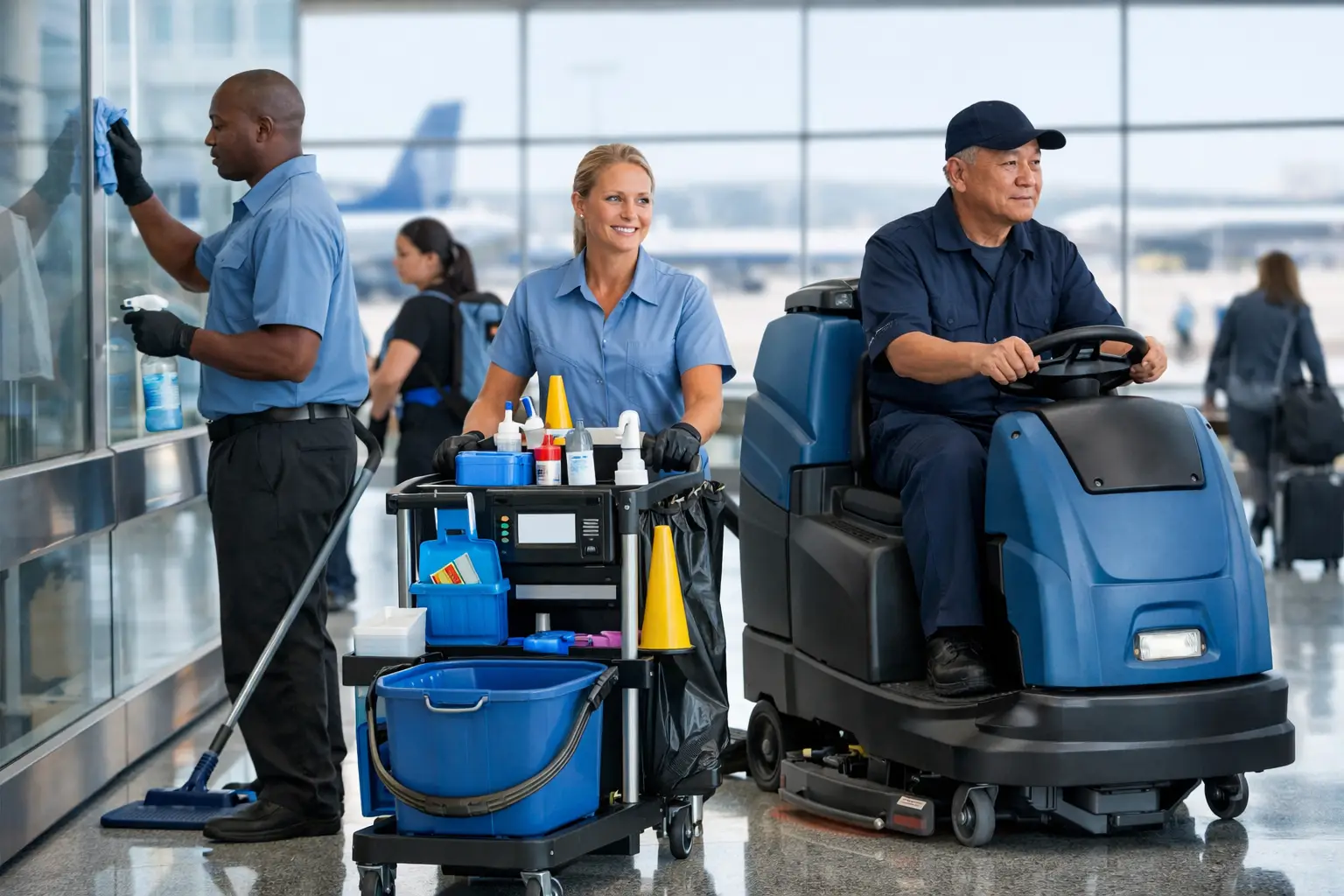
A missed restroom check, an overflowing waste receptacle, or an unaddressed spill can affect passenger confidence within minutes. This airport terminal cleaning program example shows how operations teams can organize cleaning around passenger flow, safety risks, security constraints, and documented accountability rather than treating the terminal as one large cleaning area.
Thank you for reading this post, don't forget to subscribe!The model below is designed for facilities managers, environmental services leaders, airport operators, and procurement teams evaluating a structured terminal cleaning program. It can be scaled for a regional terminal, a multi-concourse airport, or a contracted cleaning operation with multiple shifts.
What an Airport Terminal Cleaning Program Must Accomplish
Terminal cleaning is an operational support function, not simply a janitorial task. The program must protect public health, reduce slip-and-fall exposure, support the passenger experience, maintain presentable high-touch areas, and work around flight schedules, TSA-controlled spaces, and continuous occupancy.
A good program separates routine appearance cleaning from sanitation, spill response, periodic deep cleaning, and post-event recovery. Each activity has a different trigger, labor requirement, chemical selection, and documentation need. Combining them under a vague instruction such as “clean as needed” creates inconsistent outcomes and makes performance difficult to verify.
The right service frequency depends on passenger volume, terminal layout, seasonality, restroom fixture counts, food service density, and flight disruption patterns. A small airport with concentrated departure banks may need intensive cleaning around those banks, while a major hub requires continuous zone coverage and rapid redeployment throughout the day.
Airport Terminal Cleaning Program Example by Zone
This example uses a three-shift model with a day porter presence in high-traffic areas and scheduled project work during lower-volume periods. Zone assignments should be clear enough that a supervisor can confirm ownership at any time.
Zone 1: Public Entry, Ticketing, and Check-In
This zone includes exterior entry transition points, vestibules, ticket counters, self-service kiosks, queue stanchions, seating, elevator call buttons, and visible glass. Day staff complete continuous litter pickup, touchpoint disinfection according to product label directions, spot cleaning of glass, and immediate response to tracked-in moisture.
Floor conditions deserve special attention. Rain, snow, deicing residue, and rolling luggage can create hazards quickly. Staff should inspect entrance mats, place warning signage when needed, remove standing moisture, and document any condition that requires maintenance attention rather than cleaning alone.
Zone 2: Security Queues and Gate Areas
Cleaning crews must coordinate with airport security and airline operations before entering controlled or congested spaces. Tasks may include wipe-downs of seating armrests, charging stations, counters, trash receptacles, railings, and accessible touchpoints. Crews should not interfere with passenger screening, boarding announcements, or emergency access routes.
Gate areas require a flexible cadence. A scheduled pass every 30 to 60 minutes may work during normal operations, but a delayed flight can turn one gate into a high-use waiting room for hours. Supervisors should have authority to shift labor based on real-time occupancy, not only on a fixed route sheet.
Zone 3: Restrooms and Family Care Rooms
Restrooms should receive the most detailed inspection standards in the program. The goal is not merely to restock supplies. Staff must inspect fixtures, floors, partitions, doors, dispensers, waste containers, odor conditions, and accessible features during every service round.
A practical restroom log records the time of service, employee identifier, supply status, visible fixture damage, corrective action, and any escalation to maintenance. High-use restrooms may require checks every 15 to 30 minutes during peak passenger periods. Low-volume restrooms may be serviced less often, provided the frequency is supported by traffic data and inspection results.
Cleaning chemistry should be selected for the surface, soil load, and required contact time. Using a disinfectant incorrectly, including wiping it dry before the labeled contact time, can undermine sanitation objectives. Staff training must cover dilution where applicable, personal protective equipment, safe storage, and the difference between cleaning a surface and disinfecting it.
Zone 4: Food Court and Public Seating
Food areas generate a different mix of risks: beverage spills, food debris, grease transfer, overflowing waste, and pests. Terminal teams should coordinate with food service tenants so that responsibility lines are documented. Common-area tables, chairs, floors, waste stations, and public touchpoints may fall under the terminal program, while tenant workspaces and back-of-house areas may not.
During operating hours, crews focus on visible debris, spill response, waste removal, and touchpoint cleaning. After hours, the schedule can include more intensive floor care, detail cleaning around furniture bases, and approved degreasing where food soils accumulate. Eco-conscious chemistry can support safer indoor cleaning practices, but it still must deliver the performance required for the soil and surface involved.
Zone 5: Back-of-House and Employee Areas
Break rooms, offices, operations centers, staff corridors, and service hallways should not be overlooked because passengers do not see them. These spaces support employee health, morale, and operational readiness. Their service plan should specify which areas are cleaned by terminal staff, which are handled by tenant teams, and which require access authorization.
Waste handling routes must be separated from clean supply routes whenever practical. This reduces cross-contamination and helps keep carts organized. Color-coded tools, labeled containers, and defined storage locations make standards easier to sustain across shifts.
Staffing, Shift Handoffs, and Response Times
A terminal program works when staffing matches the work. Labor planning should account for square footage, passenger counts, restroom demand, flight peaks, service-level expectations, travel time between zones, and required response coverage. Staffing only to average traffic often fails during weather events, holiday surges, cancellations, and irregular operations.
Each shift should begin with a short operational briefing. The supervisor reviews flight disruptions, known spills or repairs, VIP or event activity, weather conditions, supply constraints, restricted areas, and priorities carried over from the previous shift. The outgoing team then records incomplete work, equipment issues, safety incidents, and recurring concerns in a handoff log.
Response expectations should be measurable. For example, a reported bodily fluid incident, broken glass, or active slip hazard requires an immediate controlled response and escalation process. A minor spot-cleaning request may have a longer target response time. The program should define these categories in advance so employees are not making inconsistent judgment calls under pressure.
Documentation That Supports Compliance and Performance
Documentation is not paperwork for its own sake. It gives airport leadership evidence that required work was assigned, completed, inspected, and corrected when necessary. It also helps identify recurring issues that may be caused by building conditions, passenger traffic patterns, inadequate fixture capacity, or tenant responsibilities.
A disciplined documentation package typically includes daily route sheets, restroom and inspection logs, incident reports, chemical inventory records, Safety Data Sheets, training records, equipment maintenance logs, and corrective action reports. Digital checklists can improve visibility, but only if staff can use them quickly and supervisors review the data consistently.
Quality audits should combine scheduled inspections with random checks. Scores can track floor appearance, waste condition, restroom readiness, touchpoint cleaning, odor control, supply availability, and safety compliance. When a score falls below the required standard, the corrective action should identify the cause, the responsible role, the completion deadline, and the verification method.
Procurement Considerations for Cleaning Supplies
Procurement teams should evaluate more than a product label or a broad sustainability claim. For terminal use, confirm that cleaning products are appropriate for the intended surfaces, have accessible SDS and technical documentation, support worker safety procedures, and can be supplied consistently. Concentrated products may reduce packaging and storage requirements, but they also require accurate dilution control and employee training.
The same principle applies to wipes, sanitation systems, and dispensing equipment. A convenient product that creates unnecessary waste or does not meet the required performance standard is not a sound operational choice. Conversely, a lower-harshness formulation can be a strong fit when it meets facility sanitation needs and supports the airport’s safety and environmental objectives.
Veteran Commercial Cleaning supports institutional buyers with professional cleaning solutions and documentation-minded procurement support for high-compliance facilities. The best supply plan aligns product selection with the actual task, not a one-product-for-everything approach.
Turning the Example Into a Working Program
Start with a terminal walk-through during both peak and low-volume periods. Map passenger movement, recurring spills, restroom demand, waste accumulation points, touchpoint density, supply closets, and access restrictions. Then build zone routes, task frequencies, response standards, inspection forms, and escalation procedures around what the facility actually experiences.
Review the program after the first 30 days using inspection data, staff feedback, passenger complaints, safety reports, and supply consumption. A terminal cleaning plan should be controlled enough to produce consistent results, yet flexible enough to respond when a delayed flight, storm system, or crowded concourse changes the day’s priorities. That balance is what turns cleaning from a background expense into a visible part of safe, dependable airport operations.