A missed disinfection step in an airport restroom, patient-care area, production line, or government office is not a minor housekeeping issue. It can affect worker safety, public confidence, uptime, audit results, and the ability to keep a facility operating. The future of institutional disinfection is therefore not defined by stronger-smelling chemicals or more frequent spraying. It is defined by disciplined systems that match verified chemistry, trained labor, documented execution, and risk-based decision-making.
Thank you for reading this post, don't forget to subscribe!For facilities leaders, the question is no longer simply, “What disinfectant should we buy?” The better question is, “Can our program consistently produce the required result under real operating conditions?” That shift is changing how institutional buyers evaluate products, equipment, suppliers, and cleaning procedures.
The future of institutional disinfection is risk-based
Not every room, surface, or shift carries the same exposure risk. A patient waiting area, a breakroom, a loading dock, and a high-touch security checkpoint should not automatically receive identical treatment. A mature disinfection program identifies where contamination is most likely, where vulnerable people or critical processes are exposed, and where failures carry the highest operational consequence.
This does not mean lower-risk spaces are ignored. It means resources are assigned with purpose. High-touch points such as door hardware, elevator controls, shared tools, counters, handrails, and touchscreens may require more frequent attention than large, low-contact surfaces. In manufacturing, cleaning teams must also account for soils such as grease, dust, residue, and metalworking fluids that can interfere with disinfectant contact on a surface.
Risk-based planning improves both performance and accountability. It helps operations leaders specify the right procedures by zone, schedule labor realistically, and show why a particular cleaning frequency or product selection is appropriate. It also prevents the common mistake of treating disinfection as a one-size-fits-all response.
Cleaning still comes before disinfection
Disinfectants are tested for use according to their label directions, including contact time and applicable surface conditions. Yet real facilities are rarely laboratory-clean. Organic matter, oils, grime, and heavy soil can shield microorganisms and reduce the disinfectant’s ability to reach the surface.
That is why the future program starts with cleaning. Facilities need a defined sequence: remove soil where needed, apply the disinfectant at the correct dilution or ready-to-use format, keep the surface wet for the required contact time, and allow it to dry or follow label-directed post-treatment steps. Skipping the first step to save minutes can create a false sense of security.
This distinction matters especially in industrial settings. A disinfectant should not be expected to perform the job of a degreaser, and a general cleaner should not be assumed to make a disinfectant claim. Procurement specifications and worker training should clearly separate these functions.
Safer chemistry will be judged by results, not labels alone
Institutional buyers increasingly want chemistry that supports worker safety, environmental responsibility, and indoor air quality. That direction is sound, but “eco-friendly” should never become a vague substitute for evidence. A responsible product decision balances efficacy, material compatibility, use conditions, dilution control, fragrance profile, residue, storage requirements, and safety documentation.
Harsh chemistry may be necessary for certain soils or tasks, but using it by default can bring avoidable trade-offs. It can increase ventilation concerns, damage finishes, irritate workers, complicate storage, or create unnecessary exposure risks. Conversely, a lower-hazard formulation that does not fit the soil load, surface, or pathogen claim can also fail the facility.
The practical standard is fit for purpose. Buyers should review the product label, Safety Data Sheet, technical specifications, and relevant registrations or certifications before standardizing a disinfectant. In the United States, disinfectants making public health claims must be used in accordance with their EPA-registered label. That label is an operating document, not a marketing detail.
Material compatibility deserves equal attention. Frequent disinfection can affect some coatings, plastics, screens, metals, upholstery, and aviation or medical equipment surfaces. Before broad deployment, facilities should confirm manufacturer guidance, test products in a controlled area when appropriate, and document approved use methods. A product that controls pathogens but shortens asset life is not automatically the best institutional choice.
Automation will improve consistency, not replace accountability
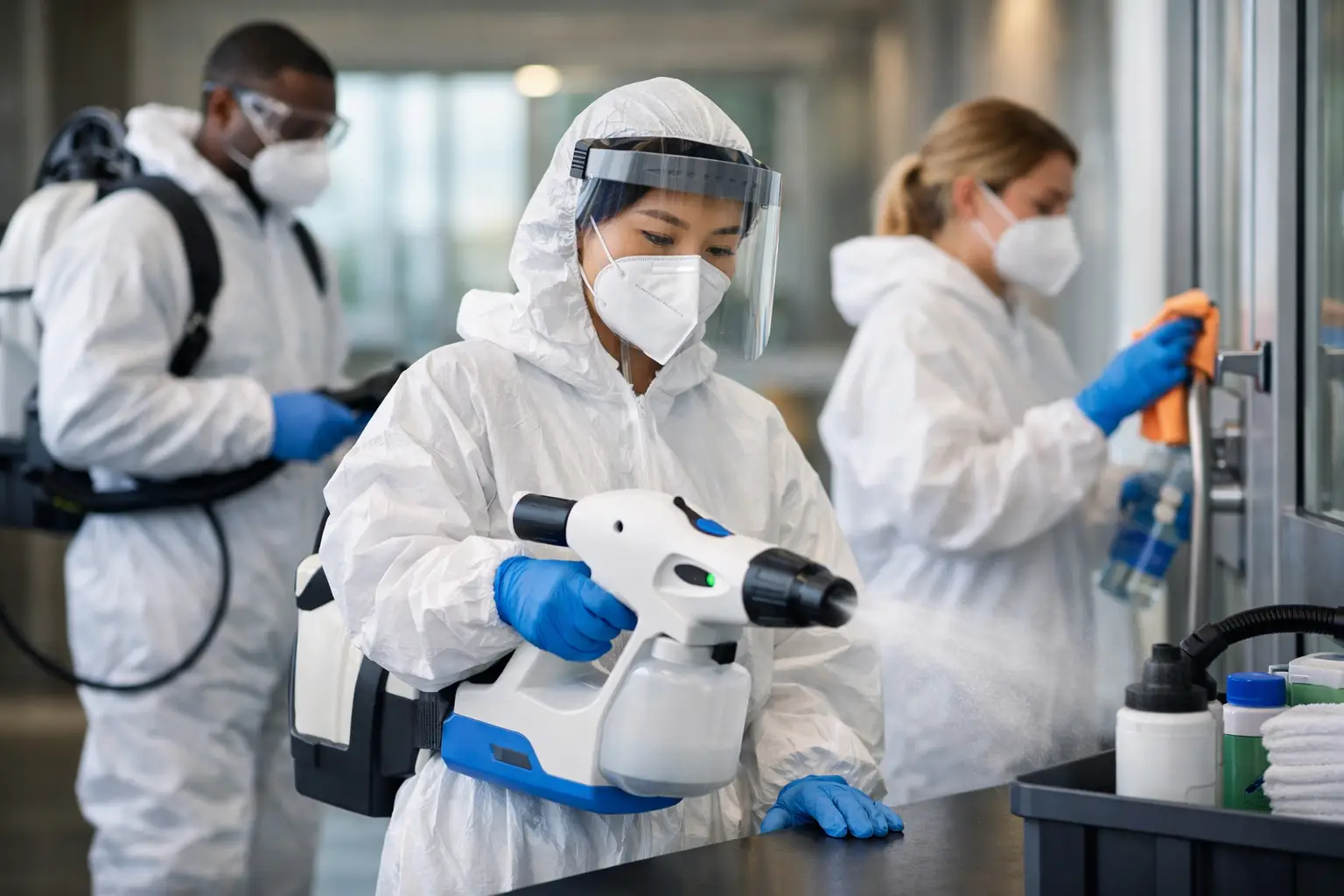
Electrostatic application, touch-free dispensing, dilution control, sensor-based restroom data, and digital work-order systems are becoming more common. These tools can reduce variation, extend coverage, and help supervisors verify that tasks were performed. They are especially useful in large facilities where schedules, traffic patterns, and multiple shifts make manual oversight difficult.
But automation has limits. Equipment cannot determine whether a surface was visibly soiled beforehand, whether a worker missed the underside of a handle, or whether a disinfectant remained wet for the required time. It also does not eliminate the need to train staff on personal protective equipment, chemical handling, cross-contamination prevention, and equipment maintenance.
The strongest approach combines technology with clear operating standards. For example, dilution control can help ensure a concentrate is mixed correctly, while a supervisor’s inspection and digital record can confirm the correct product was used in the correct area. In a healthcare environment, that record may support infection-prevention goals. In a government or military setting, it may demonstrate readiness and contract compliance. In a manufacturing plant, it may protect both workforce health and production continuity.
Data must lead to action
Facilities collect more cleaning data than ever, but data without a response process is just another report. A useful program tracks information that helps leaders make operational decisions: completion rates, supply usage, recurring inspection findings, high-traffic patterns, worker incidents, and product performance concerns.
A sudden increase in disinfectant use may signal higher demand, but it could also indicate overapplication, equipment leakage, poor dilution practices, or unclear procedures. Repeated findings in the same restroom or entry point may point to staffing schedules that no longer match traffic. The value comes from identifying the cause and correcting it.
Documentation also strengthens procurement. When buyers can define the required claim, surface compatibility, approved use procedure, training requirements, and reporting expectations, they can compare suppliers on institutional readiness rather than on generic product descriptions. Reliable documentation shortens review cycles and gives facilities a defensible record during inspections, audits, or incident reviews.
Labor and training remain the decisive variables
Disinfection quality is still delivered by people. Even the most capable chemistry and equipment will underperform when workers are rushed, not trained on label directions, or given procedures that conflict with the realities of the site.
Training should be specific to the facility. A team needs to know which surfaces require cleaning before disinfection, how to avoid moving contamination from one zone to another, when to change wipes or cloths, how to manage chemical dwell time, and what to do when a spill or unusual contamination event occurs. Training should also explain why the steps matter. People follow procedures more reliably when the operational consequence is clear.
Supervisors should make verification practical. Visual inspections are useful, but they should be paired with routine checks of supply availability, dispenser function, dilution equipment, task records, and worker technique. The goal is correction, not paperwork for its own sake.
Veteran Commercial Cleaning recognizes that critical-facility buyers need more than a product label. They need institutional-grade cleaning solutions supported by the technical documentation, safety information, and procurement discipline required to put those solutions to work responsibly.
What buyers should require from a disinfection program
Future-ready disinfection programs are built around a few nonnegotiable controls. The facility should be able to identify approved products and their intended uses, maintain current SDS and technical documents, train personnel on label-directed application, and verify that high-risk areas are serviced as scheduled. It should also have a process for evaluating surface compatibility, chemical substitutions, and changes in occupancy or operational risk.
Procurement teams should ask suppliers direct questions. Can they provide complete documentation? Are product claims clear and traceable? Can they support consistent availability for planned facility needs? Do they understand the difference between institutional performance requirements and consumer cleaning expectations? These questions help separate a dependable supply partner from a vendor offering incomplete information.
The future will favor facilities that treat disinfection as an operational control system rather than a reaction to headlines. Start with the areas where failure matters most, select chemistry that is proven and appropriate, give teams the time and training to apply it correctly, and keep records that show the work was done. That is how a cleaning program earns trust when the stakes are high.