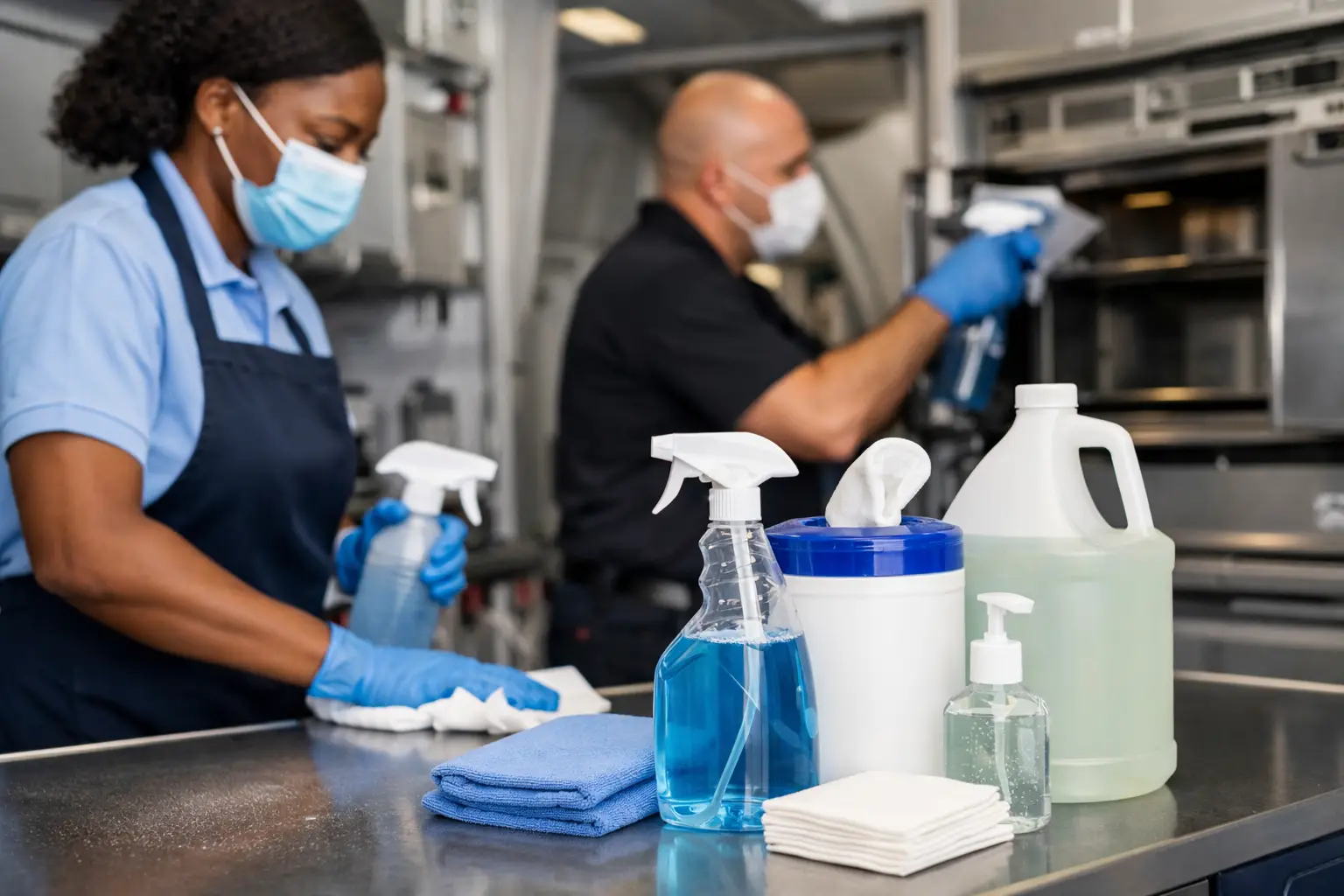
A galley can look clean and still create an operational sanitation problem. Crumbs, beverage residue, grease film, touchpoint contamination, and poorly maintained service equipment can affect food-service hygiene, crew confidence, and the passenger experience. Aircraft galley sanitation products must do more than leave a fresh appearance. They need to support controlled cleaning procedures in a confined, high-turn environment where material compatibility, chemical handling, and documentation all matter.
Thank you for reading this post, don't forget to subscribe!For aviation facilities teams, caterers, ground service providers, and procurement professionals, the right product program is not a single disinfectant or wipe. It is a defined system that matches the soil, surface, task, dwell time, and operating conditions of the galley.
What Aircraft Galley Sanitation Products Must Accomplish
Aircraft galleys combine several sanitation challenges in a small footprint. Food and beverage preparation surfaces sit near waste compartments, lavatory-adjacent service areas, storage units, carts, ovens, coffee equipment, and high-touch hardware. Turn crews often have limited time between flights, while deeper cleaning may happen overnight or during scheduled maintenance windows.
That reality requires products that can be used correctly under pressure. A highly effective chemical is not necessarily the best operational choice if it requires a long dwell time, leaves residue, has an objectionable odor, damages common galley materials, or creates unnecessary burden for crew members handling it in close quarters.
A practical sanitation program typically separates three functions. Cleaning removes visible soil, oils, sugars, and food residue. Sanitizing reduces microorganisms on appropriate surfaces after cleaning. Disinfecting is used when the risk assessment, facility protocol, or product label calls for a higher level of microbial control. Treating these as interchangeable can produce weak results, especially when a disinfectant is applied over grease or food residue without adequate pre-cleaning.
Selecting Products for Galley Surfaces and Workflows
The best aircraft galley sanitation products are selected by application, not by marketing claims alone. Procurement teams should begin with a surface and task inventory. This identifies where soil collects, which surfaces are food-contact or food-adjacent, what materials are present, and how often each area is serviced.
Start With the Soil Load
Coffee spills, syrup, milk residue, food oils, and adhesive residues need effective cleaning before sanitation can work as intended. A professional degreaser or general-purpose cleaner may be appropriate for stubborn soil, but it should be chosen with the specific surface and manufacturer guidance in mind. Strong chemistry is not automatically better. On sensitive finishes, seals, labels, and plastic components, unnecessarily aggressive products can cause dulling, cracking, discoloration, or premature wear.
For routine turnover cleaning, ready-to-use products and wipes can improve consistency because they reduce dilution errors and simplify deployment. For larger catering or maintenance operations, concentrated products may offer better control when trained personnel, proper dispensing, and documented dilution procedures are available. The right option depends on task volume and the operator’s ability to use it correctly every time.
Verify Material Compatibility
Galleys include stainless steel, aluminum, coated metal, composites, plastics, laminates, rubber seals, display surfaces, and painted components. A product that performs well on one material may be unsuitable for another. Compatibility testing and aircraft or equipment manufacturer guidance should be part of product approval, particularly for repeated-use applications.
Residue deserves equal attention. Products that leave streaks on high-visibility surfaces can create rework. Products that leave a tacky film can attract more soil. On food-contact surfaces, follow the label directions regarding required rinse steps. These details shape both hygiene performance and the time required to complete a turn.
Match Contact Time to Reality
Many sanitation and disinfectant products require a surface to remain visibly wet for a stated period. If a team wipes the product away immediately, the intended efficacy may not be achieved. A product with a contact time that does not fit the task window can undermine an otherwise well-designed program.
This does not mean every galley surface requires disinfecting after every service cycle. The proper level of control depends on the area, soil exposure, airline procedures, food-service practices, and current risk conditions. High-touch latches, handles, service panels, and cart touchpoints may require a different workflow than a cleaned food-prep counter or exterior storage door.
Documentation Is Part of the Product Decision
Institutional aviation buyers need more than a bottle label. They need documentation that supports safe purchasing, training, storage, and audit readiness. Before standardizing a sanitation product, verify that the supplier can provide current Safety Data Sheets, technical data, usage instructions, dilution guidance when applicable, and relevant regulatory documentation.
For antimicrobial products, the label is the legal use instruction. Teams should confirm the approved use sites, organisms or claims where relevant, contact time, personal protective equipment requirements, and any rinse requirements. Do not substitute assumptions for label directions, and do not make food-contact claims that the product documentation does not support.
A disciplined approval file should also record product name, approved application, storage location, responsible department, training requirements, and surface limitations. This level of control is particularly valuable when multiple stations, contractors, or service partners handle aircraft interiors across a network.
Build a Repeatable Galley Cleaning Sequence
Consistency matters more than a complex product assortment. A simple, documented sequence helps crews make the right decision quickly and prevents cross-contamination between waste areas, food-service surfaces, and touchpoints.
A dependable workflow generally begins by removing waste and loose debris, then cleaning visible soil from the highest-priority service surfaces. After cleaning, crews can apply the approved sanitizer or disinfectant according to label directions, allowing the required contact time. Fresh wipes, cloths, or tools should be used when moving from higher-soil areas to cleaner food-service surfaces.
Color-coded tools and clearly labeled bottles can support this process, but only if the system is enforced. Refillable containers must be labeled properly, and dilution control should be verified rather than estimated. Reusing a soiled cloth across multiple galley zones can defeat the purpose of the sanitation program, regardless of product quality.
Train for the Exceptions
The most common sanitation failures happen during exceptions: a delayed flight, an equipment spill, a short-staffed turn, a contamination event, or a substitute crew unfamiliar with the process. Training should explain not only what to use, but why the sequence matters and when to escalate an issue.
Teams should know which products are approved for food-service surfaces, which ones require rinsing, what to do when a chemical contacts an incompatible surface, and how to report damaged dispensers or missing labels. Brief task-based training is often more effective than broad chemical training that does not reflect galley conditions.
Evaluate Environmental Responsibility Without Reducing Standards
Environmentally responsible chemistry can be a strong fit for aviation sanitation programs when it is evaluated with the same discipline as conventional products. The goal is not to choose a product based on a broad sustainability statement. The goal is to select products that meet performance, safety, compatibility, and operational requirements while reducing unnecessary chemical harshness where possible.
Consider factors such as concentrated versus ready-to-use formats, packaging waste, worker exposure, fragrance level, and the need for repeated rinsing or rework. A lower-impact formulation that performs consistently and is easy for staff to use can reduce waste across the operation. However, sustainability claims should never replace documentation, surface testing, or compliance review.
A Procurement Checklist for Aviation Buyers
Before approving a new galley sanitation product, confirm these operational questions:
- Is it appropriate for the intended surface and soil type?
- Does its label direction fit the actual cleaning workflow and available dwell time?
- Are SDS sheets, technical specifications, and use instructions current and available?
- Has material compatibility been confirmed for repeated use on galley components?
- Can the supplier support consistent inventory, standardized ordering, and institutional documentation?
This review protects more than the aircraft interior. It helps protect crew members, food-service operations, vendor relationships, and the organization’s ability to demonstrate a controlled sanitation process.
Veteran Commercial Cleaning supports buyers who need professional-grade sanitation products backed by practical documentation and a procurement-ready approach. The strongest galley programs are built on clear standards, trained personnel, and products chosen for the work they must perform – not simply for the claim on the front label.