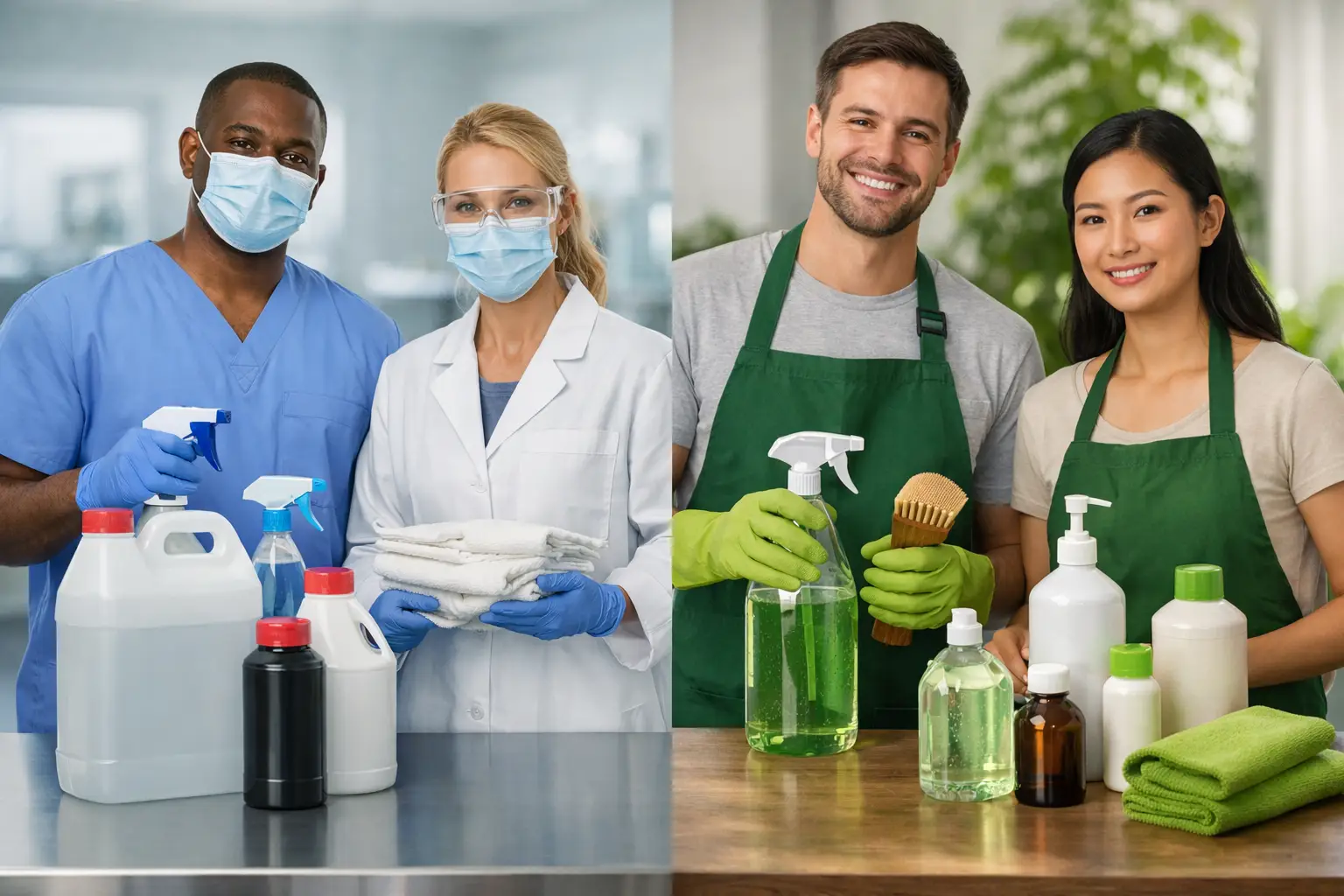
A disinfectant failure at a clinic, airport restroom, production floor, or government facility is not solved by a stronger fragrance or a more aggressive label. It is solved by using the right chemistry, at the right dilution and contact time, with documentation that supports the facility’s actual risk. That is the central question in hospital grade cleaners versus green alternatives: not which category sounds better, but which product can reliably meet the cleaning, safety, and compliance requirements of the task.
Thank you for reading this post, don't forget to subscribe!For institutional buyers, the choice should never be framed as harsh chemicals versus weak green products. Modern cleaning programs can often pair environmentally responsible chemistry with professional performance. The correct decision depends on the surface, soil load, pathogen risk, occupant exposure, equipment compatibility, and the claims a facility must be able to defend.
What “Hospital Grade” Actually Means
“Hospital grade” is widely used in the cleaning industry, but it is not a substitute for reviewing a product label and technical documentation. In practical terms, buyers generally use the term to describe disinfectants intended for healthcare-level sanitation needs and supported by antimicrobial efficacy claims.
For a disinfectant used in the United States, procurement teams should verify EPA registration when applicable, then confirm the specific organisms named on the label, approved surfaces, dilution instructions, and required contact time. A product may be effective against certain bacteria, viruses, or fungi without being appropriate for every pathogen concern or every environment. The label is the operating instruction, not a marketing suggestion.
There is also a critical distinction between cleaning and disinfecting. A cleaner removes soil, oils, residue, and debris. A disinfectant is designed to inactivate listed microorganisms when used according to its label. On visibly dirty surfaces, cleaning first is often necessary because organic matter can interfere with disinfectant performance. Facilities that treat every task as a disinfection task may increase chemical exposure, labor time, and material wear without improving outcomes.
Green Alternatives Are Not One Product Category
A green cleaner may be formulated for reduced environmental impact, improved worker exposure profiles, biodegradable ingredients, lower volatile organic compounds, or safer use around occupants. Those are meaningful advantages, particularly in high-frequency cleaning programs. But “green” alone does not establish disinfecting efficacy.
Some environmentally preferable products are daily cleaners. Others are disinfectants with EPA-registered antimicrobial claims. Some carry third-party environmental certifications, while others rely only on broad sustainability language. These are different procurement propositions and should be evaluated accordingly.
The strongest green alternatives are not selected because they make a facility look environmentally responsible. They are selected because their safety, performance, and documentation align with the job. For example, a low-odor, reduced-harshness cleaner may be a better routine option for administrative areas, schools, break rooms, public lobbies, and frequently occupied spaces. It can support indoor air quality goals and reduce unnecessary exposure for cleaning crews and building occupants.
That same product may not be the correct response to a bodily fluid incident, an isolation area, a food-contact sanitation requirement, or a documented infectious disease protocol. In those cases, the facility needs a product with claims that match the hazard and an established procedure for use.
Hospital Grade Cleaners Versus Green Alternatives by Use Case
The decision becomes clearer when buyers evaluate the work area rather than the product category.
In healthcare and clinical environments, infection prevention requirements often drive the selection. Environmental services teams need disinfectants with appropriate EPA registration, pathogen claims, contact times, and compatibility with clinical surfaces and equipment. Green chemistry can still have a role in routine floor care, glass cleaning, restroom maintenance, and general cleaning, but it must not displace an approved disinfecting protocol where one is required.
In manufacturing, the challenge may be less about patient-care pathogens and more about oils, greases, production residues, worker safety, and uptime. An industrial degreaser must remove the soil efficiently without damaging machinery, flooring, coatings, or nearby processes. Environmentally responsible options can reduce solvent burden and odor, but the formulation still needs to perform under the facility’s real conditions. A product that works on a lightly soiled office counter may fail on accumulated hydraulic oil or carbonized residue.
Airports, government buildings, and military facilities often require both high-visibility cleanliness and disciplined documentation. Public touchpoints, restrooms, transportation areas, and secure workspaces require consistent procedures across multiple shifts. Here, concentrated products, clear dilution controls, compatible wipes, and accessible SDS and technical data can matter as much as the formulation itself. The goal is repeatable execution, not a cabinet full of overlapping products.
For offices and small businesses, green alternatives can frequently handle the majority of daily work. Routine cleaning of desks, glass, floors, restrooms, and common areas does not always require the most aggressive chemistry available. Reserving hospital-grade disinfectants for designated high-touch disinfection or incident response can improve safety and control product use without lowering the cleaning standard.
Compare Performance Beyond the Front Label
Procurement decisions should begin with the facility’s requirements, then move to evidence. Ask whether the product is a cleaner, sanitizer, disinfectant, degreaser, or a combination product. Confirm the substrate it will be used on, the expected soil load, and whether the area has special requirements for food service, healthcare, aviation, or government operations.
Next, review the operational details that determine whether a product will work in the field. Contact time is one of the most commonly missed requirements. If a disinfectant requires a surface to remain visibly wet for several minutes, a quick spray-and-wipe method may not deliver the claimed result. Dilution accuracy matters as well. Overconcentration can create residue, increase exposure, and waste product, while underconcentration can compromise performance.
Surface compatibility deserves equal attention. Strong chemistry may damage finishes, discolor fabrics, corrode metals, haze screens, or shorten the service life of equipment. A safer formulation is not automatically compatible, either. Technical data should confirm intended surfaces and any restrictions before a product is deployed across a facility.
Finally, consider the human factor. A product with a complicated procedure, overpowering odor, or inconsistent dispensing method is more likely to be used incorrectly. Crew training, labeled secondary containers, standard operating procedures, and accessible safety documentation are part of cleaning performance. A compliant product that is improperly applied does not provide a compliant outcome.
Documentation Is Part of the Product
For high-compliance environments, purchasing decisions must stand up to inspection, audit, and internal review. Buyers should maintain current SDS sheets, technical specifications, EPA registration details when relevant, dilution guidance, and any applicable environmental or regulatory certifications. These records help facilities train staff, evaluate hazards, respond to incidents, and demonstrate due diligence.
Documentation also prevents a common procurement error: accepting broad claims without verifying their scope. Terms such as non-toxic, biodegradable, eco-friendly, hospital grade, and industrial strength can be useful descriptors, but they do not replace a complete label review. A responsible supplier should be able to support buyers with clear product data rather than asking them to rely on general claims.
Veteran Commercial Cleaning approaches this balance as an operational requirement. Facilities should not have to choose between chemistry that supports safer workplaces and products capable of meeting institutional sanitation demands. The right program uses the least hazardous effective chemistry for each task while preserving the disinfecting and degreasing capability needed for higher-risk work.
Build a Tiered Cleaning Program
The most effective facilities do not rely on one all-purpose product for every room and incident. They build a tiered program: routine cleaners for daily soil removal, targeted degreasers for industrial soils, approved disinfectants for defined high-touch or high-risk areas, and specialty products where surface or regulatory requirements demand them.
This approach reduces unnecessary chemical intensity while keeping stronger products available when the work requires them. It also makes training simpler because teams understand why products are assigned to particular tasks instead of treating all cleaning chemicals as interchangeable.
A better cleaning decision is not about choosing hospital grade or green as a matter of identity. It is about matching verified performance to the hazard, protecting people and surfaces, and maintaining records that support every choice. When a facility makes that match consistently, responsible chemistry becomes a practical advantage rather than a compromise.