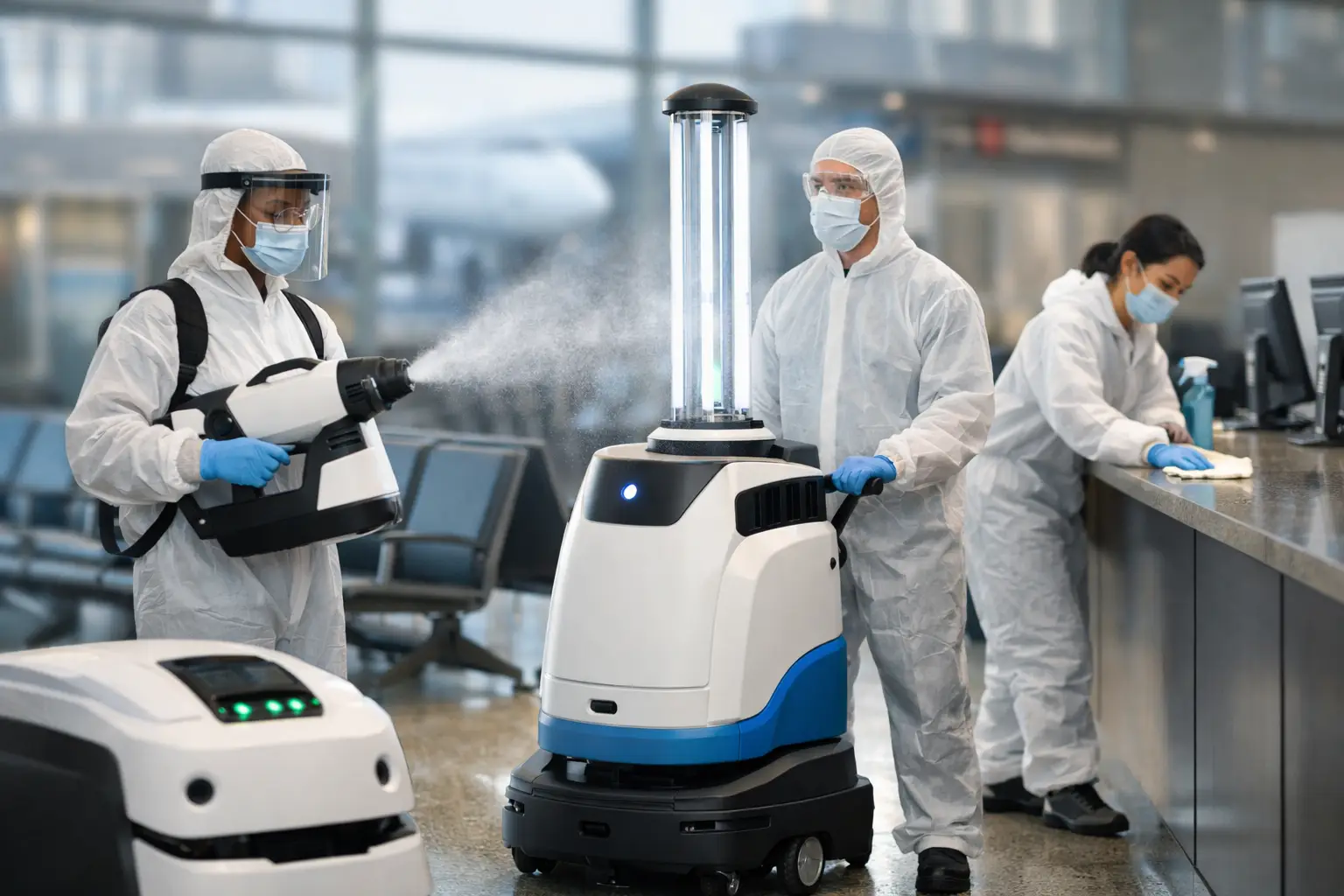
At an airport, a missed high-touch surface is not a minor housekeeping issue. It can affect passenger confidence, employee safety, tenant relationships, and the facility’s ability to maintain documented sanitation standards through constant traffic. This airport disinfection program case study examines how a representative airport operations team moved from reactive cleaning to a controlled, auditable disinfection program without disrupting flight activity.
Thank you for reading this post, don't forget to subscribe!The scenario reflects common operational conditions at medium-to-large U.S. airports: multiple terminals, public restrooms, TSA-adjacent public areas, gate seating, employee workspaces, concessions, and high-volume curbside traffic. It is not a claim about a single named facility. The value is in the operating model – and in the decisions that made the program more reliable under pressure.
The Operating Problem Was Coverage, Not Effort
The airport had an established janitorial schedule and staff members who understood the importance of cleanliness. The gap was consistency. Cleaning tasks varied by shift, traffic patterns changed without notice, and supervisors had limited proof that disinfection had occurred in the locations that mattered most.
Peak travel periods exposed the weakness. Restrooms could be serviced repeatedly while gate armrests, elevator buttons, service counters, and employee breakroom touchpoints received uneven attention. The team was working hard, but the program was organized around visible cleaning needs rather than a documented risk-based disinfection plan.
Leadership also faced a chemical-management concern. Products needed to perform in public-facing environments, but overly harsh chemistry could create odor complaints, employee exposure concerns, material compatibility issues, and unnecessary handling risks. A stronger program had to improve sanitation performance while supporting safer day-to-day use.
Airport Disinfection Program Case Study: The Program Design
The first decision was to separate routine cleaning from disinfection. Cleaning removes soil and organic material. Disinfection is a label-directed process intended to address specified microorganisms on hard, nonporous surfaces. Combining the two in a single vague instruction – “sanitize the terminal” – made quality control nearly impossible.
The airport team created cleaning zones based on traffic volume, touch frequency, and operational sensitivity. Public restrooms, security-adjacent waiting areas, gate seating zones, elevators, check-in kiosks, customer service counters, and staff areas each received defined service expectations. The goal was not identical treatment everywhere. It was appropriate treatment based on use and risk.
For example, a low-traffic administrative hallway did not require the same frequency as a family restroom near active departure gates. Conversely, a breakroom used by multiple shifts could not be overlooked simply because it was out of public view. This distinction helped the team direct labor and product use where they had the greatest operational value.
The program relied on four controls:
- Clearly defined zones and high-touch surface maps
- Approved products with available SDS sheets, technical specifications, and use instructions
- Shift-level documentation that recorded completed work and exceptions
- Supervisor verification through inspections, spot checks, and corrective actions
This framework gave the operations team a practical answer to a difficult question: how can a facility demonstrate that its disinfection process is being executed as designed?
Product Selection Focused on Use Conditions
Product selection was evaluated as an operational decision, not a purchasing shortcut. The team reviewed disinfectant labels, required contact times, dilution procedures where applicable, PPE requirements, surface compatibility, storage requirements, and disposal considerations.
Contact time became especially important. A disinfectant cannot deliver label-supported performance if it is wiped away before the required wet time has elapsed. In fast-moving public areas, that constraint affected product choice, staff workflow, and the order in which surfaces were treated. A shorter contact time may support faster turnover, but it still has to be paired with correct application and appropriate pre-cleaning when soil is present.
The team also considered environmental and employee factors. Responsible chemistry does not mean accepting weaker performance. It means selecting institutional-grade solutions that meet the facility’s disinfection needs while reducing unnecessary harshness, strong residual odors, and avoidable hazards. For airport teams, that balance matters because employees and travelers are present throughout the workday.
Training Turned Procedures Into Repeatable Work
The revised program did not begin with product deployment. It began with training. Staff members were taught why different zones had different frequencies, how to read product directions, what contact time meant in practice, and when a surface required cleaning before disinfection.
Training also addressed application methods. Wipes, spray-and-wipe processes, and other sanitation tools can all be effective when used according to their instructions and matched to the task. The wrong method can create overspray, wasted product, incomplete coverage, or damage to sensitive equipment and finishes.
Supervisors used short, practical demonstrations rather than relying only on written procedures. Teams practiced treating touchpoints in sequence, handling replenishment supplies, responding to spills, and documenting completed rounds. This was especially valuable for new staff, temporary personnel, and employees moving between terminals.
A disciplined program also needs a clear escalation path. If a restroom has a plumbing issue, a gate area is blocked by passenger congestion, or a public health concern requires added service, the team must record the exception and notify the appropriate lead. Documentation should show both the work completed and the reason a scheduled task could not be completed on time.
What Changed During Peak Operations
After implementation, the airport team saw the clearest improvement in visibility and response control. Supervisors could identify which zones had been serviced, where missed tasks were occurring, and whether staffing patterns matched actual demand. Instead of adding broad, unfocused labor during busy periods, the team could redeploy personnel toward the areas receiving the heaviest use.
Restroom complaints declined because teams had defined inspection points rather than relying solely on passenger reports. Gate-area service became more consistent because high-touch surfaces were incorporated into scheduled rounds. Internal staff also had greater confidence in the process because they understood the purpose behind the tasks and had access to the required product information.
The program did not eliminate every challenge. Flight delays, weather events, equipment failures, and staffing shortages still disrupted schedules. But the facility had a written baseline for making adjustments. A delayed round could be reprioritized, documented, and verified instead of disappearing into an informal handoff between shifts.
Documentation Became a Procurement and Compliance Asset
For airport facilities, documentation is more than an internal management tool. It can support procurement reviews, contractor oversight, safety discussions, incident response, and quality assurance. A well-maintained program should allow facility leaders to answer basic but consequential questions: What product was used? Was it used according to instructions? Who performed the service? When was the area last inspected? What corrective action was taken when expectations were not met?
The airport team standardized its records around these questions. Product documentation was kept accessible to supervisors. Shift logs used consistent zone names. Inspection forms focused on observable conditions rather than subjective statements such as “area looked good.” When a corrective action was required, the record identified the issue, owner, completion status, and verification step.
This level of control also improved vendor management. When products, service expectations, and documentation standards are clearly specified, procurement teams can evaluate suppliers on performance readiness rather than marketing claims alone. Veteran Commercial Cleaning supports this type of institutional approach by providing professional-grade cleaning solutions with the technical documentation high-compliance facilities need to make informed purchasing decisions.
Lessons for Facilities Leaders
The central lesson from this airport disinfection program case study is that cleaning frequency alone does not create a defensible sanitation program. Performance depends on defined priorities, properly selected chemistry, trained personnel, and records that show the process was followed.
There are trade-offs. More frequent service can improve coverage but may create labor strain if every zone is treated equally. Stronger chemistry may appear attractive but can introduce handling, odor, and compatibility concerns. Digital tracking can improve reporting, though a simple paper-based system may be more reliable for a team that needs immediate adoption. The right approach depends on terminal layout, passenger volume, staffing model, tenant responsibilities, and existing contract requirements.
The most effective program is the one the facility can execute every shift, verify with confidence, and improve when conditions change. For airports, that standard protects more than appearances. It supports safe operations in one of the most demanding public environments in the country.