A missed high-touch surface in a clinic, production area, airport gate, or government office can create more than a housekeeping issue. It can interrupt operations, raise employee concerns, complicate an inspection, and leave a facility without a clear record of what was done. That is why facility disinfection technology trends are moving beyond simply applying more product. The priority is controlled, verifiable disinfection that fits the risk level, schedule, materials, and compliance requirements of the facility.
Thank you for reading this post, don't forget to subscribe!For facility managers and procurement teams, the strongest trend is not one machine or chemical. It is the shift toward integrated programs: effective chemistry, trained application, documented processes, and technology used where it produces measurable operational value.
Facility Disinfection Technology Trends Are Becoming More Targeted
The early emphasis on broad, frequent disinfection has given way to a more disciplined approach. Facilities are separating routine cleaning from disinfection and directing higher-level interventions toward spaces, surfaces, and events that justify them.
This matters because disinfectants are not interchangeable with cleaners. Soil, grease, and organic matter can interfere with disinfectant performance. A surface may first require cleaning before a disinfectant can contact the surface effectively for its required dwell time. Technology can improve application consistency, but it cannot compensate for poor surface preparation or skipped procedures.
Risk-based scheduling is becoming more common in healthcare, aviation, manufacturing, public-facing government facilities, and other high-traffic environments. Restrooms, break rooms, touchpoints, shared equipment, locker areas, reception counters, and transport surfaces may receive more frequent attention than low-contact administrative areas. The result is a cleaning program that uses labor, chemistry, and equipment with greater purpose rather than treating every square foot the same way.
Digital task verification is now part of sanitation control
Digital inspection tools, QR-based task logs, mobile checklists, and time-stamped reporting are increasingly important to facility disinfection programs. These tools help supervisors confirm that assigned areas were serviced, exceptions were reported, and corrective work was completed.
Documentation does not prove that a pathogen was eliminated from every surface. What it does provide is an auditable record of the process: who performed the work, when it occurred, what area was covered, and whether the required procedure was followed. For regulated facilities and government contractors, that operational record can be as valuable as the product specification itself.
The best systems remain practical. A complex platform that frontline teams do not use consistently is less useful than a straightforward process with clear accountability. Facilities should select documentation technology based on reporting requirements, supervisor workflow, and the ability to retain records when they are needed for internal review or customer requirements.
Automation Is Expanding, but It Is Not a Substitute for Cleaning
Autonomous floor equipment and targeted disinfection devices are receiving significant attention, particularly where staffing is tight or facilities operate around the clock. Their real value is consistency on repeatable tasks and the ability to free trained personnel for detailed cleaning, inspection, and response work.
UV-C systems are one example. When properly deployed, UV-C can support disinfection in suitable environments, particularly after manual cleaning has addressed soil and debris. However, UV-C depends on line of sight, distance, exposure time, room layout, and safety controls. Shadows, obstructions, and complex equipment surfaces limit coverage. It should be treated as a controlled supplemental measure, not a replacement for trained environmental services staff.
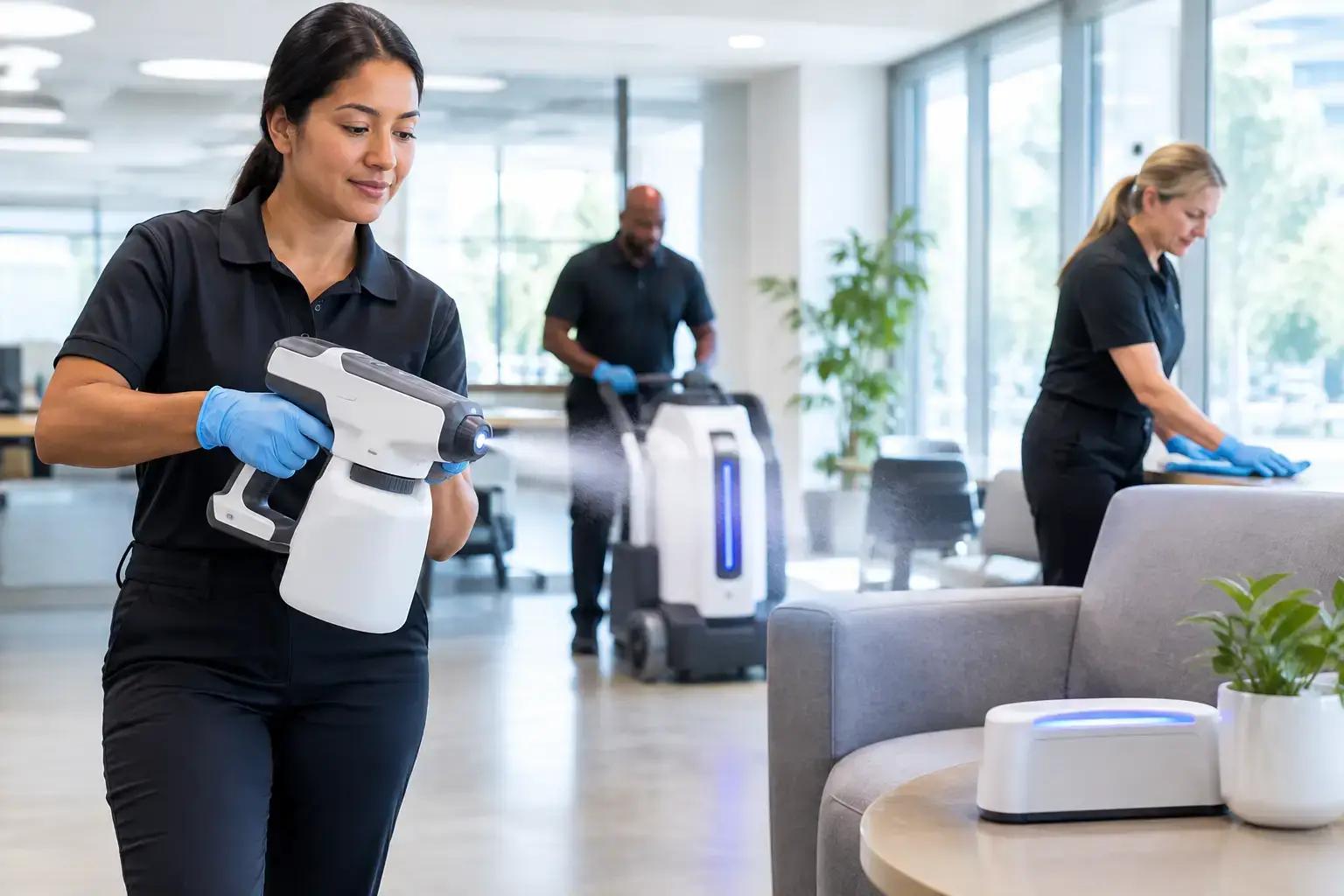
Electrostatic sprayers and other controlled application systems can help distribute approved disinfectants across complex surfaces. Yet coverage alone is not the same as efficacy. The product must be appropriate for the use site, applied according to its label, and allowed to remain wet for the required contact time. Overapplication can create residue, slip concerns, or compatibility problems with electronics, coatings, and sensitive equipment.
Robotic systems carry similar trade-offs. They can improve repeatability in defined areas, but they require route planning, maintenance, supervision, and a realistic understanding of what they can reach. Facilities should evaluate automation according to the task it can reliably perform, not the broadest claim made about the technology.
Safer Chemistry Is Becoming a Procurement Requirement
Environmental responsibility is no longer separate from institutional performance. Buyers increasingly want disinfectants and sanitation systems that meet required efficacy standards while supporting safer work practices, reduced harsh odors, and material compatibility.
The decision is not as simple as choosing the least aggressive formulation. A facility must consider the organism claims required for its environment, the surface types involved, use around occupants, ventilation conditions, contact time, and the product’s safety documentation. In high-compliance settings, the correct choice is the formulation that meets the defined sanitation objective while reducing unnecessary risk to personnel, equipment, and operations.
This is also driving greater attention to compatibility testing. Repeated disinfectant use can affect plastics, rubber, painted surfaces, screens, seals, and other materials over time. Facilities that operate aircraft interiors, production assets, clinical equipment, or specialized government equipment should verify approved methods before standardizing a product or process.
Procurement teams should require current Safety Data Sheets, technical specifications, use directions, and applicable regulatory documentation as part of the evaluation process. Documentation is not an administrative afterthought. It helps align product selection with worker safety training, storage requirements, emergency procedures, and facility-specific compliance expectations.
Data Is Improving Decisions, Not Replacing Judgment
Another important development is the use of data to refine cleaning frequency and verify operational performance. Facilities may combine inspection findings, occupancy levels, work orders, supply usage, complaint trends, and environmental monitoring results to identify where sanitation resources are needed most.
For example, a recurring issue at a shared timeclock, employee entrance, or high-volume restroom may signal a need for adjusted service intervals, different supplies, or stronger supervision. Conversely, data may show that a labor-intensive routine is occurring in an area with limited risk and low usage. That information supports better allocation of staff without lowering standards.
Some organizations also use surface testing or ATP monitoring as part of quality assurance. These tools can be useful indicators of cleaning performance, but they must be interpreted correctly. ATP readings generally indicate organic material, not the presence or absence of a specific pathogen. They are best used to improve process discipline, validate cleaning practices, and identify training needs rather than as a standalone declaration of disinfection success.
How to Evaluate New Disinfection Technology
Before adding a device, software platform, or new disinfectant to a facility program, define the problem it needs to solve. Is the concern inconsistent coverage, poor documentation, labor constraints, difficult-to-reach surfaces, material damage, or a higher-risk area that requires a different protocol? A clear operational problem leads to a more defensible purchase decision.
Next, evaluate the technology against real conditions. Consider facility layout, shift patterns, occupant access, staff training, storage capacity, maintenance requirements, and whether the process can be documented. A solution that works in an empty demonstration room may not perform the same way in a busy manufacturing plant, medical setting, terminal, or occupied government building.
Finally, establish measurable acceptance criteria before implementation. That may include inspection scores, task completion records, reduced rework, compliance with approved dwell times, lower material damage, or improved response during high-demand periods. Technology should improve a defined outcome, not merely add another layer to the cleaning program.
Veteran Commercial Cleaning supports this practical approach by emphasizing institutional-grade performance alongside responsible chemistry and the documentation facilities need to make informed purchasing and program decisions.
The most effective disinfection program is rarely the one with the most equipment. It is the one where the right chemistry, trained people, verified procedures, and appropriate technology work together under a standard the facility can consistently maintain.