A delayed turn is expensive. A sanitation miss can be worse: a passenger complaint, a crew exposure, damaged cabin finish, failed inspection, or an avoidable disruption to flight operations. Effective aviation sanitation is therefore not a cosmetic task performed between arrivals. It is a controlled operational function that protects people, preserves assets, and supports on-time performance.
Thank you for reading this post, don't forget to subscribe!For airports, airlines, fixed-base operators, maintenance teams, and contracted facility managers, the standard is clear. Cleaning programs must produce visible results while meeting chemical-safety requirements, aircraft and facility material constraints, workforce procedures, and documentation expectations. The right approach is disciplined rather than aggressive: use the appropriate chemistry, follow verified dwell times, clean high-risk areas consistently, and maintain records that can stand up to review.
Aviation Sanitation Is More Than Cabin Cleaning
Aircraft cabins receive the most attention because they are highly visible and turn quickly. Yet aviation environments include terminals, gate areas, restrooms, jet bridges, crew spaces, baggage operations, maintenance support areas, administrative offices, and ground-service facilities. Each has different soil loads, touchpoint patterns, surfaces, and risk profiles.
A cabin turnaround may prioritize seat belts, tray tables, armrests, lavatory fixtures, door handles, and galley touchpoints. Terminal sanitation often concentrates on public restrooms, security-adjacent queues, check-in counters, seating, elevators, and waste areas. In a maintenance environment, the sanitation plan may also need to address oils, lubricants, shop soils, and the separation of cleaning activities from maintenance work.
These distinctions matter because one product and one method rarely fit every surface or task. A strong disinfectant may be suitable for a restroom fixture but inappropriate for a sensitive cabin material. A degreaser that performs well in a shop may not belong near passenger-facing finishes. Aviation sanitation succeeds when teams match the cleaning objective to the location, contaminant, surface, and required result.
Start With a Risk-Based Cleaning Map
The most reliable programs are built around a site-specific cleaning map, not a generic checklist copied across every location. Facility leaders should identify where people touch surfaces most often, where moisture or waste accumulates, where food and beverage handling occurs, and where operations cannot tolerate interruption.
For each zone, define the surface types, cleaning frequency, responsible team, approved chemistry, application method, required contact time, and inspection standard. This creates practical accountability. It also prevents common failures, such as spraying a product without allowing it to remain wet for the time required by its label, or using wipes across too many surfaces without changing them.
A practical risk map usually separates work into four levels: routine daily cleaning, high-touch disinfection, incident response, and periodic deep cleaning. The distinction helps teams avoid overusing disinfectants where ordinary soil removal is the real need. Cleaning first is frequently necessary because dirt, oils, and residue can reduce the effectiveness of a disinfectant applied afterward.
High-Touch Areas Need Repeatable Controls
High-touch surfaces are not difficult to identify, but they are easy to miss when turnaround pressure rises. They include armrests, buckles, tray-table latches, lavatory handles, faucet controls, call buttons, overhead bin latches, touchscreen kiosks, counter edges, handrails, door plates, and shared equipment controls.
The operational question is not whether these points should be addressed. It is whether the process is repeatable across shifts, vendors, aircraft types, and peak travel periods. Clear zone assignments, timed procedures, and supervisor verification are more dependable than asking staff to “sanitize thoroughly” under time pressure.
Choose Chemistry for Performance and Material Compatibility
The strongest chemical is not automatically the best option. In aviation, cleaning products must balance efficacy with compatibility, worker safety, odor considerations, residue control, storage requirements, and environmental responsibility. A formulation that damages plastics, dulls coatings, corrodes metal, leaves a slippery film, or creates excessive fumes can introduce new operational problems.
Before approving a product, procurement and operations teams should review its safety data sheet, technical data, use directions, dilution requirements where applicable, disinfectant claims, and compatibility guidance. Aircraft interior surfaces require particular care. Always follow aircraft manufacturer instructions and site-specific requirements before introducing a new chemistry or process.
Environmentally responsible chemistry can be a meaningful advantage when it reduces unnecessary harshness without compromising the intended cleaning outcome. That does not mean every product should be mild, nor does it mean “green” claims replace performance validation. It means selecting fit-for-purpose products with transparent documentation and using them correctly.
Chemical control also depends on storage and dispensing. Original labeling, secondary-container labels, controlled access, proper dilution, and separation from incompatible materials reduce the chance of employee injury or costly misuse. In high-compliance facilities, these basics are not administrative details. They are part of sanitation quality.
Documentation Makes Sanitation Defensible
Aviation facilities operate under scrutiny from customers, tenants, regulators, airline partners, safety teams, and internal quality programs. When a complaint, exposure concern, or audit occurs, verbal assurance is not enough. Decision-makers need to see what was used, where it was used, who performed the work, and how the result was verified.
A defensible aviation sanitation program maintains current chemical documentation, approved-product lists, training records, cleaning schedules, inspection logs, corrective-action records, and incident-response procedures. Digital records can simplify retrieval, but paper systems can work when they are accurate, controlled, and consistently completed.
For procurement professionals, documentation should begin before the purchase order. Suppliers should be able to provide clear safety and technical information so facilities can evaluate products against their operational and compliance needs. This is especially valuable for government, military, and institutional buyers whose approval processes may require formal product review.
Train for Method, Not Just Product
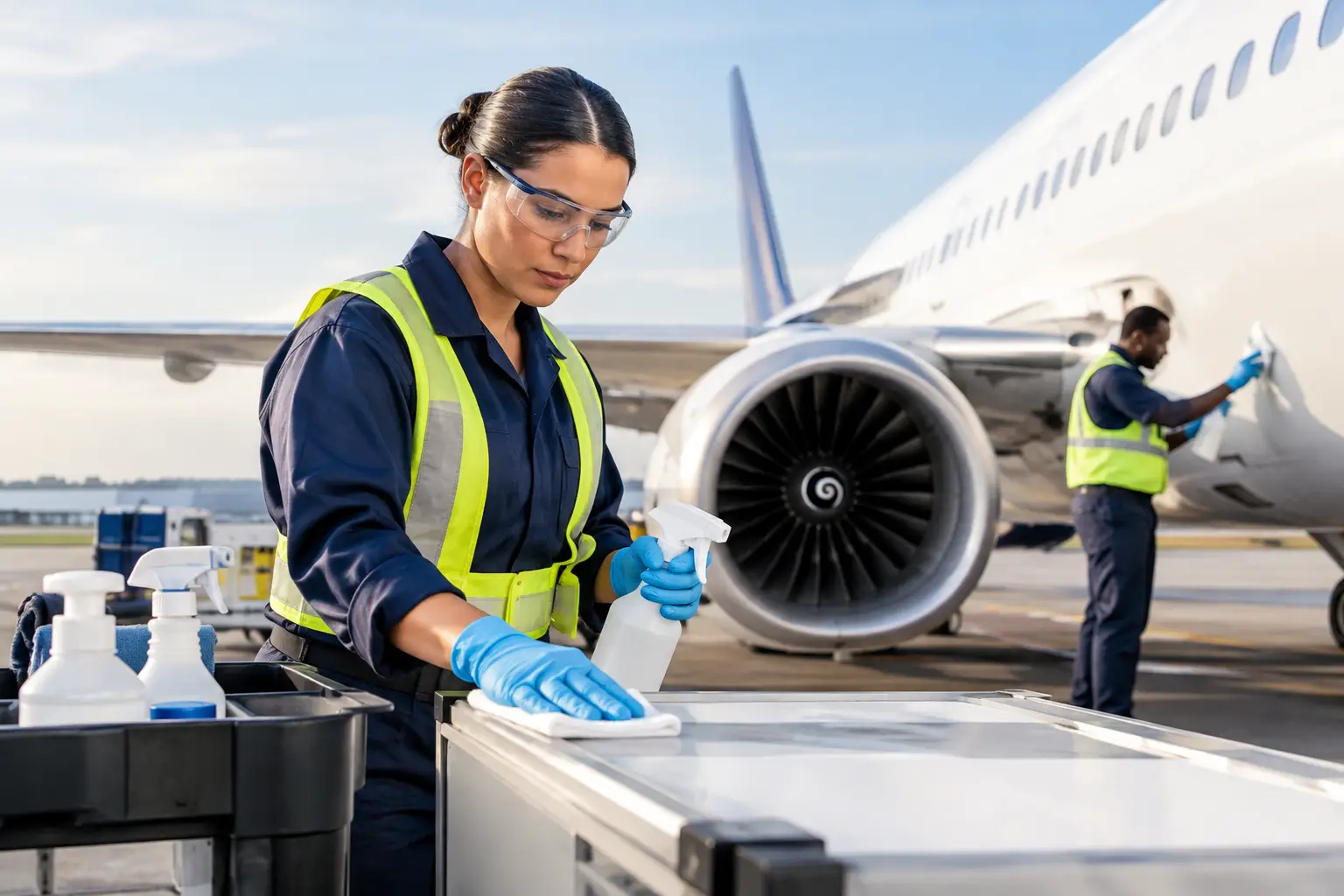
A chemical program only performs as well as the people using it. Teams need more than a product orientation. They need to understand the sequence of work: remove visible soil, apply the approved cleaner or disinfectant correctly, maintain the required wet contact time, avoid cross-contamination, and return the area to service safely.
Training should also address microfiber and wipe discipline, personal protective equipment, spill response, waste handling, dilution control, and the distinction between cleaning, sanitizing, and disinfecting. These terms are often used interchangeably in daily conversation, but they represent different outcomes and should be treated accordingly in operational procedures.
Short, recurring training is usually more effective than a single annual session. Supervisors should observe real work during actual shifts, especially during fast aircraft turns and high-volume terminal periods. If a procedure cannot be performed correctly within the available time, the issue may be staffing, workflow design, tool placement, or unrealistic scope – not employee effort alone.
Build Quality Checks Into the Shift
Visual inspection remains useful, but it does not tell the whole story. A surface can look clean while retaining residue, or appear streaked while still meeting the intended sanitation outcome. Quality assurance should combine visual standards with process verification: were the correct areas addressed, was the right product used, was contact time met, and were supplies changed often enough to prevent cross-contamination?
Facilities should define escalation triggers for issues such as bodily-fluid incidents, repeated restroom failures, supply shortages, chemical misuse, or damage reports. Fast escalation protects the next shift and reduces the likelihood that a minor sanitation miss becomes an operational event.
The best inspections are constructive. They identify the source of a failure and correct it through retraining, product adjustment, workflow changes, or better supply placement. Blame does not improve sanitation control. Clear standards and disciplined follow-through do.
Procurement Should Support Continuity
A sanitation program can fail even when its procedures are sound if approved supplies are inconsistent or documentation is difficult to obtain. Procurement teams should evaluate supplier reliability, product availability, technical support, packaging suited to the work environment, and the ability to support bulk or recurring institutional requirements.
Veteran Commercial Cleaning supports this type of evaluation with professional-grade cleaning and sanitation solutions designed for facilities that require performance, safer chemistry options, and procurement-ready documentation. For aviation buyers, the priority is not a broad catalog. It is a controlled set of approved solutions that crews can use confidently and consistently.
Aviation sanitation is strongest when it becomes part of the operating rhythm: mapped by risk, matched to materials, documented for accountability, and verified on every shift. That discipline gives crews a cleaner place to work, passengers greater confidence, and operations teams one less preventable problem to manage.