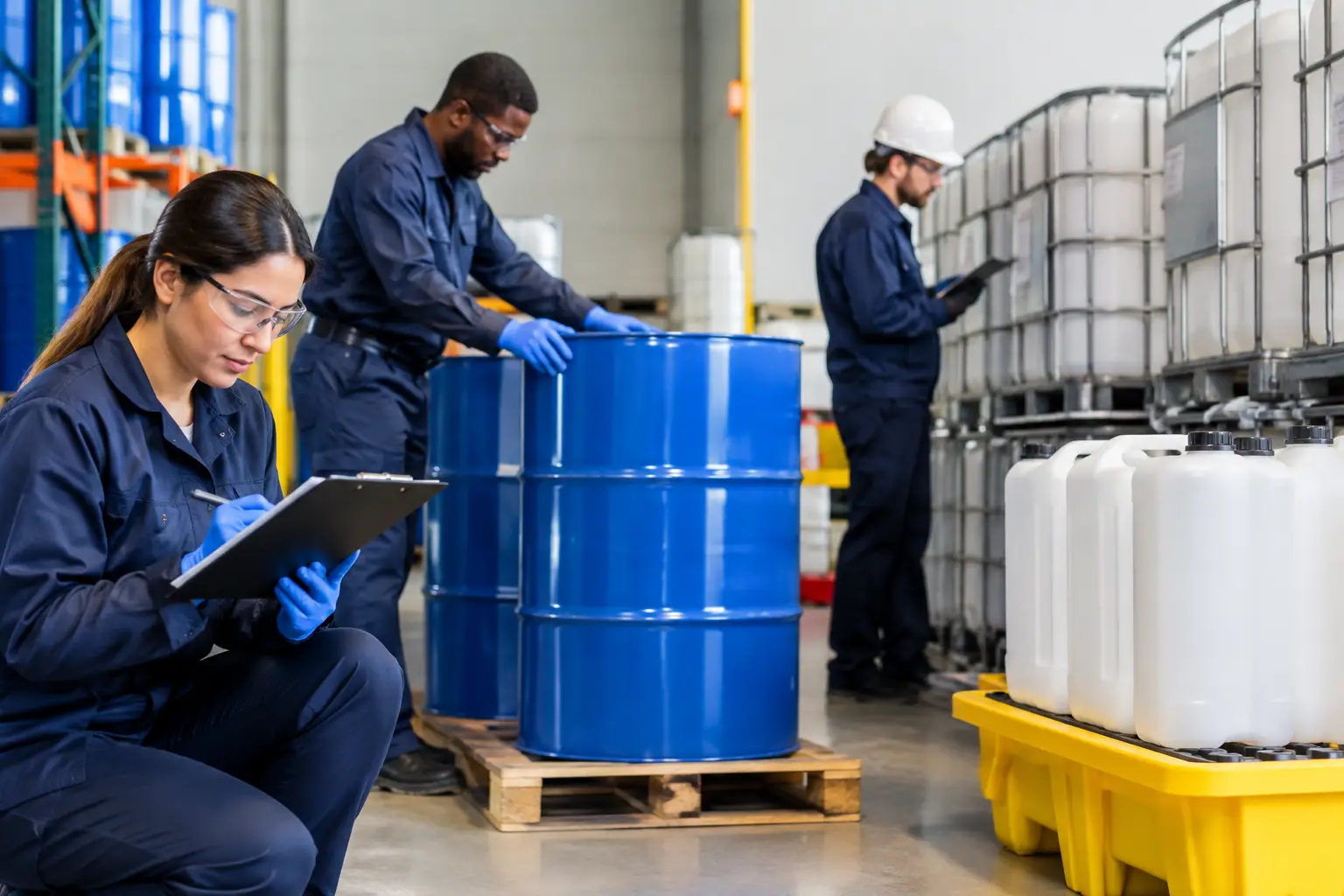
A leaking gallon of cleaner is rarely just a housekeeping issue in a plant, airport, clinic, or government facility. It can shut down an area, expose employees, damage inventory, complicate an inspection, and create a reportable incident. Knowing how to store industrial chemicals is therefore a core facility-control responsibility, not a task to leave to the end user or janitorial closet attendant.
Thank you for reading this post, don't forget to subscribe!The right storage program protects people first, then protects operations. It starts with the actual hazards of the chemicals on site, the conditions of the storage area, and the procedures employees follow when receiving, using, and returning products. A well-organized chemical room should make the safe action the easy action.
Start With the Safety Data Sheet
Every industrial chemical should have a current Safety Data Sheet, or SDS, available to employees. The SDS is not paperwork to file away after delivery. It is the operating reference for storage temperature, ventilation needs, incompatibilities, personal protective equipment, spill response, and disposal considerations.
Before a product enters storage, review Sections 2, 7, 9, and 10 of its SDS. These sections identify hazards, handling and storage instructions, physical properties, and stability or reactivity concerns. They help answer practical questions: Does the product need to be protected from freezing? Does it produce vapors? Can it be stored near oxidizers, acids, or other cleaning compounds?
Do not assume that two products belong together because both are used for cleaning. A disinfectant, degreaser, descaler, sanitizer, solvent, or drain-maintenance chemical may have very different storage requirements. Product labels and SDS instructions control when they are more restrictive than a general site practice.
Separate Chemicals by Compatibility, Not Convenience
The most common storage mistake is arranging chemicals by where they are used rather than by what can safely sit beside them. A facility may find it convenient to keep all restroom products together, but convenience does not override chemical compatibility.
At a minimum, establish designated zones for acids, bases, oxidizers, flammables, corrosives, aerosols, and general nonhazardous cleaning products. The specific categories should reflect the inventory and SDS guidance at the facility. Clearly mark shelves, cabinets, or rooms so workers can return products to the correct location without relying on memory.
Acids and bases generally require separation because a spill or leak can create a violent reaction or release heat. Oxidizers must be isolated from fuels, solvents, paper goods, rags, and other combustible materials. Flammable products need approved storage appropriate to their hazard classification, away from ignition sources and excessive heat.
Physical separation matters. Separate cabinets, distance, barriers, and spill containment can all be effective depending on the chemical and facility layout. A colored shelf label alone is not sufficient if containers can topple into one another during a spill, vibration event, or restocking rush.
Pay Close Attention to Bleach and Ammonia Products
Cleaning teams frequently encounter bleach-based products, acidic descalers, and ammonia-containing cleaners. These should never be mixed, transferred into unmarked bottles, or stored in a way that encourages accidental combination. Bleach can react with acids or ammonia-containing products to create dangerous gases.
This is one reason employee training must cover more than a label-reading reminder. Staff should understand the reason behind segregation rules and know that mixing products is not a shortcut to stronger cleaning.
Build a Storage Area That Controls Exposure
A compliant storage space is clean, dry, adequately lit, and accessible only to trained personnel when the hazards warrant restricted access. Storage areas should not double as break rooms, food storage spaces, or general supply closets where unrelated materials collect around chemical containers.
Ventilation requirements depend on the products being stored. Some chemicals need dedicated mechanical ventilation or placement where vapors cannot accumulate. Others can be stored safely in a well-maintained general storage room. Follow the SDS and applicable fire, building, and workplace requirements rather than applying a one-size-fits-all standard.
Keep chemicals off the floor whenever possible. Shelving should be stable, compatible with the products stored, and protected from impact by carts, forklifts, or other equipment. Heavy containers belong on lower shelves to reduce lifting injuries and falling-object hazards. Do not stack containers beyond the manufacturer’s guidance or store them where they can be struck by opening doors.
Secondary containment is a practical control for liquids, especially corrosives and products stored in larger containers. Trays, tubs, or compatible containment systems can limit the spread of a small leak and prevent cross-contamination. The containment material itself must be suitable for the chemical it holds.
Temperature matters as well. Heat can increase pressure in containers, degrade certain formulations, or raise fire risk. Freezing can damage some water-based products and affect performance. Keep storage rooms within the temperature range specified by the manufacturer, and do not leave chemicals in direct sunlight, near boilers, or in unconditioned spaces without confirming they can tolerate those conditions.
Label Every Container and Control Transfers
Original manufacturer labels should remain legible and attached to containers. If a product is transferred into a secondary container for daily use, that container must be labeled according to the facility’s hazard communication program and applicable requirements. A spray bottle marked only “cleaner” is not an acceptable control.
A complete secondary label should identify the product and communicate its relevant hazards. It should allow an employee, supervisor, or emergency responder to determine what is inside without guessing. Reused beverage bottles, food containers, and other consumer packaging should never be used for chemicals, even temporarily.
Limit transfers where possible. The more often a product is decanted, diluted, or moved between containers, the greater the opportunity for mislabeling, incompatible mixing, and exposure. Use approved dispensing systems and follow the dilution instructions exactly. Stronger is not necessarily better, and over-concentrated chemicals can harm surfaces, workers, and indoor air quality.
Manage Inventory Before It Becomes a Storage Problem
Overstocking creates risk. It crowds shelves, makes inspections harder, increases the chance of expired or damaged product going unnoticed, and can exceed what a storage area was designed to hold. Purchase and stage chemical inventory based on realistic consumption, delivery schedules, storage capacity, and emergency planning needs.
Use a first-in, first-out approach where shelf life applies. During routine checks, inspect containers for damaged caps, bulging, corrosion, crystallization, fading labels, residue, or signs of leakage. Remove compromised containers from normal storage, isolate them safely, and follow the SDS and site procedure for response.
A documented inventory also supports procurement and compliance work. Facilities should be able to identify what chemicals are on site, where they are stored, who maintains the inventory, and where the corresponding SDS documents are located. This information is valuable during audits, incident response, contractor coordination, and employee training.
Make Inspections Part of Normal Operations
Chemical storage controls fail when they are treated as a one-time setup project. A new employee places a product on the nearest open shelf. A partially used bottle loses its label. A shipment arrives and is staged in a corridor longer than intended. Small deviations become normal unless someone checks.
Set an inspection frequency that matches the volume and hazard level of the chemicals stored. High-use chemical rooms may need weekly checks, while limited-access cabinets may be reviewed less often. The inspection should confirm that labels are readable, incompatible materials are separated, containers are closed, spill supplies are available, aisles remain clear, and SDS access is current.
Document findings and corrective actions. A simple inspection record demonstrates that the facility has an active control process, but more importantly, it creates accountability. Repeated issues often point to a larger problem such as insufficient shelving, unclear training, poor receiving procedures, or an inventory level that exceeds available storage.
Train for the Moment Something Goes Wrong
Employees should know what to do before handling chemicals, not after a splash, vapor release, or spill. Training should cover the hazards of assigned products, required protective equipment, correct storage locations, dilution procedures, emergency eyewash or shower locations where applicable, spill reporting, and when to evacuate rather than attempt cleanup.
The response to a spill depends on the product, quantity, location, and employee training. Small spills may be manageable with the proper supplies and trained staff. Larger releases, unknown materials, strong vapors, or chemical reactions require escalation under the facility emergency plan. Never ask employees to manage a release beyond their training or available protective equipment.
For facilities with complex sanitation needs, chemical storage should be reviewed alongside the full cleaning program. Veteran Commercial Cleaning supports professional-grade cleaning operations with the documentation-minded approach that critical facilities require. The goal is not simply to keep products on a shelf. It is to maintain a controlled system where chemistry performs as intended, workers have clear direction, and the facility stays ready for inspection or incident response.
A chemical room that is orderly, labeled, and routinely inspected sends a useful message across the operation: safety procedures are real, product performance matters, and no one is expected to guess when the stakes are high.