A sanitation program is not a janitorial schedule with stronger chemicals. In a manufacturing facility, it is a controlled operating system that protects people, product quality, equipment uptime, and the organization’s ability to demonstrate compliance. The best manufacturing sanitation program examples make clear who cleans, what method they use, how they verify the result, and what happens when a standard is missed.
Thank you for reading this post, don't forget to subscribe!For facilities managers and operations leaders, the right design depends on the production environment. A food plant, metal fabrication shop, electronics assembly area, and pharmaceutical packaging operation do not face the same hazards. They do, however, need sanitation procedures that are repeatable, documented, safe for employees, and realistic within the production schedule.
What a Manufacturing Sanitation Program Must Control
Every effective program starts with risk rather than product selection. Teams should identify where contaminants originate, how they can travel, which surfaces or zones are most sensitive, and whether the risk is biological, chemical, particulate, or physical.
In a food or beverage operation, the focus may be allergen transfer, pathogen control, and residue on product-contact surfaces. In fabrication, the priority may be oil, metal fines, dust, slip hazards, and the buildup that can interfere with machinery. In electronics or precision manufacturing, particulate control and residue-free cleaning may carry more weight than disinfection.
That distinction matters because cleaning and sanitizing are not interchangeable. Cleaning removes soil, grease, debris, and other contaminants. Sanitizing or disinfecting, when appropriate for the setting and product label, addresses targeted microorganisms after the surface is clean. Applying a disinfectant over heavy soil can create a false sense of security while leaving the underlying condition unresolved.
A sound program also assigns responsibility across shifts. Production employees may handle immediate cleanup at the point of use, while a sanitation crew performs scheduled detail work and a supervisor verifies completion. Facilities teams may own drains, waste areas, ventilation surfaces, and common spaces. The assignment should be written clearly enough that no critical task becomes someone else’s assumption.
Manufacturing Sanitation Program Examples by Facility Need
The following examples are models, not copy-and-paste templates. Each requires site-specific procedures, approved chemistry, employee training, and validation against applicable customer, regulatory, and safety requirements.
1. Food Production: Pre-Operational Sanitation With Verification
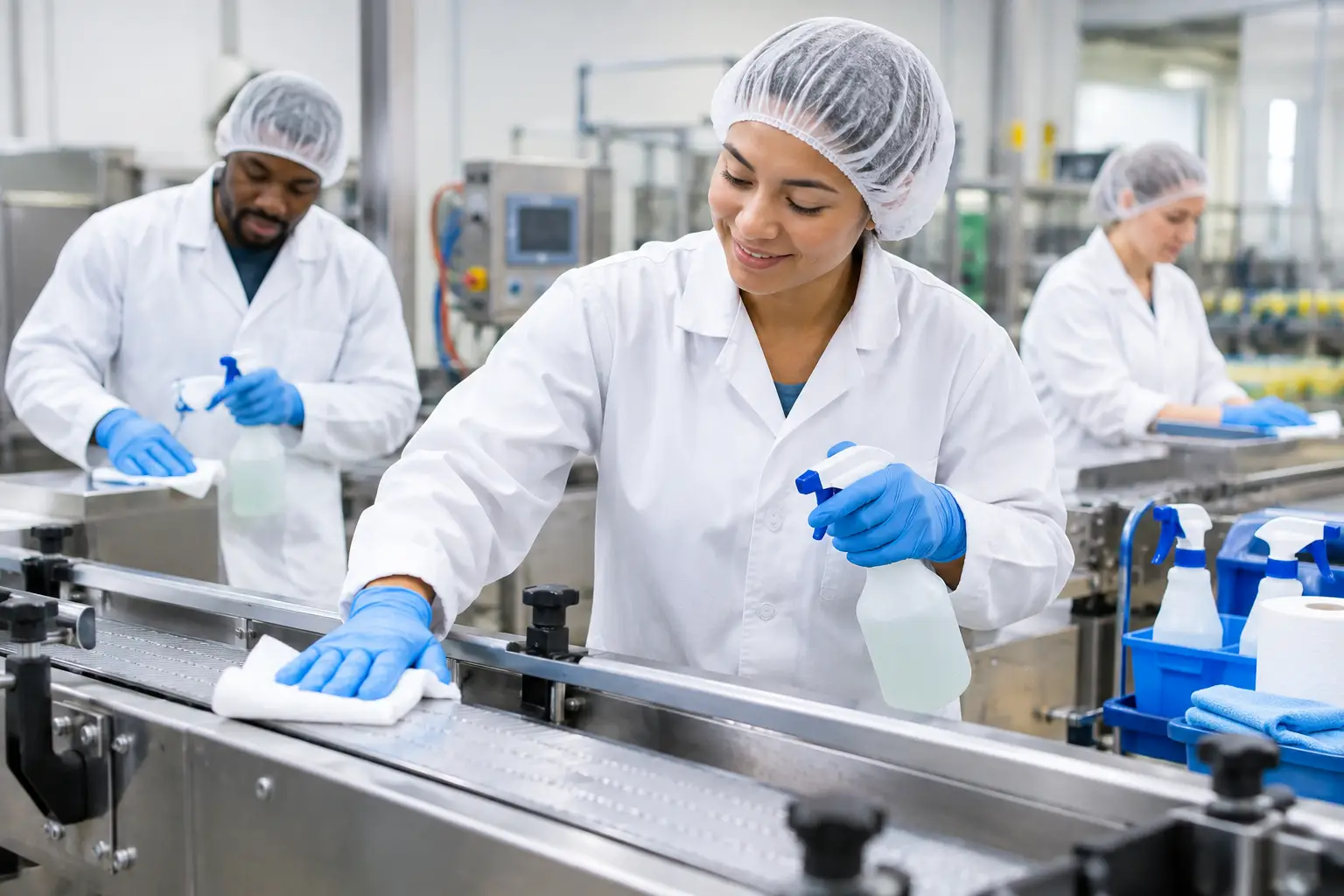
A ready-to-eat food manufacturer may run a pre-operational sanitation program before every production shift. After equipment is disassembled according to the approved procedure, employees remove gross soil, apply the designated cleaner, rinse where required, and apply a food-facility-appropriate sanitizer at the label-specified concentration and contact time. Equipment is allowed to dry or is otherwise handled as directed before startup.
The key control is verification. A sanitation lead inspects product-contact surfaces, difficult-to-reach joints, conveyor undersides, guards, drains, and utensils. The inspection record identifies the line, date, shift, employee, chemicals used, corrective action, and release authorization. Depending on the facility’s risk plan, the program may also include ATP testing, allergen swabs, environmental monitoring, or microbiological sampling.
This model works because it creates a documented decision point before production begins. If the line fails inspection, it is not released until the deficiency is corrected and rechecked. For food operations, sanitation procedures should align with the facility’s hazard analysis, preventive controls, customer specifications, and any applicable regulatory obligations.
2. Metal Fabrication: Degreasing and Slip-Hazard Control
A fabrication plant often needs a sanitation program built around oil, coolant, metal shavings, and accumulated shop dust. A practical approach divides the work into point-of-use cleanup, end-of-shift floor care, and scheduled machine-area detailing.
Operators keep absorbent materials and approved industrial degreasers available for minor spills. At shift end, assigned staff remove shavings using methods appropriate for the material and equipment, clean oily residue from machine exteriors and work surfaces, and address walking paths before conditions become slip hazards. A weekly task may include cleaning around machine bases, guarding, tool storage, and areas where residue can collect unnoticed.
The trade-off is productivity. Taking equipment offline for deep cleaning can affect output, but postponing it can increase safety exposure, degrade equipment condition, and make routine cleaning harder. The best schedules match deep-cleaning intervals to actual soil loads, maintenance windows, and documented inspection findings rather than relying on a calendar alone.
3. Electronics Assembly: Particulate and Residue Control
An electronics assembly facility may prioritize dust control, electrostatic discharge-sensitive areas, and low-residue surface cleaning. In this setting, an aggressive degreaser used in a fabrication bay may be inappropriate near sensitive components, optical equipment, or controlled assembly stations.
A program can establish zone-based practices: receiving and storage areas receive routine floor and rack cleaning; general production areas receive scheduled wipe-downs and dust removal; controlled workstations follow stricter material, cloth, and chemical requirements. Employees should use approved wipes and dispensing methods that minimize lint, residue, and overspray.
Verification is often visual plus operational. Supervisors inspect benches, carts, equipment housings, and floor edges for dust accumulation. If a facility has particulate requirements, it may set defined monitoring methods and response thresholds. Documentation should show that approved materials were used and that any contamination event was contained before it affected work in process.
4. Packaging Operations: Changeover and Allergen Separation
A packaging facility that handles multiple product types may use sanitation as a changeover control. The procedure begins when the previous run ends: remaining materials are removed, waste is cleared, equipment is cleaned from the highest surfaces downward, and the line is inspected before new materials enter the area.
Where allergen-containing products are involved, the sanitation plan should identify dedicated tools, color-coded equipment where appropriate, cleaning sequence, verification expectations, and escalation steps. A visual check alone may not be adequate for every risk level. The facility’s hazard assessment should determine whether additional testing or supervisory release is needed.
This example shows why sanitation documentation must do more than record that a task occurred. It should demonstrate that the correct line was cleaned, the prior product was accounted for, the specified method was followed, and the next run was authorized to begin.
Build Procedures Around the Real Work
Strong sanitation procedures are specific without becoming unusable. A one-page instruction that says clean all equipment leaves too much room for interpretation. A 30-page instruction for a simple task may encourage employees to skip steps. The right level of detail depends on risk, employee experience, equipment complexity, and the consequences of a failure.
At minimum, each procedure should identify the area or asset, required personal protective equipment, approved cleaning tools and chemistry, dilution or application instructions, required contact time when applicable, soil-removal steps, inspection criteria, and recordkeeping expectations. Safety data sheets and technical specifications should be accessible where chemicals are stored and used.
Training should include the reason behind the procedure. Employees are more likely to follow contact times, dilution requirements, and separation practices when they understand how a shortcut can affect worker safety, product integrity, or an audit result. Training records should show who was trained, on which procedure, and when competency was confirmed.
Use Verification and Corrective Action to Make the Program Defensible
A checklist is useful, but a checked box is not proof that sanitation was effective. Verification gives the program credibility. Methods may include supervisor inspection, pre-operational release checks, concentration testing, ATP monitoring, allergen testing, environmental swabbing, or review of chemical usage and sanitation records. The appropriate method depends on the facility and its risk profile.
When a check fails, the corrective action needs to be more than clean it again. The record should identify the failure, immediate containment, recleaning steps, reinspection result, root cause when recurring, and actions taken to prevent repetition. A recurring drain issue, for example, may indicate a scheduling problem, inadequate tools, damaged surfaces, poor traffic control, or a maintenance concern rather than an employee performance issue alone.
Trend reviews are especially valuable for larger facilities. If the same zones, shifts, or equipment repeatedly fail inspection, leadership can direct training, maintenance, staffing, or supply changes where they are needed most. This turns sanitation records into operational intelligence instead of paperwork stored for an audit.
Choose Chemistry With Safety, Performance, and Documentation in Mind
Chemical selection should match the soil, surface, application method, and environmental requirements. A cleaner that performs well on petroleum-based grime may not be suitable for every painted surface, food-contact area, or sensitive production environment. Likewise, a disinfectant must be used according to its label, including dilution, dwell time, and compatible surfaces.
Environmentally responsible chemistry can support safer operations when it still meets the facility’s performance requirements. The decision should be based on technical data, worker exposure considerations, residue concerns, waste handling, and compatibility with the facility’s sanitation standard. Procurement teams should request and retain relevant safety data sheets, technical documents, and certifications needed for their buying and compliance process.
Veteran Commercial Cleaning supports facilities that need institutional-grade cleaning supplies backed by the documentation and procurement readiness required in high-compliance environments. The goal is not to use the harshest option available. It is to use the right controlled solution for the task.
A sanitation program earns trust when it holds up during a busy shift, a customer audit, and a real contamination event. Start with the risks your facility actually faces, make every critical step verifiable, and give employees procedures and materials they can execute correctly every time.