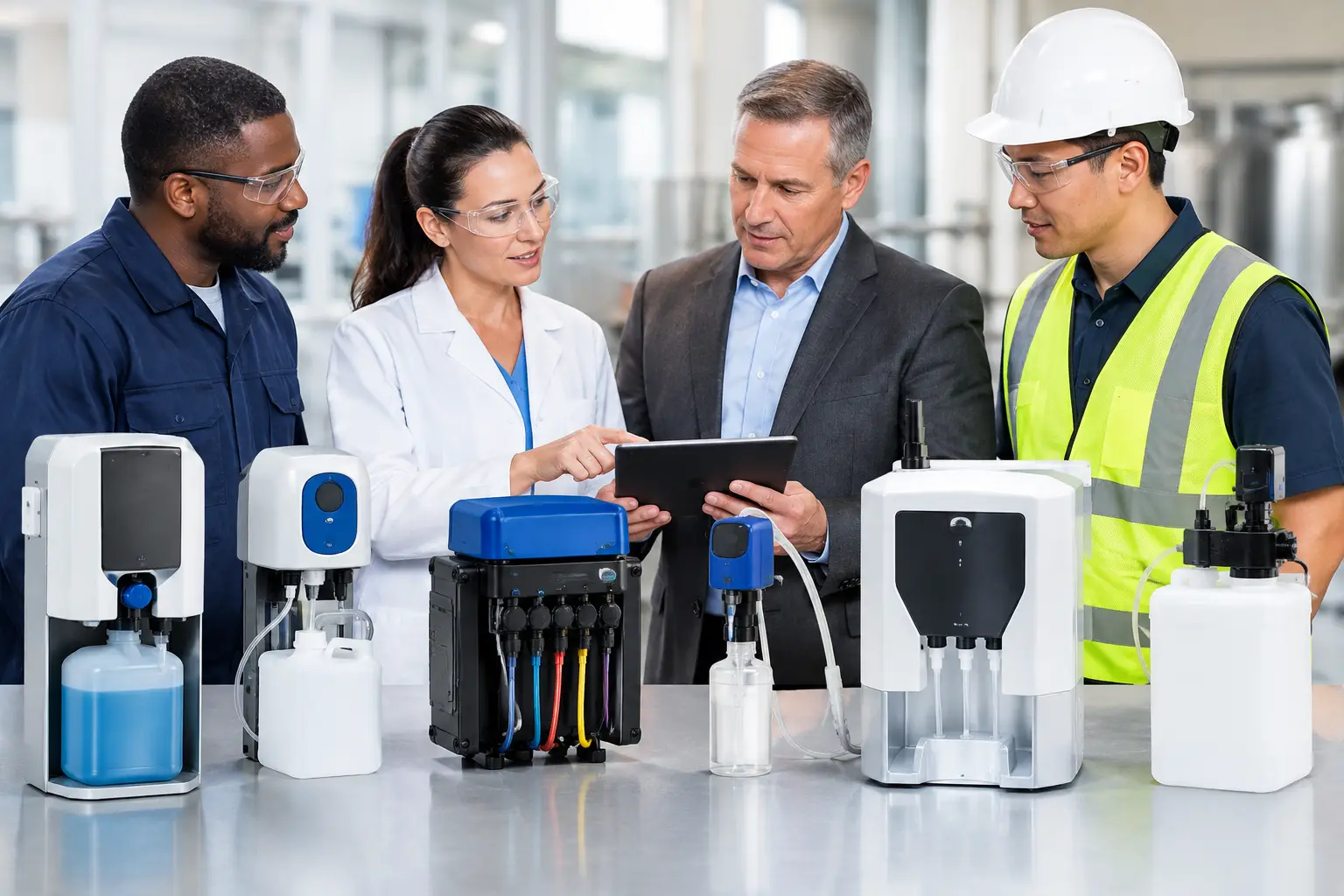
A chemical dispenser comparison should begin at the point where cleaning chemistry meets real operations: the janitorial closet, wash bay, housekeeping cart, or maintenance room. A dispenser that looks efficient on paper can still create waste, inconsistent results, worker exposure, or audit gaps if it does not match the facility’s water supply, chemical program, container format, and training capacity.
Thank you for reading this post, don't forget to subscribe!For healthcare, aviation, manufacturing, government, and other high-accountability environments, the right decision is not simply about choosing the most automated unit. It is about controlling dilution, protecting personnel, supporting documented procedures, and delivering repeatable cleaning performance shift after shift.
Chemical Dispenser Comparison: Start With the Operating Need
Chemical dispensers generally fall into four practical categories: manual proportioning systems, bottle-fill dispensers, bucket-fill dispensers, and closed-loop or cartridge-based dispensing systems. Each can be appropriate, but each solves a different operational problem.
Manual proportioning methods may work in low-volume settings where staff members handle limited chemical types and can reliably follow measured dilution instructions. Their advantage is simplicity. Their weakness is human variation. A small overpour repeated across multiple shifts can increase chemical consumption, leave residue on surfaces, and complicate safety controls.
Bottle-fill dispensers are designed to deliver ready-to-use solution into labeled spray bottles or other small containers. They are often a practical choice for restrooms, offices, patient areas, break rooms, and high-touch surface programs where staff need portable cleaner or disinfectant. The strongest systems prevent cross-connection between products and provide clear identification of the diluted solution.
Bucket-fill dispensers serve mop buckets, autoscrubbers, floor-care equipment, and larger cleaning tasks. In a manufacturing plant or government building, this approach can reduce the time required to prepare floor cleaner, degreaser, or disinfectant solution. However, the fill rate and dilution range must be matched to the equipment and the cleaning procedure. A dispenser that fills quickly but delivers the wrong concentration is not an efficiency gain.
Closed-loop systems use sealed concentrates, cartridges, or dedicated containers that connect directly to a dispenser. They are especially valuable where chemical handling risks, documentation requirements, and training consistency are major concerns. The trade-off is that these systems require disciplined inventory control and compatibility with the selected chemical line.
Dilution Accuracy Is a Performance and Compliance Issue
Cleaning chemicals are formulated to perform within a specified dilution range. Too little concentrate can reduce cleaning power or fail to support the required dwell time and soil removal process. Too much concentrate can create residue, damage sensitive surfaces, increase exposure risk, and consume inventory faster than planned.
A capable dispenser provides a repeatable ratio under normal site conditions. Facilities teams should verify what “normal” means in their building. Water pressure, water temperature, line restrictions, and maintenance condition can affect performance. A unit installed in a stable supply room may operate differently from one added to a remote maintenance area with inconsistent pressure.
For disinfectant programs, dilution control deserves particular attention. The dispenser does not replace the product label or the facility’s infection-control procedure. Staff must still use the correct solution for the intended surface, observe required contact time, and follow all label directions. In healthcare, food-service-adjacent areas, and other regulated settings, those details should be reflected in training and standard operating procedures.
A useful validation process includes checking the dispenser’s output against the manufacturer’s specified ratio during installation, after maintenance, and at a regular interval established by the facility. Keep records when your program requires them. Documentation supports consistency during internal inspections, customer audits, and regulatory reviews.
Evaluate Chemical and Surface Compatibility
Not every dispenser is compatible with every formulation. Concentrated degreasers, disinfectants, neutral cleaners, and specialty products can differ in viscosity, pH, required dilution, and packaging design. The tubing, seals, valves, and connectors inside a dispenser must be suitable for the chemistry being used.
Compatibility also extends beyond the dispenser itself. Consider the surfaces and equipment being cleaned. A diluted product intended for sealed hard surfaces may not be appropriate for aviation interiors, medical devices, food-contact surfaces, painted metal, natural stone, or sensitive electronics. The cleaning program should identify the approved chemistry, dilution method, application equipment, dwell time, and post-cleaning steps for each task.
Environmentally responsible chemistry can be an excellent fit for institutional programs, but it should be evaluated on operational criteria rather than broad claims alone. Look at the product’s intended use, safety documentation, performance requirements, and applicable certifications. A safer formulation still needs to remove the soils present in your facility and support the required sanitation outcome.
Worker Safety Depends on More Than a Locked Cabinet
A dispenser can reduce direct handling of concentrated chemicals, but it does not eliminate safety responsibilities. The equipment should be mounted at an appropriate height, secured to a suitable wall or support, clearly labeled, and located where staff can fill containers without creating slip, splash, or traffic hazards.
Clear identification matters. Every secondary container should carry the required workplace labeling, and staff should be able to distinguish products without guessing. Color-coded components can help, but color should not be the only control. Written labels, pictograms, and task-specific training remain necessary.
Facilities should also review how a dispenser behaves when something goes wrong. Can a worker quickly stop the flow? Is there a risk of backflow into the water supply? Does the system include the appropriate backflow protection for the installation? Are replacement parts and service procedures available? These questions matter most in the moment when a line leaks, a bottle is misplaced, or a new employee is asked to cover an unfamiliar area.
Safety data sheets, technical specifications, and chemical labels should be accessible to supervisors and employees. For institutional buyers, a supplier that can provide complete documentation helps reduce delays in approvals, onboarding, and environmental health and safety review.
Match Capacity to Labor Workflow
The best dispenser is the one employees will use correctly under normal workload. A high-volume airport restroom program needs different capacity and placement than a small office suite. A plant maintenance team addressing oils and heavy soils may need nearby access to a degreaser station, while environmental services personnel may need bottle-fill access close to supply staging areas.
Look at the full route, not just the dispenser location. If staff must walk across a building to refill bottles, they may carry excess containers, improvise dilution, or skip replenishment. If a unit is placed too close to a busy corridor, refill activity can interrupt operations. A properly positioned system reduces unnecessary movement while keeping chemical preparation controlled.
Capacity should also account for peak demand. Shift changes, visitor events, production schedules, weather-related soil loads, and outbreak-response procedures can all increase solution use. It may be more effective to install multiple targeted stations than to rely on one central dispenser that becomes a bottleneck.
Serviceability and Procurement Readiness Matter
A dispenser should be evaluated as an operating asset, not a one-time purchase. Ask who will inspect it, replace wear components, test dilution output, and respond when a unit is out of service. A system with specialized parts may be appropriate for a tightly managed facility, while a simpler design may be more practical for distributed sites with limited maintenance support.
For procurement teams, the review should include the documentation needed to support approval and ongoing use. This may include product labels, safety data sheets, technical specifications, dilution guidance, equipment instructions, and relevant certification information. Government and contract-managed facilities may also need vendor documentation aligned with their purchasing and compliance process.
Standardization can simplify this work. Using a defined dispenser platform and an approved set of compatible chemicals can reduce training burden, make labeling more consistent, and help operations teams maintain reliable inventory. Standardization should not become rigidity, however. A high-soil industrial area may need a different dispensing approach than an administrative office or a clinical support space.
A Practical Evaluation Before Deployment
Before committing to a facility-wide setup, test the dispenser in a representative location. Confirm that it fits the available water connection, delivers the intended ratio, accommodates the containers and equipment staff actually use, and can be maintained by the responsible team. Observe employees preparing solution during a normal shift. Their workflow will reveal issues that are easy to miss in a conference-room review.
Veteran Commercial Cleaning supports institutional buyers with professional-grade chemistry and the documentation-focused approach required in demanding facilities. The objective is not to add complexity to routine cleaning. It is to establish a controlled process that protects people, surfaces, and operational standards.
The right dispenser choice is the one that makes correct chemical use the easiest option for the person doing the work. When dilution, labeling, placement, and documentation all support that outcome, the cleaning program becomes more dependable where it counts: on the floor, on every shift, and under inspection.