A floor can look clean under overhead lighting and still create a slip risk, spread tracked contaminants, or interfere with sanitation. The question of when should floors be degreased is not answered by a calendar alone. It depends on what reaches the floor, how often people and equipment move across it, and whether the facility has controls that reveal buildup before it becomes an incident.
Thank you for reading this post, don't forget to subscribe!For facilities managers, environmental services teams, and operations leaders, degreasing should be a defined maintenance decision. The goal is to remove accumulated oils, fats, lubricants, and greasy residues without damaging the substrate, creating excess runoff, or disrupting operations. A documented program also gives supervisors a defensible basis for assigning labor, selecting chemistry, and verifying completion.
When Should Floors Be Degreased?
Floors should be degreased whenever oily soil is no longer being removed through routine cleaning, or when the type of soil present creates a safety, sanitation, or production concern. In high-soil areas, that may mean daily attention. In lower-exposure spaces, it may mean scheduled deep cleaning after inspections identify a change in surface condition.
The most reliable trigger is a combination of visible evidence and operational risk. A dull, darkened traffic lane may be cosmetic in one office corridor but a serious warning in a food-adjacent work area, loading zone, maintenance bay, or healthcare support space. Facility teams should consider degreasing when they observe any of the following conditions:
- Floors feel tacky, slick, or unusually slippery after standard mopping.
- Water beads on the surface instead of spreading evenly, suggesting an oily film.
- Blackened grout lines, floor edges, drains, and equipment perimeters hold stubborn residue.
- Tire paths, wheel marks, or footprints quickly reappear after routine cleaning.
- Odors persist near grease-generating processes, waste areas, kitchens, or mechanical equipment.
- Slip incidents, near misses, or failed housekeeping inspections point to surface contamination.
These signals should not be treated as a reason to simply apply more general-purpose cleaner. A neutral cleaner is often appropriate for daily soil, but it may not have the chemistry or dwell time needed to lift heavy petroleum-based lubricants, cooking oils, animal fats, or manufacturing residues. Repeatedly mopping an oily floor with the wrong product can redistribute the soil and leave a hazardous film behind.
Degreasing Is Not the Same as Routine Mopping
Routine mopping removes loose dirt and water-soluble contamination. Degreasing addresses hydrophobic soils that cling to flooring, grout, textured surfaces, and low points around machinery. The distinction matters because heavy grease can trap dirt, reduce traction, and make a floor appear permanently stained even when it receives regular service.
A floor may need degreasing before disinfection as well. Disinfectants are designed for use on pre-cleaned surfaces and are not a substitute for removing heavy soil. Where a facility requires both processes, teams should first remove the grease and residue, rinse or recover soil as required by the product procedure, then apply the disinfectant according to its labeled contact time.
Set Frequency by Exposure, Not Guesswork
A fixed facility-wide schedule is easy to manage, but it can waste labor in low-risk areas while under-serving high-risk zones. A better approach assigns frequency by soil load, traffic, flooring type, and the consequence of a slippery or contaminated surface.
In commercial kitchens, food preparation support areas, vehicle maintenance spaces, manufacturing lines using lubricants, and loading docks exposed to hydraulic fluids, degreasing may be needed daily or several times each week. These locations should be inspected as part of the regular shift or closing routine. Floors around fryers, cook lines, waste stations, machining equipment, and charging areas often require more attention than the main walkways nearby.
Moderate-use spaces, such as warehouse aisles, break rooms, receiving areas, and shared maintenance corridors, may need weekly or biweekly degreasing. The correct interval depends on how quickly residues return after cleaning. If a floor remains clean and maintains traction through the full interval, the program is likely adequate. If it becomes slick or discolored early, either the frequency, product selection, application method, or source control needs to change.
Offices, lobbies, classrooms, and administrative areas may only require periodic spot degreasing unless they receive tracked-in oils from shop areas, garages, or exterior entrances. Applying strong degreasing chemistry where it is not needed can increase cost, create unnecessary chemical exposure, and affect some floor finishes. The right standard is targeted performance, not maximum chemical strength.
Account for the Floor Material and Finish
Concrete, sealed concrete, quarry tile, ceramic tile, epoxy, vinyl composition tile, rubber flooring, and coated surfaces do not all respond the same way to degreasers. Alkaline chemistry may be effective against heavy oil but can be inappropriate for certain finishes, coatings, or sensitive surfaces. Porous concrete can retain oils beneath the surface, while textured tile and grout may require mechanical agitation to release soil.
Before expanding a degreasing procedure, review the flooring manufacturer guidance, the product technical data, and the Safety Data Sheet. Conduct a small compatibility test in an inconspicuous area when the surface, finish, or prior cleaning history is uncertain. This is especially important in healthcare, aviation, government, and military facilities, where flooring replacement, slip resistance, and documentation requirements can carry significant operational consequences.
Use a Controlled Degreasing Process
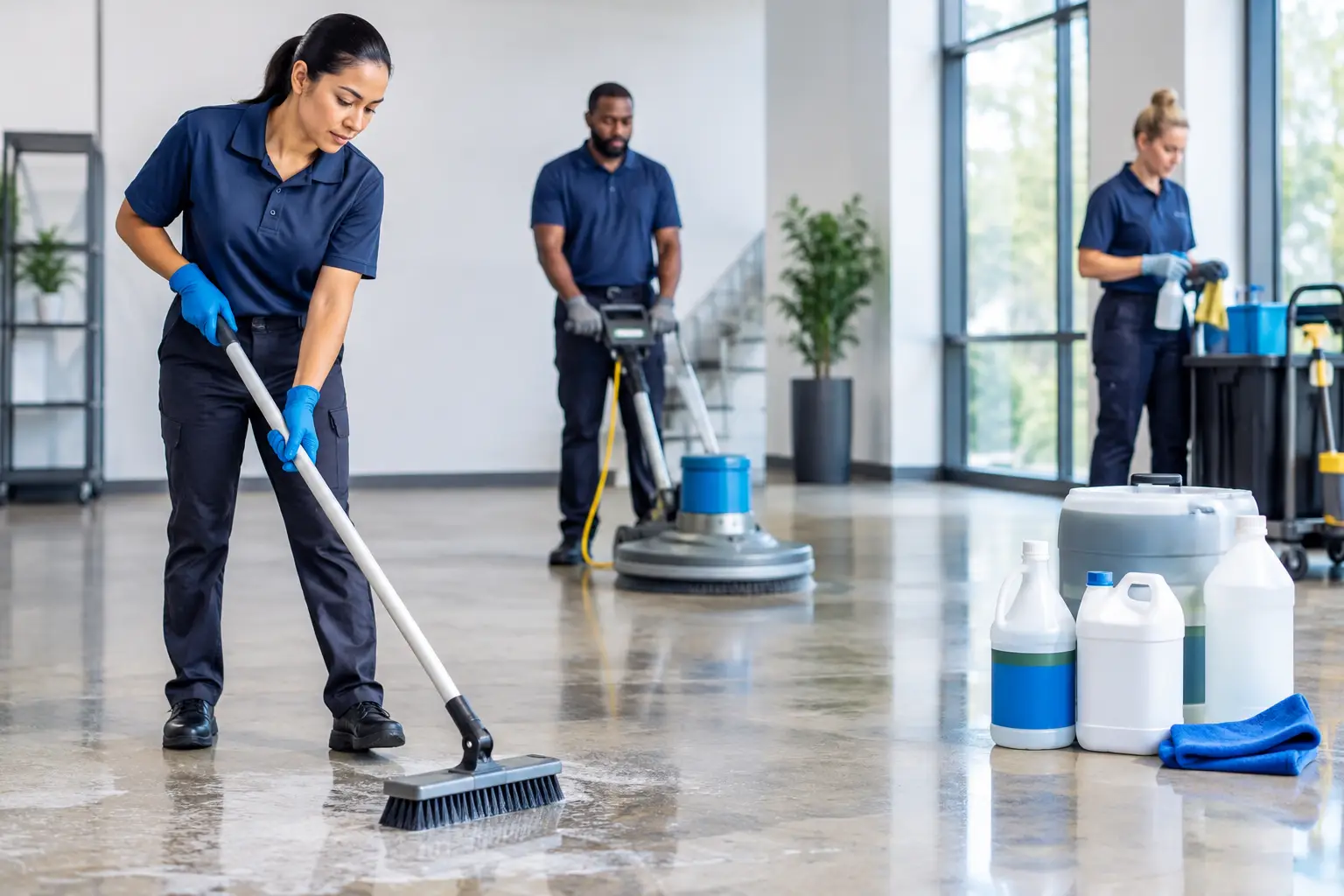
Effective degreasing is a process, not a quick spray-and-mop task. First, control the area. Post wet-floor signage, redirect traffic where possible, and protect nearby drains, equipment, and sensitive materials according to site procedures. Dry-remove loose debris before applying any solution so the product can contact the greasy soil directly.
Apply the selected commercial degreaser at the correct dilution and allow the label-specified dwell time. This contact period is where the chemistry begins to break up oily residue. Do not let the solution dry on the floor, and do not assume that a stronger mix will work better. Over-concentration can leave residue, affect finishes, and create avoidable handling concerns.
Agitation is often the difference between a floor that looks better and a floor that is actually clean. Use an appropriate brush, pad, auto scrubber, or other approved equipment to work the solution into textured surfaces, grout, and traffic lanes. Recover the dirty solution rather than spreading it into adjacent areas. Rinse when required by the product procedure, then allow the floor to dry fully before reopening it.
After drying, inspect the surface under normal lighting and at a low angle, where films and streaking are easier to see. Check high-risk edges, corners, and drain approaches. If the floor still feels slick, shows water beading, or transfers residue to a clean towel, it needs further cleaning or a review of the underlying contamination source.
Look Upstream When Grease Returns Too Quickly
A floor that needs constant emergency degreasing may be signaling a process problem rather than a cleaning failure. Leaking equipment, poorly positioned absorbent mats, overloaded waste containers, improper oil handling, and inadequate entryway controls can overwhelm even a well-run cleaning program.
Maintenance and cleaning teams should share observations. For example, recurring oil around a compressor may indicate a seal issue. Greasy tire tracks in a warehouse may show that forklifts are passing through a contaminated area before entering pedestrian zones. In a food operation, buildup around a cook line may point to splash patterns, incomplete end-of-shift cleaning, or equipment that is difficult to access.
Correcting the source reduces chemical use, protects floor life, and lowers the risk of falls. It also helps facilities reserve intensive degreasing for the places where it produces a measurable safety and sanitation benefit.
Document the Work in High-Compliance Facilities
In regulated or high-accountability environments, a clean floor is not enough. The facility may need to show that staff followed an established procedure using approved products and appropriate safety controls. A practical record can include the area serviced, date and time, technician or crew, product used, dilution, equipment, observed condition, corrective actions, and supervisor verification where required.
Documentation supports consistency across shifts and vendors. It can also help identify patterns: one area may require a revised cleaning frequency, while another may need maintenance intervention. Keep product Safety Data Sheets and technical specifications accessible to the personnel responsible for use, training, and incident response.
Veteran Commercial Cleaning supports facility teams that need institutional-grade cleaning chemistry and a disciplined approach to documentation, safety, and performance. The strongest programs pair appropriate products with clear procedures and inspection standards rather than relying on a one-size-fits-all cleaning schedule.
A floor should be degreased before its condition becomes someone else’s problem – a slip, a failed inspection, a sanitation concern, or an avoidable production interruption. Build inspection into normal operations, respond to the actual soil load, and treat recurring residue as a signal worth investigating.