A leaking drum, overturned container, or damaged battery can turn a routine shift into a safety event within minutes. Spill response kits give personnel the materials needed to isolate, contain, absorb, and manage a release before it spreads into walkways, drains, equipment areas, or occupied spaces. For facilities with compliance obligations, the kit itself is only part of the solution. Placement, training, inspection, and documentation determine whether it performs when conditions are not controlled.
Thank you for reading this post, don't forget to subscribe!Why Spill Response Kits Matter in Critical Facilities
Spills create more than a housekeeping problem. In manufacturing, aviation, healthcare, government, and military environments, an unmanaged release can expose employees, interrupt production, damage surfaces, create slip hazards, and complicate regulatory reporting. The response must protect people first while limiting the environmental and operational effects of the material released.
A properly selected spill kit supports a faster initial response. It places absorbents, containment materials, personal protective equipment, disposal supplies, and clear instructions close to the hazard. That reduces the time spent searching for supplies while a liquid moves across a floor or toward a drain.
Speed matters, but speed without control can make an incident worse. Personnel should understand the boundaries of their role: when they can safely handle a minor spill using available equipment, and when they must secure the area and escalate to trained emergency responders. A spill kit is not a substitute for an emergency action plan, hazard communication program, or site-specific safety procedures.
Selecting Spill Response Kits by Hazard
The correct kit depends on the materials present, the volume that could reasonably be released, the facility layout, and the level of training available to employees. A general-purpose kit may be appropriate for water-based liquids, coolants, and many non-aggressive maintenance fluids. It may not be appropriate for acids, caustics, solvents, fuels, oils, or unknown substances.
Universal and General-Purpose Kits
Universal kits are designed for common non-hazardous or lower-risk workplace liquids. Their absorbents often handle water-based fluids, hydraulic fluids, oils, and other routine maintenance releases. These kits can be useful near maintenance rooms, receiving areas, janitorial closets, loading zones, and equipment locations where the hazard profile is mixed but well understood.
Facility teams should still review compatibility before relying on a universal kit. The word “universal” does not mean every chemical can be handled safely with the same absorbent or protective equipment. The safety data sheet for the material remains the primary reference for spill response requirements.
Oil-Only Kits
Oil-only absorbents are intended for petroleum-based fluids and are commonly used in transportation, aviation, fleet maintenance, industrial service areas, and outdoor locations. Their water-repellent properties can make them appropriate where oil must be recovered from wet surfaces or standing water.
Oil-only materials should not be treated as a catch-all solution for chemicals. Fuel, lubricants, hydraulic oils, and certain petroleum products may require different protective measures, fire precautions, or disposal procedures depending on the material and quantity involved.
Chemical Spill Kits
Chemical kits are designed for corrosives and other hazardous chemical releases. They typically use absorbents and containment supplies selected for broader chemical compatibility, but they still require verification against the specific substances on site. Acid and base neutralizers may also be used in certain programs, provided personnel are trained on their limits and the facility has evaluated the reaction risks.
For laboratories, healthcare environments, industrial processing areas, and chemical storage locations, the kit should align with the chemicals actually stored or used there. A generic chemical kit is not sufficient planning for highly reactive materials, large-volume releases, or substances requiring specialized response capabilities.
What a Functional Kit Should Include
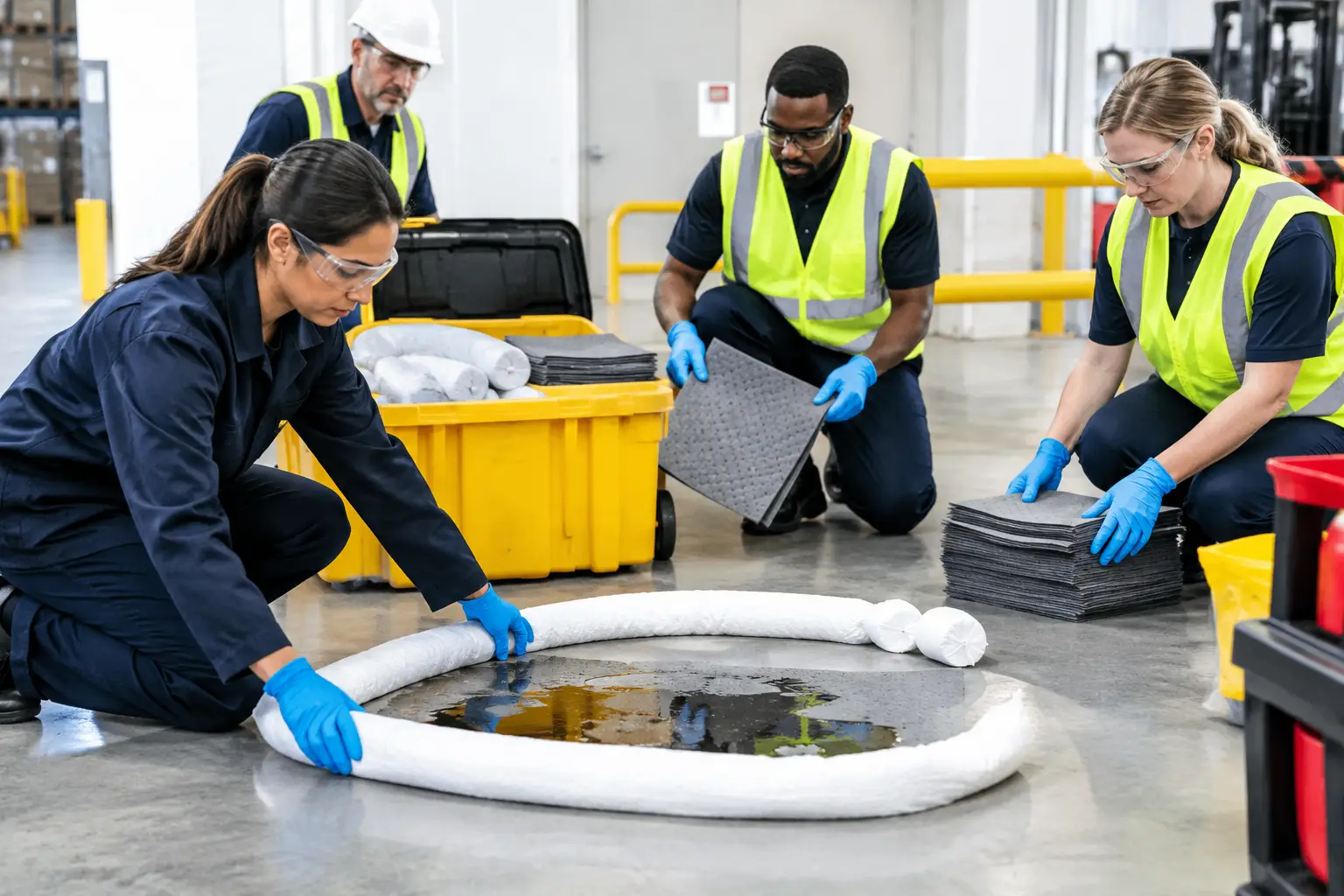
A spill kit should be designed to help personnel control a release in a deliberate sequence: protect themselves, stop or isolate the source where safe, contain the liquid, absorb it, collect used material, and secure the waste for proper disposal. The contents should support that sequence without requiring employees to improvise.
Most workplace kits include a practical combination of the following materials:
- Absorbent pads, socks, pillows, or loose absorbent for controlling and recovering liquid
- Temporary containment materials for blocking drains, doorways, or travel paths
- Appropriate gloves, eye protection, and other personal protective equipment based on the site hazard assessment
- Disposal bags, ties, labels, and tools such as scoops or scrapers for collecting used absorbents
- Response instructions and inventory information that staff can follow under pressure
The container matters as well. A portable bag or small cabinet may work for a localized hazard, while a wheeled unit may be more suitable for larger facilities, loading areas, or locations with higher potential release volumes. Storage should protect contents from moisture, weather, and unauthorized use while keeping the kit immediately accessible.
Placement Is a Risk-Control Decision
A kit stored in a central supply room may look organized, but it is of limited value if a release occurs on the other side of a large facility. Place spill response supplies near credible sources of release, not simply where storage is convenient.
High-priority locations often include chemical storage areas, maintenance shops, fueling or fleet areas, loading docks, waste accumulation points, battery charging areas, laboratories, and areas near floor drains. Each location should be evaluated for the type of liquid, the likely spill volume, nearby drains or sensitive equipment, pedestrian traffic, and access restrictions.
For larger sites, clearly marking kit locations on facility maps can support a coordinated response. Signs should be visible enough that new employees, contractors, and shift personnel can identify supplies without delay. In government and institutional settings, this supports continuity when staffing changes or multiple teams share the same building.
Inspection, Training, and Documentation
A sealed kit is not necessarily a ready kit. Supplies can be removed for minor cleanup, damaged by moisture, misplaced, or rendered unsuitable after a facility changes the chemicals it uses. Routine inspections should verify that the kit is present, accessible, labeled, complete, and appropriate for current hazards.
Inspection frequency depends on the environment. A low-risk office or administrative area may require less frequent review than a manufacturing line, maintenance bay, or chemical handling area. When a kit is used, it should be replenished promptly and the incident should be reviewed for lessons about placement, capacity, or training needs.
Training should cover more than opening the container. Employees need to know how to identify the material involved, consult the safety data sheet, establish a safe perimeter, use the required protective equipment, protect drains where appropriate, and report the incident through the facility’s established process. They also need clear guidance on when not to respond.
Documentation supports both safety and procurement discipline. Keep records of kit inspections, replenishment, employee training, relevant safety data sheets, and incident reports. For regulated facilities, those records can demonstrate that spill preparedness is managed as an operational control rather than treated as a one-time purchase.
Common Gaps That Undermine Readiness
The most frequent failure is buying a kit without matching it to the facility’s hazards. Another is placing one kit in a building where several distinct risk areas need separate coverage. Teams also underestimate disposal requirements. Used absorbents and contaminated protective equipment may need to be handled according to the characteristics of the spilled material, not simply placed in ordinary trash.
Overreliance on labels is another concern. A kit labeled for chemicals may still require a compatibility check, and employees should never assume that available supplies make every spill safe to handle. Unknown liquids, strong odors, fumes, fires, significant quantities, injuries, or releases reaching drains are clear reasons to isolate the area and follow escalation procedures.
Environmentally responsible facility practices also require careful distinction between prevention and disposal. Safer cleaning chemistry can reduce unnecessary chemical burden in many routine operations, but it does not eliminate the need for a disciplined response plan when a release occurs. The goal is to prevent contamination at the source and manage any incident with the least practical risk to people and the environment.
A well-maintained spill kit sends a clear operational message: the facility is prepared to act before a small release becomes a larger interruption. Review your highest-risk areas, verify that each kit matches the materials present, and make readiness a routine part of facility management rather than an item discovered during an incident.