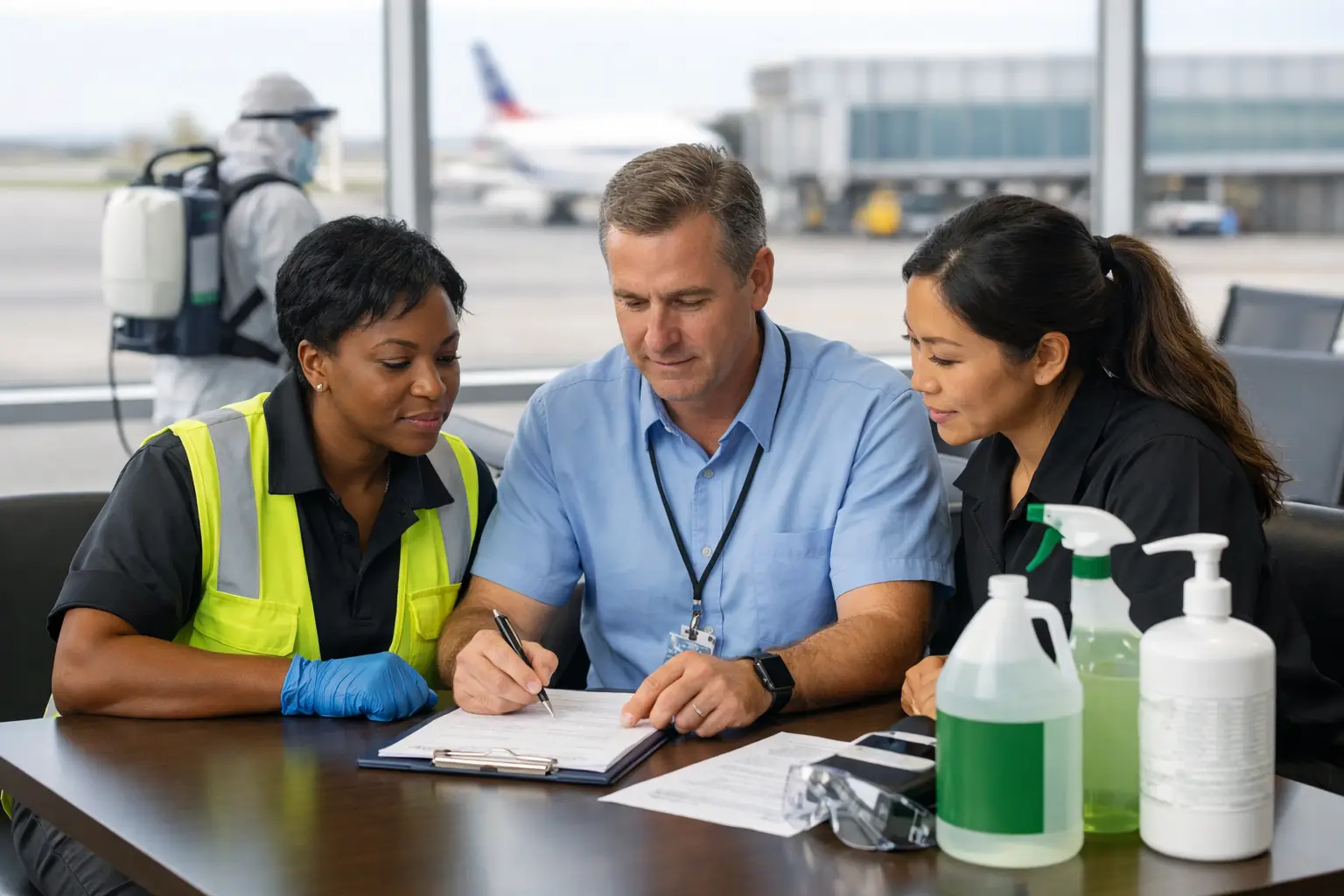
A disinfectant can perform exactly as intended and still create a compliance problem if the airport cannot prove what it was, how it was used, and whether staff followed the label. Airport disinfectant documentation requirements are therefore more than a purchasing file. They are the evidence chain connecting product selection, worker safety, cleaning performance, and operational accountability.
Thank you for reading this post, don't forget to subscribe!For airport authorities, terminal operators, contractors, fixed-base operators, and tenant facilities, documentation must stand up to routine internal reviews as well as customer complaints, incident investigations, inspections, and procurement audits. The goal is not to create paperwork for its own sake. It is to ensure the right chemistry is used in the right place, by trained personnel, under the conditions required for it to work.
What airport disinfectant documentation requirements cover
Airport environments combine high passenger volume, diverse surface materials, round-the-clock operations, food service areas, restrooms, baggage operations, offices, maintenance spaces, and secure zones. A single disinfectant program may need to support several use cases, but every use must remain within the product label directions.
The core documentation package usually begins with the product label and the manufacturer’s Safety Data Sheet, commonly called an SDS. These records serve different purposes. The label establishes the legal directions for use, including target organisms, dilution instructions, contact time, approved surfaces, precautionary language, and applicable use sites. The SDS supports workplace hazard communication by identifying hazards, personal protective equipment, first-aid measures, storage conditions, spill response, and transport information.
A technical data sheet is also valuable, even though it does not replace the label or SDS. It can help facilities teams verify dilution ratios, surface compatibility, application methods, fragrance or dye characteristics, packaging information, and performance details relevant to a specific cleaning program. Procurement teams should retain the version supplied with the product rather than relying on an undated sales description.
For disinfectants sold or distributed in the United States, an EPA registration number is a central verification point when the product makes pesticidal or antimicrobial claims. The registration number should be documented against the exact product being purchased, not assumed from a similar name or related product line. If a product is used during a disease-specific response, facilities should also verify that its labeled claims and any applicable EPA list placement align with the intended use.
The label is the operating instruction
A frequent documentation failure occurs when a facility records that an area was “disinfected” without recording enough information to show that disinfection actually occurred. Spraying a product and immediately wiping it dry may be acceptable for a cleaning task, but it may not satisfy the stated contact time required for disinfection.
The label should be translated into a practical standard operating procedure. That procedure should identify the approved product, required dilution, application method, minimum wet contact time, surfaces or areas covered, required PPE, ventilation considerations, and any rinse requirement for food-contact surfaces. It should also state what staff should do when conditions make the labeled process impractical, such as a heavily soiled surface, a sensitive electronic device, or an occupied gate area that cannot remain wet for the required time.
A procedure cannot expand a label claim. If the label does not authorize a use, the facility should not represent the product as approved for that use. This is especially relevant in aircraft-adjacent operations, food service locations, and areas with specialized materials. Airport teams should confirm any additional requirements established by aircraft operators, airport authorities, tenant agreements, or equipment manufacturers.
Records that make a disinfectant program audit-ready
The strongest programs organize documents by product, location, and task. A centralized digital file is often practical, but controlled paper binders can work where staff need immediate access in custodial closets, maintenance rooms, and remote operational areas. What matters is currency, accessibility, and consistency.
A complete airport disinfectant file commonly includes:
- The current EPA-registered product label, where applicable, and the current SDS
- Technical data sheets, dilution instructions, and surface-compatibility information
- Product approval records, purchasing specifications, and lot or batch information when required by the facility
- Written cleaning and disinfection procedures tied to specific spaces and tasks
- Staff training records, including label comprehension, dilution, PPE, contact time, and spill response
- Cleaning logs, inspection records, corrective actions, and incident documentation
Cleaning logs should be useful operational records, not vague check-the-box forms. At a minimum, they should identify the area serviced, date and time, task completed, product used, and employee or contractor responsible. Higher-risk or high-visibility areas may justify additional detail, such as dilution verification, supervisor inspection, re-cleaning activity, or a documented reason for deviation from the normal schedule.
The appropriate level of detail depends on the airport’s risk profile. A public restroom in a major terminal, a medical response room, a baggage maintenance area, and an administrative office do not necessarily require identical frequencies or records. However, each should have a documented rationale that aligns the cleaning schedule and product choice with traffic, soil load, exposure risk, and operational requirements.
Training records protect people and performance
An SDS in a shared drive does not demonstrate that an employee knows how to use the product safely. Training records should show that staff received instruction before use and that the instruction addressed the actual products and tasks they perform.
For concentrated disinfectants, training should cover dilution-control equipment, measuring methods, container labeling, chemical segregation, and what to do if a dilution error occurs. Ready-to-use products reduce some mixing risks, but they still require training on contact time, PPE, safe application around passengers, and the difference between cleaning and disinfecting.
Contracted cleaning teams require the same discipline. Airport management should define who owns the documentation, how often records are submitted, who reviews them, and how missing or incomplete records are corrected. A contractor’s general safety manual is not a substitute for product-specific records and location-specific procedures.
Common gaps in airport disinfection records
The first gap is outdated paperwork. Manufacturers may update labels, SDS documents, packaging, or instructions. A facility should establish a review cadence and replace obsolete documents promptly, particularly after a product substitution, new contract award, or procedural change.
The second is a mismatch between the product on the shelf and the product named in the procedure. This often happens when purchasing substitutes an item because of availability or packaging changes. Before a substitute enters service, the facility should verify its label, SDS, dilution method, contact time, and approved use conditions. Similar chemistry does not automatically mean identical compliance requirements.
The third is incomplete evidence of dilution and contact time. A disinfectant concentrate may be properly approved, but the program can fail if staff cannot demonstrate that it was mixed correctly or kept wet for the labeled duration. Closed-loop dispensing systems, labeled secondary containers, timed procedures, and supervisor observations can reduce this risk.
The fourth is treating environmental responsibility and institutional performance as competing priorities. They do not have to be. Facilities can evaluate environmentally responsible chemistry while still requiring documented efficacy, safety information, appropriate registrations, and clear use instructions. The right selection depends on the task, the surfaces, indoor-air considerations, worker exposure, and the operational standard the airport must meet.
Build documentation into procurement, not after delivery
Documentation is easiest to control before a product reaches a janitorial closet. Procurement specifications should state the documents required for evaluation and acceptance, including current SDS documents, labels, technical specifications, applicable regulatory information, and any facility-specific compatibility requirements.
This approach helps prevent last-minute substitutions and gives operations teams time to update procedures and training. It also creates a defensible record showing that the airport evaluated the product for the intended use rather than selecting solely on convenience.
Veteran Commercial Cleaning supports high-compliance buyers with professional-grade cleaning documentation designed to support safer procurement decisions, practical facility use, and institutional accountability. For airport operations, the most effective program is the one staff can follow under pressure and management can verify without guesswork.
A well-organized documentation file will not clean a terminal by itself. It does, however, give every shift a clear standard to follow and gives airport leadership the evidence needed to defend that standard when it matters most.