A terminal floor can look clean at 6:00 a.m. and become a slip, sanitation, and brand-risk concern by noon. US airport floor cleaners operate in one of the most demanding facility environments: constant foot traffic, rolling luggage, food and beverage spills, weatherborne soil, deicing residues, and cleaning windows that rarely stop passenger movement.
Thank you for reading this post, don't forget to subscribe!For airport facilities leaders, the question is not simply whether a floor cleaner removes visible dirt. The right program must preserve flooring, support safe walking conditions, reduce odor and residue, fit existing equipment, and stand up to documentation requirements. Performance has to be repeatable across concourses, restrooms, baggage areas, employee corridors, and public entryways.
Why airport flooring requires a different standard
Airports are active transportation hubs, not conventional office buildings. A cleaning process that works well in a low-traffic lobby may fail quickly in a terminal where thousands of travelers track in moisture, grit, road salt, oils, and debris every day. The floor is also a highly visible part of the passenger experience. Scuffed tile, sticky patches, dull finishes, and dirty grout create an immediate perception of poor facility control.
The safety stakes are higher as well. Wet floors near entrances, gates, restrooms, and concession areas can create slip hazards. At the same time, overly aggressive chemistry can damage coatings, leave a slick residue, discolor surfaces, or accelerate wear. The operational target is a clean, dry, stable walking surface that can be maintained throughout the shift without creating new risks.
Airport flooring is rarely uniform. A single facility may include terrazzo, vinyl composition tile, polished concrete, ceramic tile, carpet tile, rubber flooring, epoxy-coated service areas, and natural stone. Each surface has different soil-retention patterns and tolerance for pH, agitation, moisture, and finish maintenance. A one-size-fits-all chemical choice is usually a poor procurement decision.
What US airport floor cleaners must accomplish
The most effective US airport floor cleaners are part of a system, not a stand-alone purchase. That system begins with identifying the soil load and flooring material, then matching chemistry, dilution, equipment, labor practices, and inspection requirements to the area being maintained.
In public-facing zones, daily cleaning should remove tracked-in soil before it becomes abrasive. Fine grit acts like sandpaper under shoes and rolling bags, shortening the life of finishes and creating a worn appearance. Entrance mats, frequent spot response, dry debris removal, and controlled wet cleaning work together to reduce that damage.
In food-adjacent locations, the challenge changes. Oils, sugars, drink syrups, and organic debris can leave tacky or slippery films that plain water will not reliably remove. Chemistry must be selected for the type of residue while remaining appropriate for the floor and the surrounding operating environment. Teams should avoid assuming that a stronger formula is automatically better. The best option is the one that cleans effectively at the approved dilution, rinses or dries as required, and does not compromise surface safety.
Back-of-house areas bring another level of complexity. Baggage handling zones, maintenance corridors, loading areas, and employee entrances may see heavier soil, equipment marks, and localized grease. These conditions often require more targeted cleaning procedures than passenger areas. Separating public-area routines from service-area routines improves both results and chemical control.
Appearance and safety are connected
Floor appearance is often treated as an aesthetic issue, but it has a direct operational impact. A dull, scuffed floor makes spills harder to see. A dirty entrance can obscure moisture conditions. Residue left behind by improper cleaning may make a surface look hazy while also affecting traction.
Facilities teams should evaluate cleaning outcomes using more than visual brightness. Inspection should include dry time, residue, odor, slip-risk indicators, finish condition, edge and grout-line cleanliness, and recurring trouble spots. A floor that looks acceptable immediately after cleaning but becomes sticky after traffic is not performing as intended.
Build cleaning zones around traffic and risk
A disciplined airport floor program divides the facility into zones with distinct service frequencies and methods. Passenger entrances and security-adjacent circulation paths usually need continuous attention during peak traffic. Restrooms and concession corridors require rapid spill response and more frequent inspection. Gate areas may need planned service between flight activity, while administrative spaces can often follow a different schedule.
This zoning approach helps managers allocate labor where it matters most. It also prevents overcleaning low-risk areas while high-risk locations fall behind. The schedule should change with the season, weather, passenger volume, construction activity, and special events. A winter storm response plan, for example, should account for increased moisture, salt, grit, and mat saturation at every public entrance.
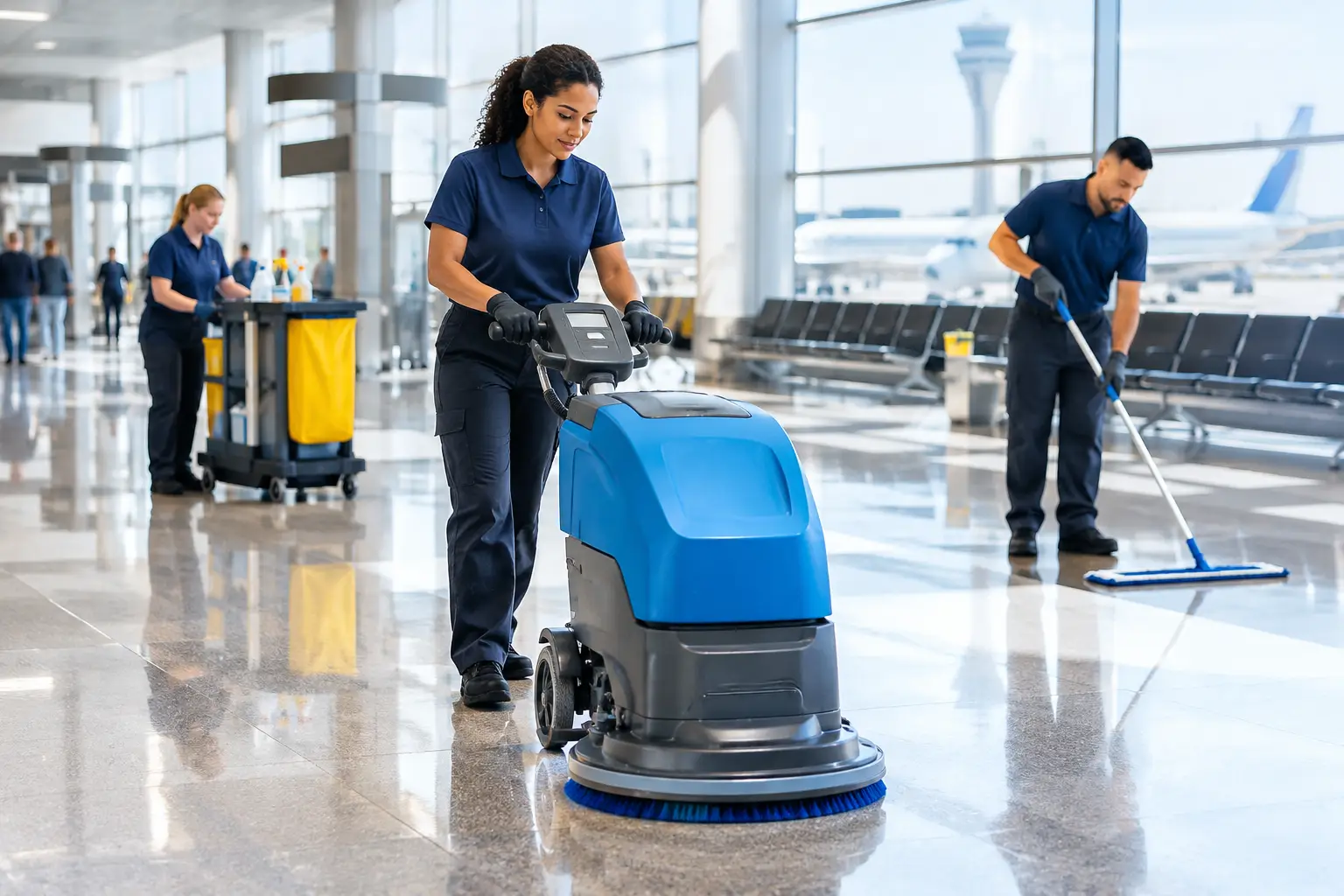
Equipment selection should follow the zone as well. Large open concourses may benefit from mechanized cleaning where operations allow it, while tight gate areas and restroom entrances often require smaller tools and fast spot-cleaning response. Equipment must be maintained carefully. Dirty pads, worn squeegees, clogged recovery systems, and incorrect solution flow can leave floors wetter and dirtier than expected.
Documentation matters as much as chemistry
Airport cleaning procurement is not only about performance claims. Contracting teams and facility managers need documentation that supports safe and consistent use. Safety Data Sheets, technical data, dilution guidance, surface compatibility information, training requirements, and applicable certifications should be available before a product enters the program.
Clear documentation helps standardize cleaning across shifts and contractors. It also gives supervisors a reference point when investigating damage, recurring residue, employee exposure concerns, or service failures. If a chemical is used at the wrong dilution or on an incompatible surface, the resulting repair cost can far exceed the savings from a lower-cost supply decision.
Environmentally responsible chemistry deserves the same level of scrutiny. A safer formulation is valuable when it also meets the operational demands of the facility. Procurement teams should seek documented performance, practical handling requirements, and a realistic fit with their equipment and soil conditions. Environmental considerations should strengthen the cleaning program, not become an unsupported label.
Training protects floors and people
Even well-selected supplies can fail when teams lack clear procedures. Staff need to understand which cleaner belongs in each zone, how to dilute it, how long it should remain on the surface when applicable, and when a floor should be rinsed, extracted, or allowed to dry before reopening.
Training should also cover signage, spill isolation, equipment checks, and escalation procedures for unusual contamination. A small spill in a terminal can become a larger incident if it is handled slowly or with the wrong method. Consistent training reduces variation between shifts and gives supervisors measurable standards for quality assurance.
Common mistakes that undermine airport floor care
One frequent mistake is using a single chemical and method across every surface. This may simplify inventory, but it can increase residue, damage finishes, and leave heavy-soil zones inadequately cleaned. Another is treating floors only after they look visibly dirty. By then, soil may already be embedded, abrasive, or difficult to remove without more labor and stronger intervention.
Facilities also lose ground when they focus solely on scheduled cleaning and underinvest in immediate spot response. Passenger-facing floors are judged continuously. A spill left unattended for even a short period can affect safety, disrupt traffic, and undermine confidence in the facility.
Finally, documentation should not sit apart from operations. If the approved cleaning procedure is impractical for the equipment, staffing level, or traffic pattern, teams will develop workarounds. A strong program is one employees can execute correctly during the busiest part of the day.
A procurement approach built for long-term control
When evaluating airport floor cleaning solutions, start with a site assessment rather than a catalog. Identify surfaces, traffic patterns, recurring soils, current equipment, labor constraints, and compliance needs. Then establish a limited, clearly documented set of compatible cleaning procedures that staff can follow consistently.
Veteran Commercial Cleaning supports institutional buyers with professional-grade cleaning solutions and the documentation-minded approach critical facilities require. For airport teams, the objective is not harsh chemistry for its own sake. It is controlled performance: clean floors, safer pathways, protected surfaces, and a program that holds up under daily operational pressure.
The most dependable floor care plan is the one that treats every terminal surface as an operational asset. When chemistry, training, equipment, and inspection are aligned, cleaner floors become easier to maintain – even when the next wave of passengers is already walking through the door.