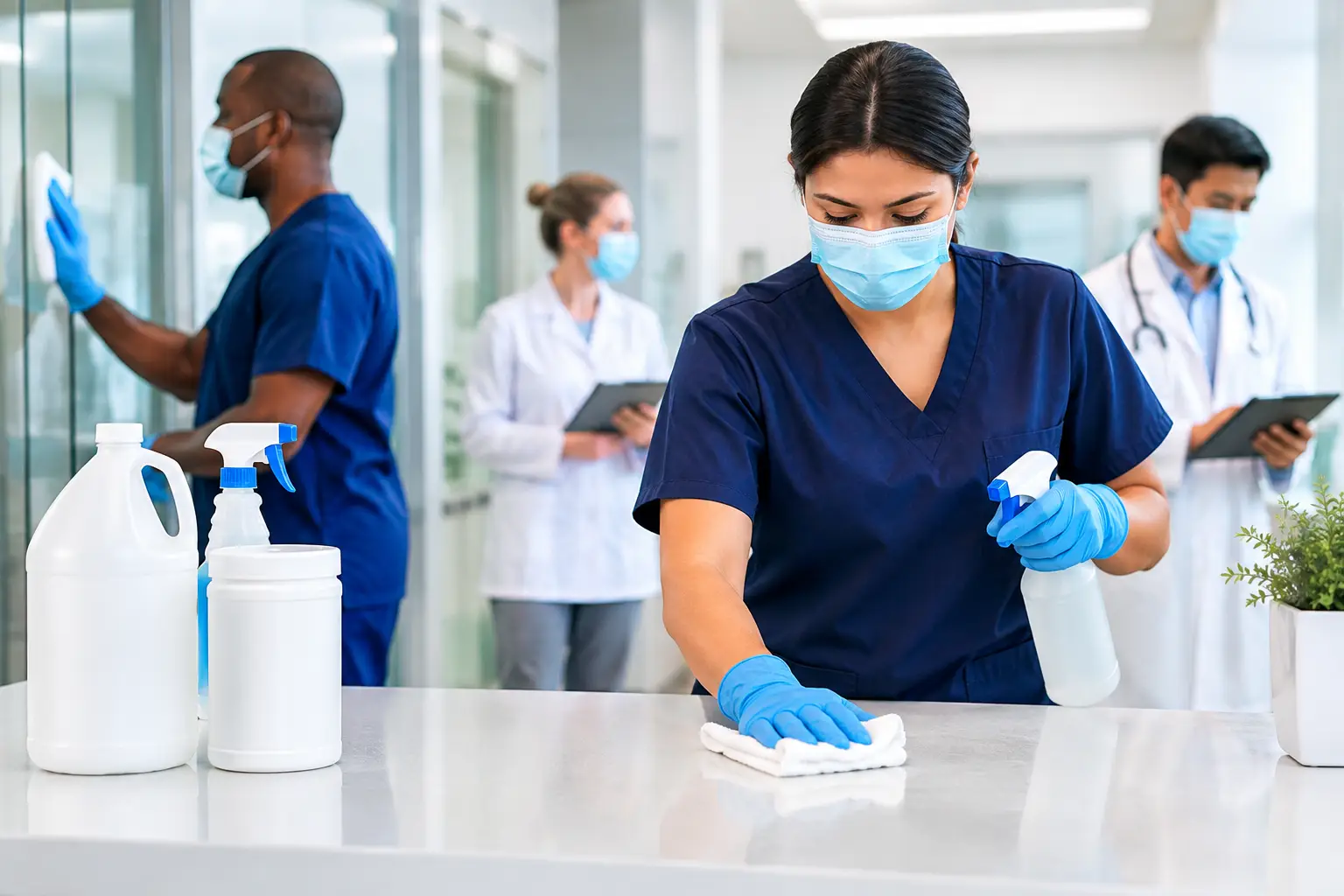
A disinfectant can help control infection risk on a high-touch surface, but the same product can create unnecessary risk when it is diluted incorrectly, applied in a poorly ventilated area, or used on a material it was not designed to treat. So, are disinfectants safe? Yes, when the product, task, environment, and use instructions are aligned. Safety is not a blanket product claim. It is the result of disciplined chemical management.
Thank you for reading this post, don't forget to subscribe!For facilities managers, procurement teams, and environmental services leaders, the question is larger than whether a bottle is safe to store. The real standard is whether a disinfectant can deliver its labeled antimicrobial performance while protecting workers, occupants, equipment, and compliance obligations.
Are Disinfectants Safe? It Depends on How They Are Used
A properly selected disinfectant is evaluated for a specific purpose. Its label identifies the organisms it is intended to address, the surfaces it can be used on, the required dilution if applicable, the contact time, precautionary statements, and first-aid guidance. Those instructions are not general recommendations. They are part of the conditions under which the product performs as intended.
This distinction matters in critical facilities. A product may be appropriate for hard, nonporous restroom surfaces but unsuitable for a sensitive control panel, food-contact surface, medical device, aircraft interior material, or painted finish. A disinfectant may also be safe for routine use in an occupied building when applied according to directions, yet require additional ventilation or restricted access during large-scale application.
The word “safe” should therefore be treated as operationally specific. The relevant questions are: safe for whom, safe on what surface, safe at what concentration, and safe under what work conditions? A defensible program answers each question before a product reaches the floor.
The Label, SDS, and Technical Data Must Work Together
Institutional chemical safety begins with documentation. The product label provides the legally approved directions for use and hazard communication. The Safety Data Sheet, or SDS, gives personnel and supervisors details on hazards, personal protective equipment, storage, spill response, transport, and emergency measures. Technical data may add dilution ratios, material compatibility, application guidance, and performance specifications.
These documents serve different functions, and none should replace the others. Procurement personnel should verify that current documents are available before approving a disinfectant for facility use. Operations teams should make them accessible at the point of use and incorporate the relevant instructions into training and standard operating procedures.
For regulated environments, documentation also supports audit readiness. A facility should be able to show what product was used, why it was selected, where it is approved for use, and how employees were trained to handle it. That record supports more than compliance. It reduces improvisation during turnover, staffing changes, inspections, and incident reviews.
EPA Registration Is Not a Substitute for Safe Handling
For disinfectants making antimicrobial claims in the United States, EPA registration is a central consideration. It indicates that the product has been reviewed for its intended pesticidal claims when used according to its label. It does not mean the product is harmless in every setting or that it can be used beyond its directions.
A registered disinfectant can still irritate skin, eyes, or respiratory passages if mishandled. It can damage surfaces if used at the wrong concentration or left on incompatible materials. It can also fail to disinfect if it is wiped away before the required contact time is complete. Registration, worker safety, and cleaning effectiveness are connected, but they are not interchangeable.
The Most Common Risks Are Usually Process Failures
Many disinfectant problems are not caused by an inherently unsuitable product. They are caused by gaps in process control. In busy facilities, the pressure to clean quickly can lead to overconcentration, underdilution, missed contact times, mixing chemicals, or using one product across surfaces with different requirements.
The most reliable defense is a controlled workflow. Remove visible soil first when required by the label and facility protocol. Apply the disinfectant at the correct dilution. Keep the surface wet for the stated contact time. Allow appropriate drying or rinsing where directions require it. Then document the process when the area or task calls for verification.
Dilution deserves particular attention. Concentrated products can reduce packaging and storage demands, but they require a dependable dilution system and trained users. Guessing at ratios creates two risks at once: a solution that is too weak may not perform as claimed, while one that is too strong may increase exposure risk, residues, odor, material damage, and unnecessary chemical use.
Never mix disinfectants with other cleaners unless the manufacturer specifically directs it. Combining chemicals can create hazardous fumes or unpredictable reactions. This rule should be reinforced in training, posted at dilution stations, and reflected in clear container labeling.
Ventilation and Occupancy Change the Safety Decision
A product that works well in a warehouse restroom may need a different application approach in a small clinic room, aircraft cabin, school office, or confined maintenance area. Ventilation, room volume, temperature, application method, and occupancy all affect exposure potential.
Spraying can increase airborne exposure compared with applying product to a cloth or wipe, particularly in enclosed spaces. Where the label permits more than one application method, facilities should select the method that meets the cleaning objective with the least practical exposure. This can also improve control over overspray on electronics, fixtures, and adjacent surfaces.
Timing matters as well. High-traffic spaces may require cleaning during occupied hours, while other areas can be serviced when occupants are absent. The right choice depends on the task, the product instructions, building conditions, and the people who may be present. Facilities should not assume that a lower-odor product eliminates the need for ventilation, training, or other controls.
Safer Chemistry Still Requires Verification
Environmentally responsible chemistry can be a strong operational choice, especially when facilities want to reduce unnecessarily harsh formulations, improve user acceptance, or align with sustainability objectives. But terms such as “green,” “eco-friendly,” and “non-toxic” should never replace technical review.
A responsible product evaluation looks at the actual label claims, hazard profile, use directions, third-party certifications where relevant, packaging, dilution requirements, and compatibility with the facility’s surfaces and workflows. The best option is not always the strongest-smelling or most aggressive formulation. It is the product that achieves the required sanitation outcome with a manageable safety profile and reliable implementation.
For procurement teams, this is where supplier discipline matters. Request current SDS sheets, technical specifications, regulatory documentation, and instructions that match the intended application. For operations teams, confirm that the product can be deployed consistently by the staff who will actually use it.
Protecting Workers Is Part of Infection Control
Disinfectant safety is inseparable from worker safety. Employees need training that goes beyond identifying a product as a disinfectant. They should understand the difference between cleaning and disinfecting, when each is required, how to measure dilution, what contact time means, which personal protective equipment is required, and what to do after a spill or exposure.
Training should be practical and repeated. A laminated procedure at a janitorial station may be more useful during a shift than a policy stored in a digital folder. Supervisors should also observe real-world use. If workers routinely shorten dwell time because surfaces must be returned to service quickly, the process needs adjustment rather than blame.
Personal protective equipment should match the product label, task, and exposure potential. Gloves are common, but they are not a universal answer. Eye protection, protective clothing, ventilation controls, and hand hygiene may also be necessary depending on the product and application. Facilities should build these requirements into task procedures, not leave them to individual interpretation.
Material Compatibility Protects Assets and Continuity
Disinfectants can affect finishes, coatings, seals, touchscreens, metals, and specialty materials. In aviation, manufacturing, healthcare, and government environments, material damage can become a safety, maintenance, or availability issue. Replacing a degraded surface or taking critical equipment out of service can cost far more than the original chemical purchase.
Before standardizing a disinfectant, review compatibility guidance for representative surfaces and test in an inconspicuous area where appropriate. Pay close attention to high-value assets and frequently disinfected touchpoints. A product that is acceptable for a durable countertop may not be suitable for a display screen, a coated control surface, or an equipment housing.
The strongest disinfectant program is not the one with the harshest chemistry. It is the one that gives staff clear instructions, gives procurement teams complete documentation, and gives the facility repeatable protection without creating avoidable risk. When those controls are in place, disinfectants become what they should be: a dependable part of a safe, compliant cleaning operation.