A missed contact time in a patient room can matter more than a product label claim. That is why the real question is not simply are eco disinfectants effective in hospitals, but whether a specific formulation can meet healthcare disinfection standards under actual operating conditions.
Thank you for reading this post, don't forget to subscribe!For procurement teams, EVS leaders, and facility operators, the answer is yes – some eco disinfectants are effective in hospitals. But effectiveness depends on the same factors that govern any hospital-grade disinfectant: EPA registration, organism kill claims, contact time, compatibility with surfaces, staff adherence, and alignment with your infection prevention protocols. “Eco” does not lower the bar. In a hospital environment, it still has to perform.
Are eco disinfectants effective in hospitals in practice?
In practice, eco disinfectants can be effective when they are selected for the right use case and deployed with discipline. Hospitals do not disinfect based on marketing language. They disinfect based on validated claims, risk level, and workflow reliability.
A product described as eco-friendly may use chemistries designed to reduce harsh residues, lower odor, improve user safety, or lessen environmental impact. None of those traits automatically make it suitable for a healthcare setting. The deciding factor is whether the product is registered and documented for the pathogens and surfaces relevant to the care environment.
That distinction matters. An environmentally preferable cleaner may be useful for routine soil removal, but a hospital-grade disinfectant must demonstrate antimicrobial performance according to regulatory standards. Buyers should separate sustainability language from disinfection evidence. If the product cannot support healthcare documentation requirements, it should not be positioned as a substitute for compliant infection control chemistry.
What makes a disinfectant hospital-effective
Hospital effectiveness starts with regulatory standing. In the US, disinfectants used in healthcare settings are generally expected to carry EPA registration and clearly stated claims for the organisms they are proven to kill. For higher-risk areas, facilities may also need specific claims tied to emerging pathogens, bloodborne pathogens, tuberculosis, or spores, depending on protocol and application.
The next issue is contact time. A disinfectant may have strong efficacy in laboratory conditions, yet become operationally weak if staff cannot realistically keep a surface wet for the full labeled dwell time. This is where some eco disinfectants compare favorably. Certain formulations are easier on staff and surfaces, which can improve consistent use. But shorter or easier use is only valuable if the label claims match the facility’s risk profile.
Surface compatibility also affects real-world performance. Hospitals contain sensitive finishes, touchscreens, mattresses, rails, polymers, and specialty equipment. Highly aggressive chemistries can degrade surfaces over time, leading to equipment damage, harder-to-clean materials, and increased replacement costs. Eco-focused formulations may offer an advantage when they deliver disinfection without unnecessary material stress. That said, gentler chemistry is not a free pass. Compatibility should be confirmed against manufacturer guidance and internal asset standards.
Where eco disinfectants fit well in hospitals
Many healthcare spaces do not carry the same level of infection risk. Patient rooms, waiting areas, administrative spaces, corridors, and certain outpatient environments may support broader product selection, provided the disinfectant meets the site’s documented requirements. In these areas, eco disinfectants can support both sanitation goals and occupational safety priorities.
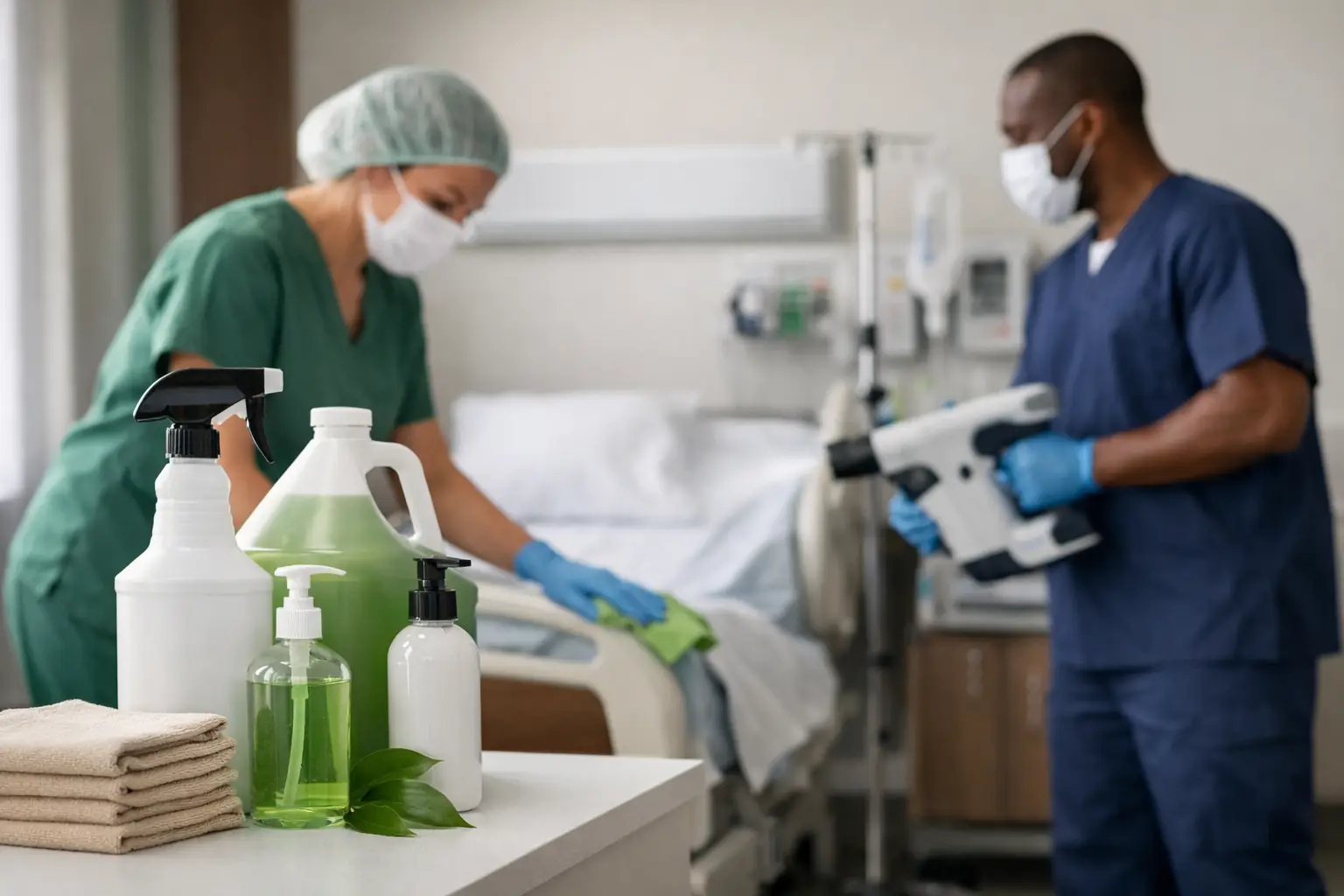
They may be especially useful where odor control, indoor air quality, and repeat staff exposure are operational concerns. Environmental services teams work with these products every shift. Reducing unnecessary chemical harshness can help support safer handling, better comfort, and potentially stronger compliance with routine use protocols.
There is also a training benefit when products are simpler to deploy correctly. If a disinfectant has a practical dwell time, straightforward instructions, and acceptable user experience, teams are more likely to use it as intended. In hospitals, the best product on paper still fails if it is avoided, diluted incorrectly, or wiped away too soon.
Where the answer is more limited
Not every eco disinfectant belongs in every hospital application. High-acuity settings, isolation areas, operating environments, and incidents involving specific pathogens may require targeted chemistries with claims that not all eco-positioned products can meet.
This is where procurement decisions need precision. If a facility faces C. diff risk, for example, the product selection process changes. If the protocol requires sporicidal performance, buyers need a disinfectant labeled and validated for that use. The same applies when bloodborne pathogen protocols, terminal cleaning procedures, or outbreak response measures call for a narrower set of approved options.
So the question are eco disinfectants effective in hospitals has an honest answer: often yes, sometimes no, and always conditionally. They are not universal replacements for every disinfection task. They are tools that must be matched to the clinical environment, pathogen risk, and compliance standard.
How procurement teams should evaluate eco disinfectants
A disciplined review process prevents two common mistakes: rejecting eco chemistry on assumption, or approving it based on broad sustainability claims alone. Hospital buyers should evaluate eco disinfectants with the same procurement rigor applied to any institutional product.
Start with the label and technical documentation. Confirm EPA registration status, intended use sites, organism claims, dwell times, dilution instructions if applicable, and any applicable safety or environmental certifications. Review the SDS and technical data sheet, not just the marketing summary.
Then compare the product against the facility’s risk map. A medical office building, surgical center, long-term care setting, and acute care hospital do not all require the same coverage. Match the disinfectant’s claims to the actual environments where it will be used, and involve infection prevention or clinical leadership when product substitution could affect protocol.
Operational fit matters just as much. Consider whether the product works within current dispensing systems, wipe formats, storage procedures, and staff training capabilities. A product can be compliant and still fail operationally if it complicates workflows or creates confusion at the point of use.
Finally, assess vendor readiness. In healthcare and government-adjacent environments, documentation is not a side issue. Buyers need access to current SDS sheets, technical specs, certifications, and clear support for audit and inspection requirements. A supplier that understands compliance documentation reduces friction and shortens approval cycles.
Common misconceptions about eco disinfectants
One misconception is that eco disinfectants are just weaker versions of conventional hospital disinfectants. That is not inherently true. Some are fully capable of meeting healthcare disinfection needs, provided the claims and use conditions align with the setting.
Another misconception is that a greener profile guarantees safer or easier implementation. Safer chemistry can still be misused. If staff skip pre-cleaning when required, fail to meet dwell time, or use the wrong product for the pathogen risk, outcomes suffer regardless of how the product is positioned.
A third misconception is that sustainability and compliance are competing goals. In many facilities, they are procurement goals that can and should be evaluated together. The standard is not to choose between effectiveness and environmental responsibility. The standard is to select chemistry that achieves the required level of infection control without introducing avoidable handling, surface, or air-quality burdens.
The operational standard hospitals should keep
Hospitals should not ask whether a disinfectant is eco-friendly first. They should ask whether it is clinically appropriate, compliant, and usable at scale. If the answer is yes, and the product also supports environmental and occupational safety goals, that is a meaningful advantage.
This is the framework disciplined buyers use. They look past broad product categories and evaluate actual performance evidence, workflow fit, and documentation support. That approach protects patients, staff, and the facility itself.
For organizations balancing infection prevention, worker safety, and sustainability goals, eco disinfectants deserve serious consideration – but not reduced scrutiny. The right product earns its place through label claims, operational reliability, and documentation that stands up when compliance matters most.
The best decision is rarely the harshest chemistry on the shelf. It is the one your team can verify, deploy correctly, and defend with confidence in a regulated environment.