Turn time is where good disinfectant decisions either support flight operations or create avoidable friction. An aviation interior disinfectant review is not just about whether a product kills pathogens on paper. It is about whether that chemistry performs on high-touch cabin surfaces, protects sensitive materials, fits crew workflows, and stands up to compliance review when documentation is requested.
Thank you for reading this post, don't forget to subscribe!Aircraft interiors are controlled environments with very little margin for error. Disinfect too aggressively and you risk surface damage, haze, tackiness, or odor complaints. Disinfect too lightly and you create sanitation gaps that can affect passenger confidence, crew safety, and operating standards. For procurement teams and facility leaders, the right review framework has to balance efficacy, material compatibility, dwell time, residue profile, and documentation.
What matters most in an aviation interior disinfectant review
The first screen should always be efficacy backed by recognized labeling and technical support. A disinfectant may perform well in a general commercial setting but still be a poor fit for aviation interiors if its contact time is too long for operational turnover or if it requires a rinsing step on common touchpoints. In cabin service, every extra step affects labor, consistency, and on-time performance.
Material compatibility is just as critical. Aircraft interiors combine plastics, laminates, leather, coated metals, tray tables, armrests, touchscreens, and soft-touch finishes that do not all respond the same way to repeated chemical exposure. A product that looks acceptable after one use can still create long-term wear through discoloration, embrittlement, or surface film buildup. This is where buyers need more than marketing claims. They need technical specifications, SDS documentation, and practical evidence that the product is suitable for repeated use on interior surfaces common to aviation environments.
Residue is often underestimated in reviews. A disinfectant can meet efficacy requirements and still fail operationally if it leaves streaks on gloss surfaces, attracts soil, or creates a tacky feel on tray tables and armrests. In an aircraft cabin, the cleaning result is visible and tactile. Passengers notice residue immediately, and crews do too.
Performance is more than kill claims
Disinfectant labels matter, but labels alone do not complete the evaluation. Buyers should review how the chemistry behaves under real use conditions, including rapid application, variable wipe pressure, and repeated use across multiple shifts. Products that depend on perfect saturation or unusually long wet contact times may underperform in practice, even if the efficacy profile looks strong in a controlled setting.
This is why dwell time deserves careful scrutiny. Shorter contact times can improve throughput, but only if the product remains wet long enough on actual cabin surfaces. Some formulations flash off quickly, especially in low-humidity or conditioned environments, making listed disinfection claims harder to achieve without reapplication. Others maintain wetness but leave enough residue to create a second cleaning problem. The right choice depends on your workflow and the surfaces being treated.
Odor also belongs in any serious review. Strong fragrances or harsh chemical smells can create complaints in enclosed passenger environments and may not align with broader indoor air quality goals. A lower-odor formulation can support a better occupant experience, but it still has to deliver institutional performance. That trade-off should be examined directly, not assumed.
Surface risk in aircraft cabins
A practical aviation interior disinfectant review has to account for the fact that aircraft cabins are not built like hospitals, schools, or office suites. Many interior components are appearance-sensitive and replacement-intensive. Even a small compatibility issue becomes costly when multiplied across fleets, terminals, lounges, or support vehicles.
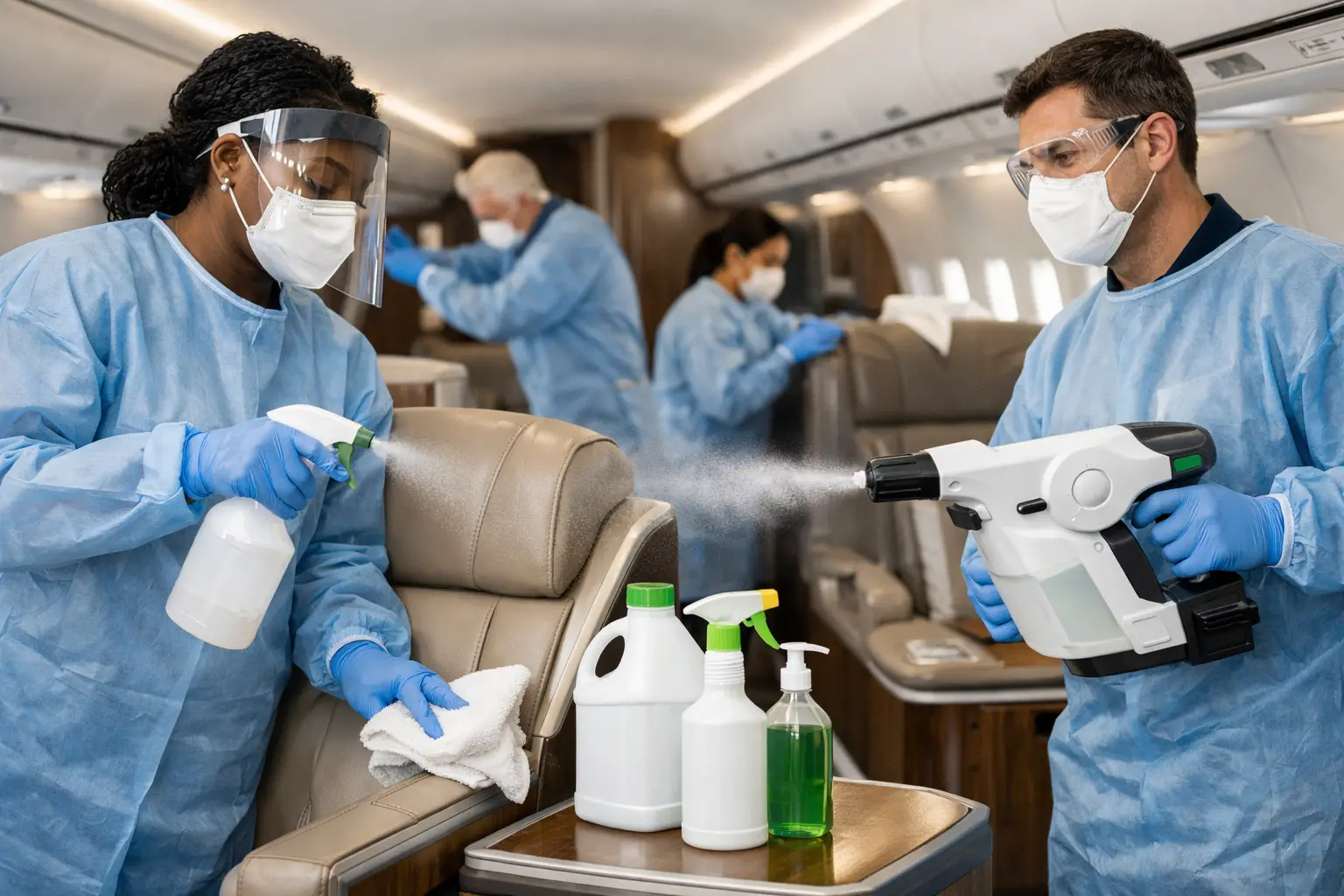
Hard nonporous surfaces such as tray tables, lavatory touchpoints, armrests, and galley contact areas usually carry the highest cleaning frequency. These are logical priorities for disinfection, but they are also areas where visual finish matters. Repeated exposure to the wrong formulation can dull clear plastics, damage coatings, or leave visible film in high-light conditions.
Electronic touchpoints add another layer of caution. Seatback screens, payment interfaces, and control panels may require a product that is effective yet less likely to leave moisture pooling or interfere with sensitive surfaces. In these areas, the product may not be the only factor. Wipe material, saturation level, and application method can all change the outcome.
Soft surfaces complicate the picture further. Not every disinfectant intended for hard surfaces is appropriate for fabrics, leather, or treated upholstery. If your program includes both hard-surface disinfection and soft-surface sanitation, trying to force one chemistry across all materials can create performance gaps. Sometimes standardization helps. Sometimes it creates unnecessary risk.
Compliance and documentation are part of the product
For aviation buyers, documentation is not administrative clutter. It is part of the purchase decision. Any disinfectant under consideration should come with current SDS materials, technical data, use instructions, and any relevant regulatory support that helps environmental services teams, maintenance leads, and procurement personnel validate the product before deployment.
This is especially important when products are being reviewed across multiple facilities or under government and institutional purchasing standards. A product may appear operationally suitable but still create delays if the supplier cannot support submittals, specification review, or audit questions. In high-compliance environments, supplier readiness matters almost as much as chemistry.
That is one reason many buyers prefer partners that understand institutional procurement rather than consumer-style retail sales. Veteran Commercial Cleaning operates in that procurement-ready space, where performance claims are expected to be backed by usable documentation and operational clarity rather than broad promotional language.
Eco-conscious chemistry without operational compromise
Aviation teams are under pressure from two directions at once. They need disinfectants that perform at a high institutional standard, and they are also being pushed to reduce unnecessary chemical harshness where safer chemistry can do the job. The right review does not treat those goals as opposites.
Environmentally responsible chemistry can be a strong fit for aviation interiors when it reduces residue, odor burden, or user exposure concerns while still meeting sanitation requirements. But buyers should avoid assuming that every greener product is automatically cabin-ready. Some may be better suited for light-duty maintenance than repeated disinfection in high-touch passenger spaces. Others may perform well but require more disciplined application to achieve labeled results.
The best approach is comparative testing tied to actual use conditions. Review the product against your core surfaces, your turnover schedule, and your cleaning staff’s application methods. A formulation that looks ideal in a specification sheet can behave very differently during overnight deep cleaning than it does during fast gate-side service.
How to evaluate disinfectants before rollout
A desk review should come first, but field validation should follow quickly. Start by narrowing candidates based on intended use, contact time, residue profile, odor, and compatibility guidance. Then test them on representative cabin materials and real cleaning tasks rather than isolated sample panels alone.
Pay attention to what happens after repeated cycles. Early performance can be misleading. Surface haze, tackiness, and finish wear often emerge only after sustained use. It also helps to evaluate worker acceptance. If staff find the product difficult to use, unpleasant to handle, or inconsistent in wipe performance, compliance at the point of use tends to drop.
Training needs should also be considered part of the review. Some disinfectants are forgiving and easy to apply consistently. Others require close attention to wet time, dilution control, or post-application handling. In aviation operations, simpler often scales better, especially across multiple crews, shifts, and locations.
Common reasons products fail after purchase
Most disinfectant failures in aviation settings are not caused by lack of efficacy on the label. They happen because the product did not match the operational environment. Long dwell times conflict with turn schedules. Residue creates passenger-facing quality issues. Material compatibility problems show up after repeated use. Documentation is incomplete when safety or procurement teams request it. Or the application method required for compliance proves unrealistic for front-line staff.
Another common issue is overconcentration or misuse. Teams sometimes compensate for uncertainty by applying more product than necessary, which increases residue, waste, and surface risk without improving outcomes. Clear instructions and disciplined product selection reduce that tendency.
The right review question to ask
The most useful question is not, “Which disinfectant is strongest?” It is, “Which disinfectant reliably meets sanitation requirements in our aircraft interiors without creating new operational problems?” That shift matters because aviation cleaning is a performance system, not a label comparison exercise.
A strong product for this environment will support disinfection goals, protect cabin materials, fit realistic contact times, maintain a clean finish, and arrive with documentation that satisfies internal review. That is the standard procurement teams should hold.
When disinfectant selection is treated as an operational control rather than a commodity purchase, cabin cleaning becomes more consistent, staff execution improves, and compliance conversations get easier. That is usually the difference between a product that merely passes evaluation and one that actually belongs in an aviation program.