A cabin turnaround can be measured in minutes, but a poor disinfectant decision can leave lasting consequences: damaged trim, rejected cleaning records, employee exposure concerns, or a sanitation process that does not perform as represented. The best aviation cabin disinfectant options are not simply the strongest chemicals available. They are products and application systems that align with the aircraft’s approved cleaning guidance, the facility’s infection-control plan, and the realities of a fast, repeatable operation.
Thank you for reading this post, don't forget to subscribe!For airlines, FBOs, charter operators, airport service contractors, and government flight departments, selection should begin with performance evidence and documentation. A product must be effective against the organisms relevant to the operation, but it must also fit the surfaces, equipment, dwell-time window, and worker-safety controls of the cabin-cleaning program.
What Makes an Aviation Cabin Disinfectant Suitable?
Aircraft interiors contain a demanding mix of materials: leather and vinyl seating, tray tables, armrests, plastic panels, touchscreens, lavatory fixtures, painted components, metal hardware, carpet, and composite surfaces. A disinfectant that works well in a hospital room or warehouse may cause discoloration, cracking, residue, corrosion, or haze in an aircraft cabin if it is not compatible with those materials.
The first requirement is a current EPA registration and label directions that support the intended disinfection claim. Procurement teams should verify the product’s listed pathogens, required contact time, dilution instructions when applicable, and approved surface uses. A broad claim does not eliminate the need to follow label language exactly. If a label requires a surface to stay visibly wet for several minutes, a rushed wipe-and-dry process does not deliver the stated disinfection result.
The second requirement is aircraft and component compatibility. The aircraft manufacturer’s cleaning and maintenance documentation should govern the process. When a chemical is not specifically addressed, obtain written compatibility information from the product manufacturer and test it in an inconspicuous area under controlled conditions. This is especially relevant for cockpit-adjacent surfaces, acrylics, coated displays, leather finishes, and high-gloss trim.
Finally, the right option supports consistent execution. A technically sound disinfectant is of limited value if crews cannot apply it accurately during turn service or if its odor, residue, or PPE requirements create unnecessary operational friction.
Best Aviation Cabin Disinfectant Options by Use Case
No single chemistry is automatically best for every aircraft, pathogen concern, or cleaning workflow. The most practical choice depends on the cabin zone and the controls already in place.
Ready-to-use disinfectant wipes for touchpoints
Pre-moistened disinfectant wipes are often the most practical option for high-touch areas during fast cabin servicing. They are well suited to tray tables, armrests, seatbelt buckles, lavatory handles, call buttons, door hardware, and galley touchpoints when the product label permits those uses.
Wipes reduce dilution errors and limit overspray, which matters around electronics, seams, and sensitive finishes. Their trade-off is coverage control. Crews must use enough wipes to leave the surface wet for the required dwell time and must avoid using a depleted wipe on a large area. Facilities should specify wipe type, coverage expectations, disposal procedures, and storage requirements in their standard operating procedure.
Neutral or low-residue ready-to-use liquids for broad cabin surfaces
For larger nonporous areas, ready-to-use liquid disinfectants can provide more efficient coverage than wipes. Products designed for low residue are particularly valuable in passenger cabins, where visible streaking, sticky surfaces, or chemical odor can affect the travel experience and create extra re-cleaning work.
Application should be controlled. In many cases, applying the product to a microfiber cloth rather than spraying directly onto a surface is the safer approach, particularly near seat controls, vents, display panels, and electrical connections. The cleaning team must still maintain the label-required wet contact time. A cloth that is only lightly damp is not a substitute for a disinfecting application.
Hydrogen peroxide-based disinfectants for lower-harshness programs
Improved hydrogen peroxide formulations are frequently considered by facilities seeking effective disinfection with a more environmentally responsible chemical profile. Depending on the individual product and its label, these formulations may offer broad antimicrobial claims, manageable odor, and lower residue than some traditional chemistries.
That does not make every peroxide-based product suitable for every aircraft material. Concentration, additives, surface finish, and contact time all matter. Procurement teams should request the safety data sheet, technical data, EPA registration information, and compatibility guidance before approving a product for fleet-wide use. This option can be a strong fit when a facility is reducing unnecessarily harsh chemistry without compromising documented sanitation requirements.
Quaternary ammonium disinfectants for routine programs
Quaternary ammonium, commonly called quat, disinfectants remain common in institutional cleaning programs because they are available in wipes and liquids, can be practical for routine touchpoint disinfection, and may be compatible with many hard, nonporous surfaces when used as directed.
The trade-offs deserve attention. Some quat products can leave residue, and compatibility varies by formulation and surface. Misuse can also create problems when cloths are not changed frequently, when the solution is mixed incorrectly, or when surfaces are wiped dry before the dwell time ends. A disciplined program addresses these issues through product-specific training, microfiber management, and documented application methods.
Specialized lavatory disinfectants where soil load is higher
Aircraft lavatories require a separate evaluation because soil load, odor control, and surface exposure differ from the passenger cabin. A disinfectant used on lavatory touchpoints should be effective for the organization’s target organisms while remaining appropriate for fixtures, seals, metals, and plastics found in the aircraft.
Cleaning comes before disinfection when visible soil is present. Organic matter can interfere with the disinfectant’s contact with the surface. Teams should remove soil using an approved cleaner, then apply the disinfectant according to its label. Combining these steps carelessly or using an unapproved acidic, bleach-based, or highly alkaline product can damage materials and create worker-safety risks.
How to Evaluate Aviation Disinfectant Options Before Purchase
A product evaluation should produce a defensible purchasing record, not just a favorable sample test. Start by defining the surfaces, cabin zones, flight schedules, pathogen concerns, and labor constraints involved. Then compare products using the same operational criteria.
Review these documents before approval: the EPA label and registration information, safety data sheet, technical data sheet, dilution and dwell-time instructions, storage requirements, and manufacturer guidance regarding material compatibility. For government, military, healthcare-adjacent, and other compliance-sensitive operations, retain these records in the facility’s chemical inventory and training file.
Dwell time is often the deciding factor. A product with a longer required wet time may be appropriate for overnight deep cleaning but unrealistic during a short turnaround. Conversely, a shorter dwell time should not outweigh concerns about residue, surface compatibility, ventilation needs, or the scope of the product’s approved claims.
Field testing should mirror actual conditions. Test on representative cabin materials, using the same microfiber, wipe technique, and turnaround timing that crews will use. Observe whether the surface remains wet long enough, whether the product streaks or leaves a film, and whether employees can follow the process reliably while wearing required PPE.
Application Controls Matter as Much as Chemistry
Even the best aviation cabin disinfectant options fail when the process is uncontrolled. Cleaning leaders should separate routine cleaning, targeted disinfection, and response cleaning after a known contamination event. Each task may require different products, dwell times, PPE, and documentation.
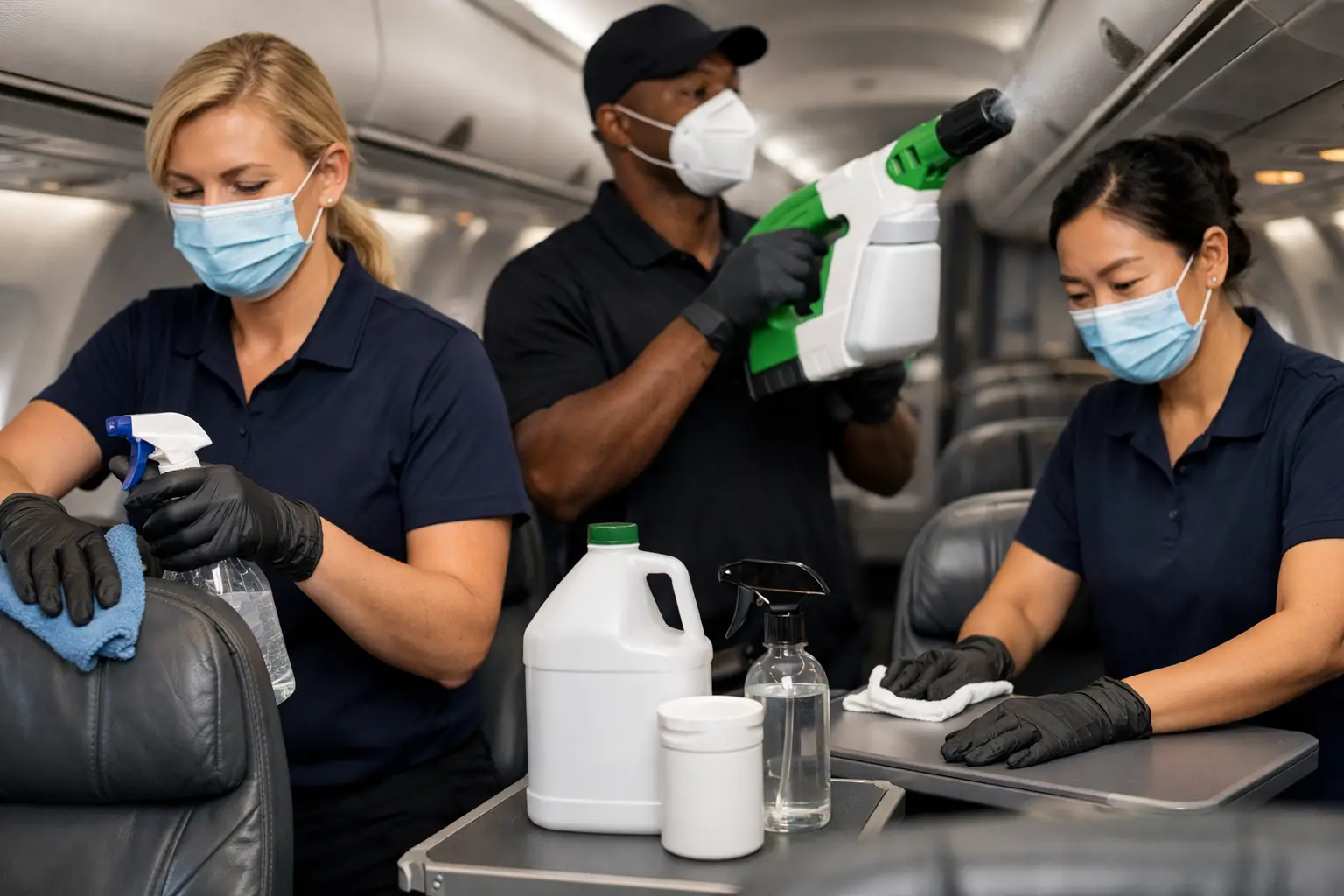
Train crews on the difference between cleaning and disinfecting. Cleaning removes soil and reduces contaminants. Disinfecting uses an EPA-registered product on a pre-cleaned surface for the label-specified contact time. Employees should know where direct spraying is restricted, which surfaces require a damp-cloth method, and when to replace cloths or wipes to prevent cross-contamination.
Avoid chemistry shortcuts. Never mix disinfectants with other cleaning products unless the manufacturer specifically directs it. Do not transfer chemicals into unlabeled containers. Do not use fogging, electrostatic application, or other specialized methods inside an aircraft unless the product label, equipment instructions, aircraft guidance, ventilation plan, and operational approval all support that use.
Documentation is part of performance. Maintain current SDS sheets, product labels, training records, lot or inventory controls where required, and written cabin-cleaning procedures. These records support safer work, clearer vendor accountability, and faster response when an airline customer, regulator, or contracting officer requests evidence of the sanitation program.
A Better Standard for Cabin Sanitation
The right disinfectant program protects more than cabin surfaces. It protects passenger confidence, crew safety, equipment value, and the integrity of the operation. Veteran Commercial Cleaning supports institutional buyers with professional-grade sanitation solutions and the technical documentation needed to make informed, compliance-focused decisions.
Choose the chemistry that crews can apply correctly, that aircraft materials can tolerate, and that your records can defend. That standard may require more evaluation at the start, but it creates a cabin-cleaning program that holds up under daily operational pressure.