A cleaning failure in a controlled facility is rarely just a cleaning problem. It can interrupt production, create a safety concern, weaken infection-control procedures, or leave a procurement team without the documentation needed to defend its process. That is why commercial cleaning chemicals must be selected as part of an operational system, not treated as interchangeable supplies.
Thank you for reading this post, don't forget to subscribe!For facilities managers, environmental services teams, and procurement professionals, the right chemistry has to perform under real conditions. It must address the soil load, surface material, worker exposure requirements, sanitation objective, and recordkeeping expectations of the site. A product that works well on a lightly soiled office countertop may be the wrong choice for a manufacturing floor, an airport restroom, or a healthcare environment.
Commercial Cleaning Chemicals Are Not One Category
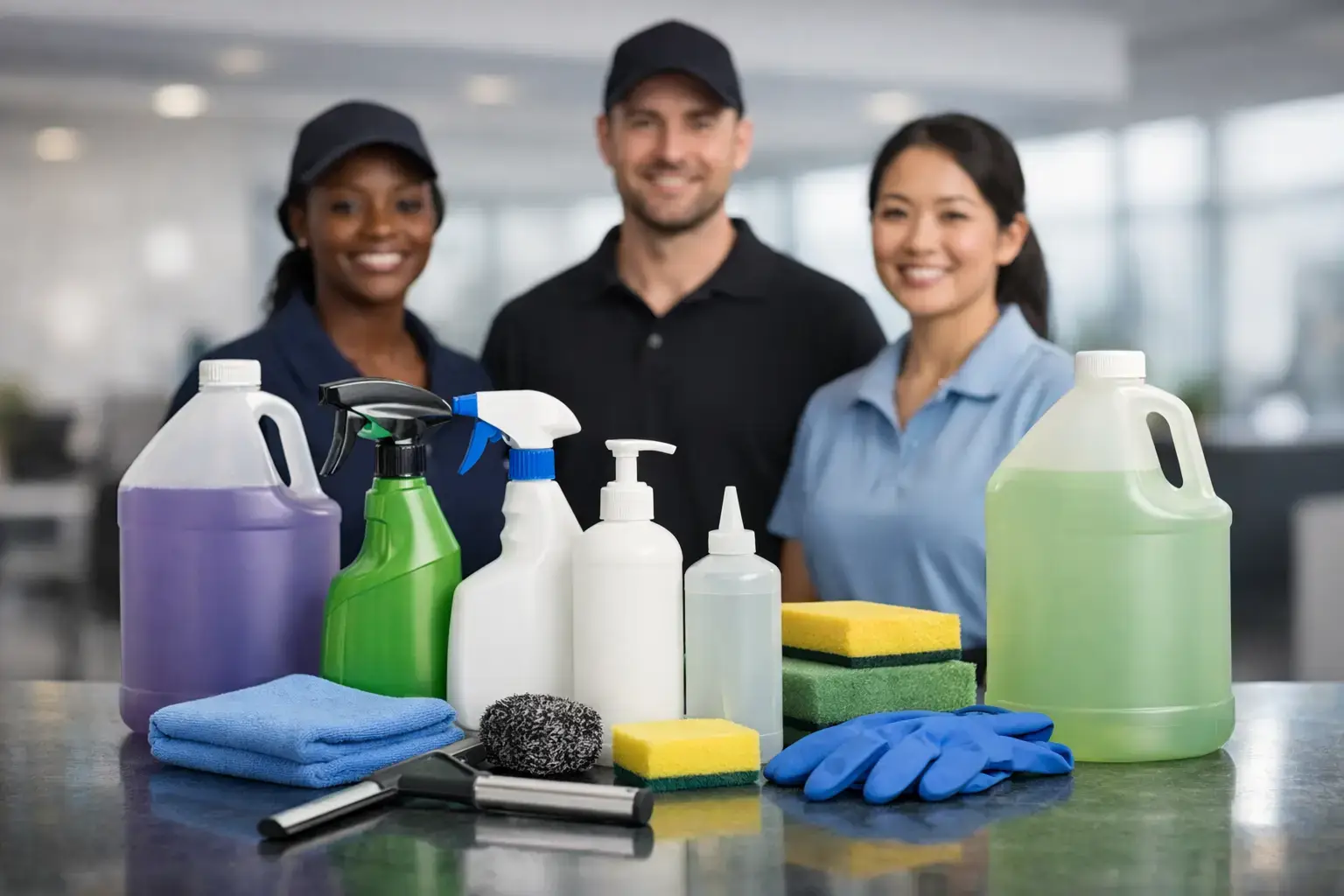
The term commercial cleaning chemicals covers several distinct functions. Cleaners remove visible soil and residues. Degreasers break down oils, lubricants, and heavy industrial buildup. Disinfectants are used according to their labeled directions to address specified microorganisms on hard, nonporous surfaces. Sanitizers reduce certain bacteria to levels considered safe under their labeled use conditions.
These functions overlap in a facility cleaning program, but they should not be confused. A disinfectant may not cut through heavy grease effectively. A strong degreaser may leave a surface clean but does not automatically provide a disinfecting claim. Using one product for every task can create avoidable waste, poor results, surface damage, or missed sanitation requirements.
The practical question is not, “What is the strongest chemical available?” It is, “What product is appropriate for this task, this surface, and this facility standard?” That distinction supports better cleaning outcomes and safer daily operations.
Start With the Soil, Surface, and Required Outcome
Before selecting a product, define what must be removed or controlled. Dust, mineral deposits, oils, protein residues, adhesive buildup, soap scum, and microbial contamination require different approaches. The visible condition of a surface is only part of the assessment.
A manufacturing facility may need an industrial degreaser that can remove lubricant residue from durable equipment surfaces without creating a slip hazard or leaving a film that affects downstream work. A healthcare facility may need a cleaner and an appropriate disinfectant process for high-touch surfaces, with close attention to label contact time and compatibility with finishes. Government and military facilities may also require complete technical documentation and consistent supply availability across multiple locations.
Surface compatibility matters just as much. Chemicals that are suitable for sealed concrete or stainless steel may not be suitable for aluminum, acrylic, painted finishes, natural stone, electronics, or specialty flooring. Repeated use of an overly aggressive formula can dull surfaces, degrade coatings, corrode metals, or shorten the life of high-value assets.
When evaluating a product, confirm three points: the type of soil, the material being cleaned, and the result required after cleaning. That simple discipline prevents many common specification errors.
Cleaning First Often Determines Disinfection Success
In high-compliance environments, teams sometimes focus on the disinfectant claim and overlook the condition of the surface before application. That is a costly mistake. Organic matter, oil, dust, and visible debris can interfere with the ability of a disinfectant to reach the surface evenly.
A two-step process is often necessary when surfaces are heavily soiled: first remove soil with the appropriate cleaner or degreaser, then apply the disinfectant according to its label. In other situations, a properly selected cleaner-disinfectant may fit the workflow. The correct choice depends on the level of soil, the product label, the required procedure, and the facility’s infection-control or sanitation protocol.
Contact time deserves the same attention. A product cannot perform its labeled disinfecting function if it is wiped away before the required dwell period has elapsed. Training should make this practical. Staff need to know how much solution to apply, whether the surface must remain visibly wet, which tools to use, and when a surface can return to service.
Documentation Is Part of the Product
For institutional buyers, a container on a shelf is not the full product package. The associated documentation is often just as important as the chemistry itself. A dependable supplier should provide current Safety Data Sheets, technical specifications, use instructions, dilution guidance where applicable, and regulatory information relevant to the product’s intended use.
These documents support more than compliance files. They help environmental health and safety teams evaluate worker protections, assist supervisors with training, and give procurement staff the information needed to make defensible purchasing decisions. They also help facilities standardize procedures across shifts, departments, and sites.
For disinfectants and sanitizers, the label is especially important. Product claims, approved use sites, application directions, and contact times must be followed as written. Teams should avoid relying on assumptions, old procedures, or marketing language that goes beyond the product’s actual labeling.
A documentation-ready program is particularly valuable in aviation, healthcare, manufacturing, public facilities, and government environments, where audits and incident reviews can expose gaps quickly.
Safer Chemistry Does Not Mean Lower Standards
The choice between performance and environmental responsibility is often framed as a trade-off. It should not be. Modern commercial cleaning chemicals can be formulated to reduce unnecessary harshness while still meeting demanding operational needs.
That does not mean every environmentally responsible product is suitable for every application. High-soil industrial tasks, specialized disinfection requirements, and material-specific cleaning may call for different formulations. The goal is to select the least aggressive chemistry that reliably achieves the required result, rather than defaulting to harsh products out of habit.
This approach can support worker comfort, reduce odor concerns, protect sensitive surfaces, and simplify routine cleaning in occupied spaces. It also aligns with facilities that have environmental purchasing goals or seek to reduce avoidable chemical exposure without compromising sanitation discipline.
The strongest formula is not automatically the best formula. The best formula is the one that performs as required, fits the task, and can be used consistently and safely by the people responsible for the work.
Build Chemical Control Into Daily Operations
Product selection fails when the facility lacks a system for storage, dispensing, training, and review. Concentrated products require accurate dilution and controlled dispensing. Ready-to-use products can reduce mixing errors and simplify deployment, though they may not be the best fit for every high-volume application. The operational decision depends on usage volume, staff training, storage capacity, and the risk of dilution inconsistency.
A chemical management plan should address at least these five areas:
- Approved products and the tasks or surfaces assigned to each one
- Current SDS sheets and product instructions available to staff
- Proper labeling of secondary containers and dilution systems
- Required personal protective equipment and ventilation considerations
- Training on application methods, contact times, storage, and spill response
This is not paperwork for its own sake. Clear chemical control reduces misuse, supports employee safety, improves cleaning consistency, and limits the chance that an unapproved substitute enters the workflow during a supply disruption.
Questions Procurement Teams Should Ask
Procurement decisions should look beyond whether a product can be ordered quickly. Ask whether the supplier can support the documentation, consistency, and institutional requirements attached to the purchase. For recurring needs, standardization can reduce training complexity and improve accountability across locations.
Evaluate whether the product is appropriate for the facility’s actual conditions, whether technical information is current and accessible, and whether the supplier understands high-compliance environments. Buyers should also confirm packaging, storage, and ordering practices fit their operational model without creating excess inventory risk or forcing crews to improvise with incompatible products.
Veteran Commercial Cleaning approaches chemical supply with that broader operational view. For critical facilities, the objective is not simply to stock cleaners. It is to support a cleaning program that stands up to daily use, worker safety expectations, sanitation procedures, and procurement scrutiny.
Choose Chemistry That Holds Up Under Scrutiny
Commercial cleaning chemicals should make the work more controlled, not more complicated. When each product has a defined purpose, verified instructions, compatible surfaces, and supporting documentation, cleaning teams can act with confidence instead of guesswork.
The next time a facility reviews its cleaning inventory, start with the areas where failure carries the greatest consequence. Match the chemistry to that risk, equip staff with clear procedures, and keep the documentation close to the point of use. That is how routine cleaning becomes a reliable part of facility readiness.