Grease buildup rarely fails all at once. It shows up first as a slip risk near a press line, a maintenance delay on a conveyor, a failed inspection note, or residue that keeps returning after every washdown. That is why a factory degreasing program example matters – not as a generic cleaning checklist, but as an operating framework that protects equipment, workers, production flow, and compliance records.
Thank you for reading this post, don't forget to subscribe!In manufacturing environments, degreasing is never just about appearance. Oils, lubricants, hydraulic fluid, carbon soils, and process residue can affect traction, machine performance, product quality, and even fire risk. A useful program has to define what gets cleaned, how often, with what chemistry, under whose responsibility, and with what documentation. If any one of those parts is vague, the program usually breaks down under production pressure.
What a factory degreasing program example should include
A strong program starts with classification, not chemicals. Facilities often make the mistake of selecting a degreaser first and then trying to force every surface and soil type into that choice. In practice, degreasing should be built around the interaction between soil load, surface material, production sensitivity, and safety requirements.
For example, a fabrication plant may have heavy petroleum grease on machine exteriors, light oil mist on floors near CNC equipment, and carbonized residue in maintenance areas. Those are not the same cleaning jobs. They require different dwell times, agitation methods, dilution controls, and in some cases different approval standards if the area is adjacent to food packaging, medical device production, or regulated assembly work.
A complete program usually defines four things early. It identifies critical areas, assigns cleaning frequencies, specifies approved methods, and sets documentation expectations. That sounds simple, but it is where most inconsistency begins. If a line supervisor expects daily wipe-downs while the janitorial scope says weekly service, residue accumulation becomes predictable.
Factory degreasing program example for a production facility
Consider a mid-sized manufacturing facility operating two shifts with machining, packaging, maintenance, and warehouse zones. The goal is to reduce slip hazards, improve equipment cleanliness, and maintain auditable cleaning records without introducing unnecessarily harsh chemistry.
Zone 1: Production equipment exteriors
This zone includes machine housings, guards, control panel surrounds, and non-sensitive exterior surfaces where lubricant overspray is common. The program standard might call for end-of-shift spot degreasing in high-contact areas and a more complete weekly treatment during planned downtime.
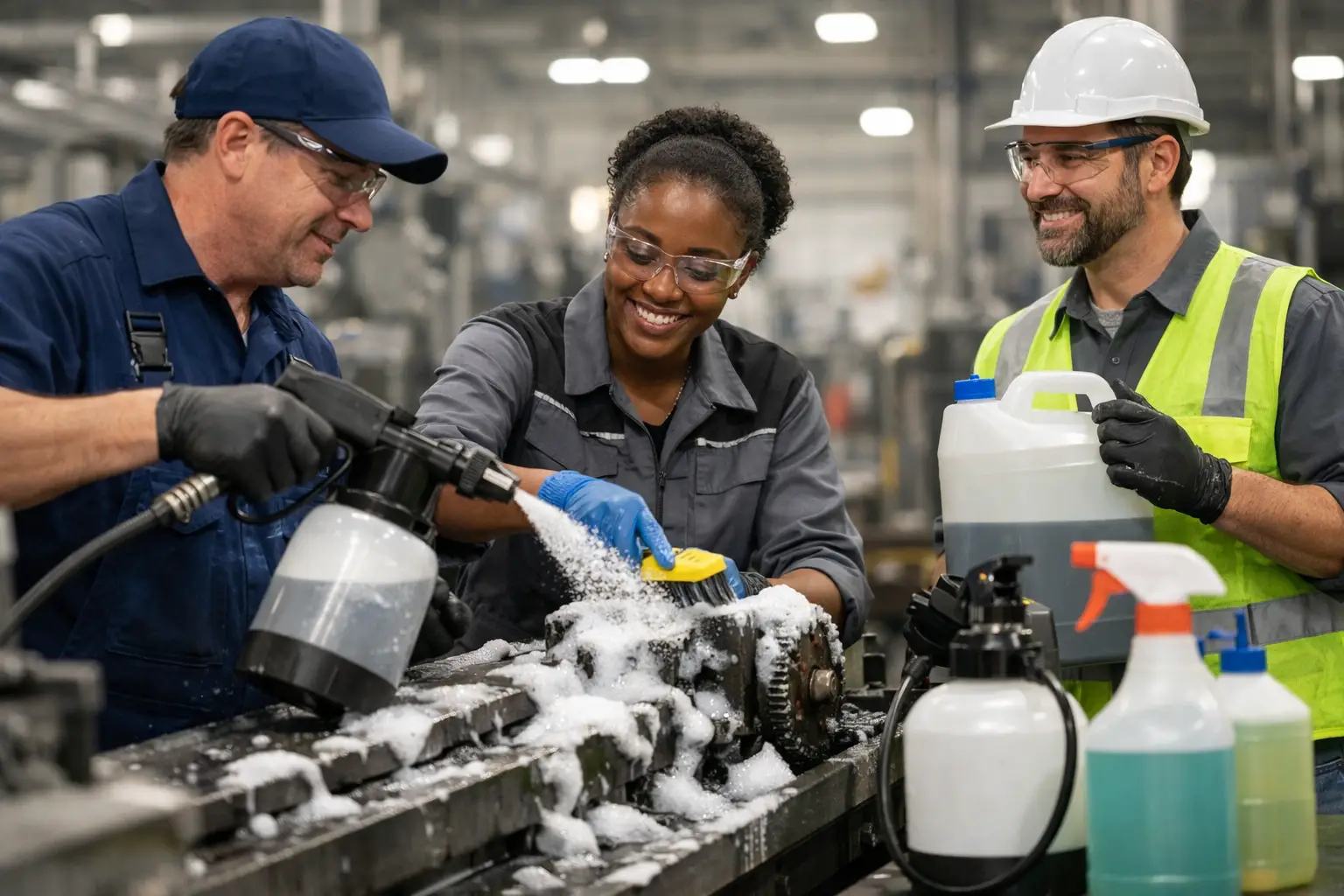
Operators handle visible residue during shift change using approved wipes or diluted degreaser application with low-moisture methods. Environmental services or designated sanitation staff perform the weekly service, using a documented dwell time and non-abrasive agitation to remove set soils without damaging painted or coated surfaces. Maintenance verifies that cleaning does not compromise labels, controls, or sensitive seals.
The reason this split works is operational. Operators can manage routine buildup before it spreads, while deeper weekly cleaning stays controlled and consistent. If operators are expected to do all of it, production usually wins and cleaning slips. If sanitation teams own all of it, daily residue is often left too long.
Zone 2: Floors in grease-prone areas
Floor degreasing should be treated as a safety control, not a cosmetic task. Around machining centers, loading points, maintenance benches, and hydraulic equipment, the program may require daily inspection and as-needed response for visible spills, followed by scheduled degreasing at defined intervals.
In this example, first-shift leads complete a visual inspection at startup. Any active leak or fresh spill triggers immediate containment and cleaning under spill response procedures. Separate from spill response, floor crews conduct scheduled degreasing three times per week in identified hot zones and weekly in moderate-load areas. The method includes dry debris removal first, then degreaser application, scrub action, and residue recovery so soils are removed rather than redistributed.
This distinction matters. Too many facilities call every floor issue a degreasing issue when the root cause is actually equipment leakage. A cleaning program should reduce risk, but it should also generate escalation notes when contamination patterns suggest a maintenance problem.
Zone 3: Maintenance shop and parts cleaning support
Maintenance areas often generate the heaviest soils and the weakest documentation. Yet these spaces can create downstream safety and environmental issues if used solvent, oily towels, or residue migration are not controlled.
A disciplined program assigns the maintenance manager responsibility for task-specific degreasing at benches and service areas, while facility sanitation owns common surfaces, floors, and waste staging cleanliness. Parts cleaning methods are standardized by equipment type and residue type, with SDS access, PPE requirements, and disposal procedures clearly posted.
This is also where chemistry selection becomes more nuanced. Stronger degreasers may be appropriate for baked-on residue or heavy petroleum soils, but only if ventilation, surface compatibility, employee training, and waste handling are already addressed. Safer chemistry can reduce worker exposure and material damage, but it still has to match the soil. Eco-responsible does not mean underpowered.
Zone 4: Warehousing and shipping interfaces
Shipping and warehouse areas are often overlooked because they seem cleaner than production. In reality, forklift traffic, pallet residue, dock grime, and packaging dust can move contaminants across the facility. A practical program sets routine degreasing for dock plates, battery charging areas, and high-traffic thresholds where oils migrate.
The frequency here may be lower, such as weekly or biweekly, but the inspection standard should remain clear. If a zone is visible to auditors, customers, or agency personnel, cleaning consistency matters beyond housekeeping. It supports confidence in the broader operation.
Documentation and control points
A degreasing program without records is hard to defend during an audit, incident review, or contract performance discussion. The documentation does not need to be excessive, but it does need to be usable.
At minimum, the facility should maintain approved chemical lists, SDS access, task schedules, training logs, and completion records for assigned cleaning tasks. Some facilities also benefit from exception logging, where crews note abnormal residue levels, recurring leaks, or failed cleaning outcomes. That creates a feedback loop between sanitation, production, safety, and maintenance.
Procurement teams and facility leaders should also confirm that the selected chemistry aligns with site requirements for worker safety, ventilation constraints, wastewater practices, and any applicable regulatory or customer-specific standards. The best degreasing program on paper can still fail if the product documentation is incomplete or the chemical is unsuitable for the environment.
Where factory degreasing programs usually fail
Most failures are not caused by a lack of effort. They come from poor alignment. The schedule does not match the soil load. The cleaner is too weak for the residue, or too aggressive for the substrate. Operators are assigned tasks without training. Supervisors expect results without downtime. Documentation is required but not built into workflow.
Another common issue is overgeneralization. A single degreasing method across the whole plant may seem efficient, but it often leads to surface damage in one area and poor cleaning in another. Standardization is useful, but only to the point where it still reflects actual operating conditions.
There is also a trade-off between speed and verification. Fast wipe-downs support uptime, but they do not replace periodic deeper cleaning with inspection. On the other hand, a program that is too heavy or too frequent can disrupt production and invite workarounds. The right balance depends on process type, soil generation rate, staffing, and compliance exposure.
How to adapt this example to your site
If you are building or revising a degreasing program, start with a walk-through that includes operations, maintenance, safety, and cleaning leadership. Map where grease originates, where it migrates, and where it creates the highest consequence. Then build the schedule around those facts rather than around legacy habits.
Next, validate the chemistry against your real surfaces and residues. A product that performs well in one plant may not be right for another if the soils, coatings, or ventilation conditions differ. In high-compliance environments, that review should include SDS, technical specifications, and any relevant certifications or support documentation needed for internal approval.
Finally, assign ownership in plain language. Every zone should have a named role responsible for execution, a defined frequency, an approved method, and a record of completion. That level of discipline is what turns degreasing from a recurring problem into a controlled process.
For facilities that operate under close oversight, whether from customers, regulators, internal quality teams, or government contracting requirements, cleaning programs need to stand up to more than routine use. They need to be explainable, repeatable, and defensible. Veteran Commercial Cleaning supports that standard with institutional-grade cleaning solutions built for performance, safety, and documentation.
A good degreasing program does more than remove residue. It gives your operation fewer surprises, clearer accountability, and a cleaner path through the next inspection, shutdown, or production week.