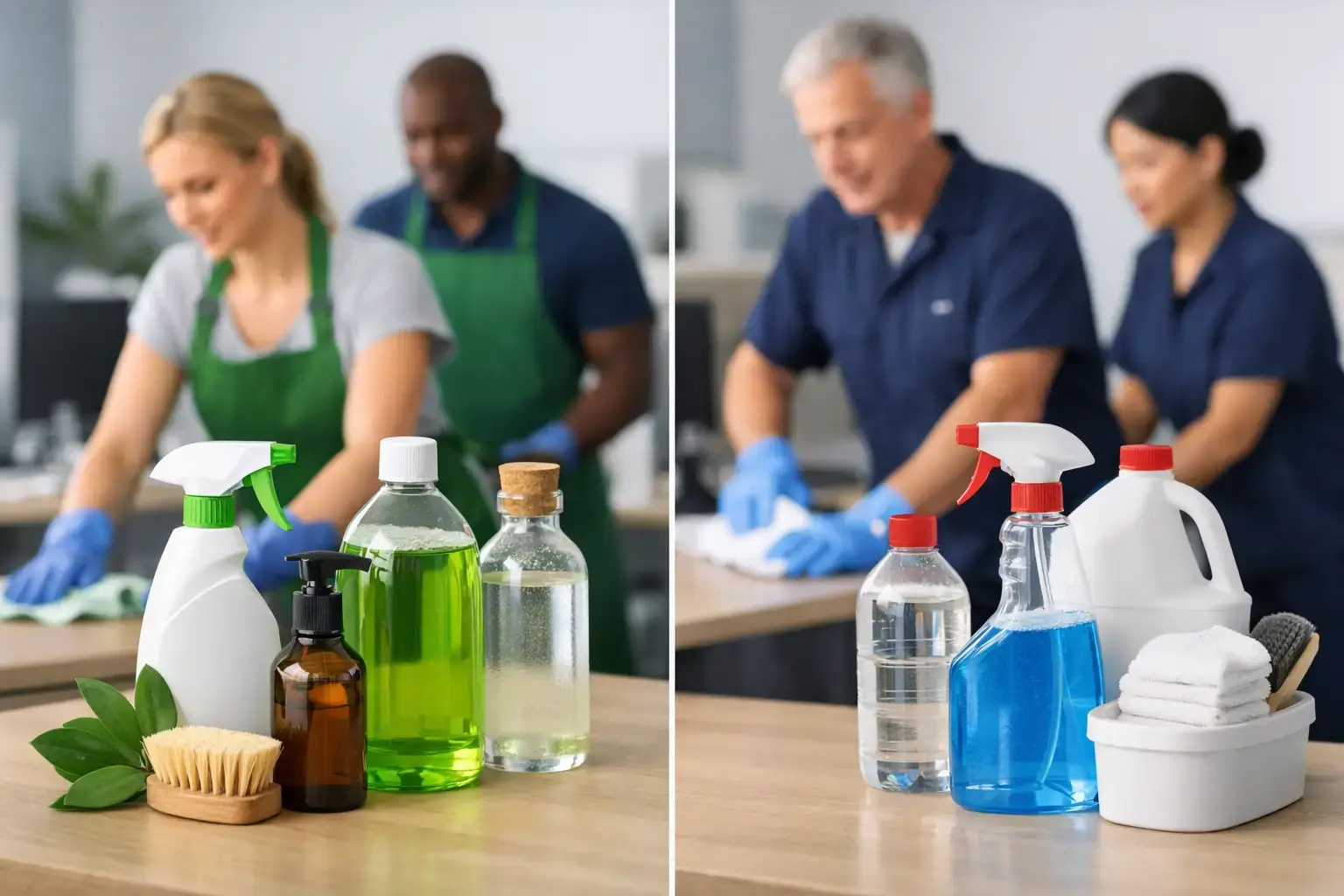
A disinfectant decision can affect far more than a cleaning closet. In a healthcare wing, aircraft cabin, manufacturing plant, or government facility, the choice between green disinfectants vs bleach cleaners influences worker exposure, surface life, odor, waste handling, and the ability to document an effective sanitation program. The right answer is not a matter of preference. It depends on the organism of concern, the required contact time, the surface, the operating environment, and the compliance standard the facility must meet.
Thank you for reading this post, don't forget to subscribe!Bleach remains a familiar tool because it is inexpensive, widely understood, and effective against a broad range of pathogens when used correctly. Environmentally responsible disinfectants have earned a larger role because many facilities need effective chemistry with less corrosiveness, lower odor, improved material compatibility, or a more manageable safety profile. Neither category should be selected based on a label color or a marketing claim alone.
Green Disinfectants vs Bleach Cleaners: Start With the Job
The word “green” is not a universal performance standard for disinfectants. It may refer to ingredients, biodegradability, fragrance choices, reduced volatile organic compounds, packaging, worker-safety considerations, or third-party environmental attributes. Those factors can be meaningful, but they do not replace antimicrobial registration or site-specific validation.
For a product to be used as a disinfectant, the facility should confirm that it carries the appropriate EPA registration and that its label supports the required use. The label identifies the microorganisms covered, approved surfaces, dilution instructions, contact time, personal protective equipment requirements, and use limitations. A cleaner that makes general environmental claims is not automatically a disinfectant, and an effective disinfectant is not automatically the best fit for every surface or shift.
Bleach cleaners generally rely on sodium hypochlorite. They can be highly effective when prepared, applied, and allowed to remain wet for the required contact time. However, bleach solutions can be corrosive to metals, damaging to some finishes and fabrics, and difficult to use consistently in areas with frequent cleaning cycles. Strong odor and irritation concerns can also affect employee acceptance and occupant comfort.
Many greener disinfectant options use alternative active ingredients such as hydrogen peroxide, citric acid, or quaternary ammonium compounds in formulations designed to balance antimicrobial performance with surface compatibility and handling. Each chemistry has limitations. Some may have narrower organism claims, longer contact times, residue concerns, or restrictions on certain materials. The operative question is not whether a product sounds safer or stronger. It is whether it meets the facility’s documented cleaning objective without creating avoidable operational risk.
Efficacy Depends on the Label and the Process
A disinfectant does not work merely because it was sprayed on a surface. Soil, grease, and organic matter can interfere with performance. High-touch surfaces generally need cleaning before disinfection unless the product label specifically supports a one-step cleaning and disinfecting process under the conditions present.
Contact time is often where programs fail. If a label requires a surface to remain visibly wet for several minutes, a quick wipe-on and wipe-off application may not deliver the claimed disinfection result. This matters in fast-moving environments such as terminals, production lines, public restrooms, and shared offices, where staff need methods that can be executed consistently under real workload conditions.
Bleach is frequently selected for response situations involving bloodborne pathogens, certain outbreak protocols, or applications where a governing procedure specifically calls for chlorine-based chemistry. In those cases, substitution should not be assumed. Review the applicable protocol, product label, infection prevention guidance, and contract requirements before changing products.
Conversely, routine use of bleach across every area may be unnecessary. If the target organisms, surface types, and risk assessment support an EPA-registered alternative, a facility may reduce material damage and improve day-to-day usability without lowering sanitation standards. That is a controlled operational decision, not a compromise.
Safety and Surface Compatibility Drive Long-Term Cost
The apparent simplicity of bleach can obscure its operational burden. Repeated chlorine exposure may corrode stainless steel, damage coatings, dull finishes, weaken textiles, and affect equipment components. In aviation, healthcare, food-adjacent operations, laboratories, and manufacturing environments, compatibility with approved materials can be as important as kill claims.
Bleach must never be mixed with ammonia, acids, or other incompatible chemicals. Such combinations can produce dangerous gases. Facilities should also manage dilution carefully, particularly when using concentrates or preparing fresh solutions. An over-concentrated solution can increase damage and worker exposure without improving results beyond the product’s labeled use instructions.
Green disinfectants are not automatically harmless. Concentrated hydrogen peroxide products, quaternary ammonium compounds, and other active chemistries may require gloves, eye protection, ventilation, or controlled storage. “Safer” should mean evaluated against the actual use scenario, not assumed from a sustainability claim.
A strong program reviews the safety data sheet, technical data sheet, label directions, dilution control procedures, storage requirements, disposal guidance, and employee training needs. For institutional buyers, these documents are part of the purchasing decision, not paperwork to collect after the order is placed.
Choose Chemistry by Area, Not by One Facility-Wide Rule
A single disinfectant may not be the most efficient solution for an entire campus or operation. Higher-risk spaces can require a different protocol than administrative offices, break rooms, warehouses, or exterior common areas. Segmentation allows facilities teams to apply the right chemistry where it is needed while controlling unnecessary exposure and material wear elsewhere.
Consider four questions before standardizing a product:
- What pathogens, regulations, customer requirements, or internal protocols define the required level of disinfection?
- What surfaces will be treated repeatedly, including metals, touchscreens, finished floors, plastics, upholstery, and coated equipment?
- Can the workforce reliably meet the dilution, dwell time, rinsing, and personal protective equipment requirements during normal operations?
- Does the supplier provide current EPA registration details, safety documentation, technical specifications, and traceable lot or quality information when required?
This framework prevents a common procurement mistake: selecting a product based on a broad claim, then discovering that the chemistry does not fit the facility’s surfaces, workflow, or documentation requirements.
Documentation Is a Performance Requirement
For government, military, aviation, healthcare, and regulated manufacturing environments, the chemical itself is only one part of compliance. Procurement teams may need safety data sheets, EPA registration information, technical specifications, cleaning procedures, training records, and proof that products are used according to label directions. Contract requirements may also specify approved product categories, environmental attributes, packaging standards, or domestic sourcing considerations.
This is where disciplined supplier support matters. A facility should be able to identify what was used, where it was used, how it was diluted, and which procedure governed the work. If an audit, inspection, incident review, or customer complaint occurs, vague statements about using an “eco-friendly cleaner” will not demonstrate compliance.
Veteran Commercial Cleaning supports this operational approach by emphasizing professional-grade chemistry, procurement-ready documentation, and cleaning solutions selected for demanding facility conditions. The objective is not to make a green claim for its own sake. It is to help buyers align safety, sanitation performance, and responsible chemistry with the standards their sites must meet.
When Bleach Is the Better Choice
Bleach can remain the appropriate selection when a facility protocol specifically requires it, when its labeled claims match the contamination event, or when alternative products are not approved for the target organism or use area. It can also be suitable for certain hard, nonporous surfaces that tolerate chlorine exposure and can be rinsed as required.
The key is control. Use the correct concentration, apply it only to compatible surfaces, meet the labeled contact time, provide required protective equipment, and never improvise chemical combinations. Bleach performs best as part of a defined process, not as a universal answer to every cleaning challenge.
When a Green Disinfectant May Be the Better Fit
An EPA-registered disinfectant with environmentally responsible attributes may be preferable for routine high-touch disinfection, sensitive surfaces, occupied areas, or facilities seeking to reduce harsh chemical exposure and odor. It may also support programs that prioritize material longevity, employee comfort, and broader environmental purchasing goals.
That choice still requires scrutiny. Confirm organism claims, contact time, surface compatibility, required rinse steps, and any use restrictions. Review environmental certifications or claims separately from disinfectant efficacy. A product can perform well in both areas, but the facility should verify each requirement rather than treating one claim as proof of the other.
The most reliable cleaning programs do not choose between environmental responsibility and institutional performance. They define the risk, verify the chemistry, train the people doing the work, and maintain the documentation that proves the process can stand up to inspection. That is how a disinfectant choice becomes a safer, more durable facility standard.