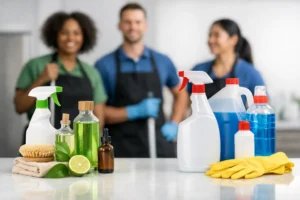
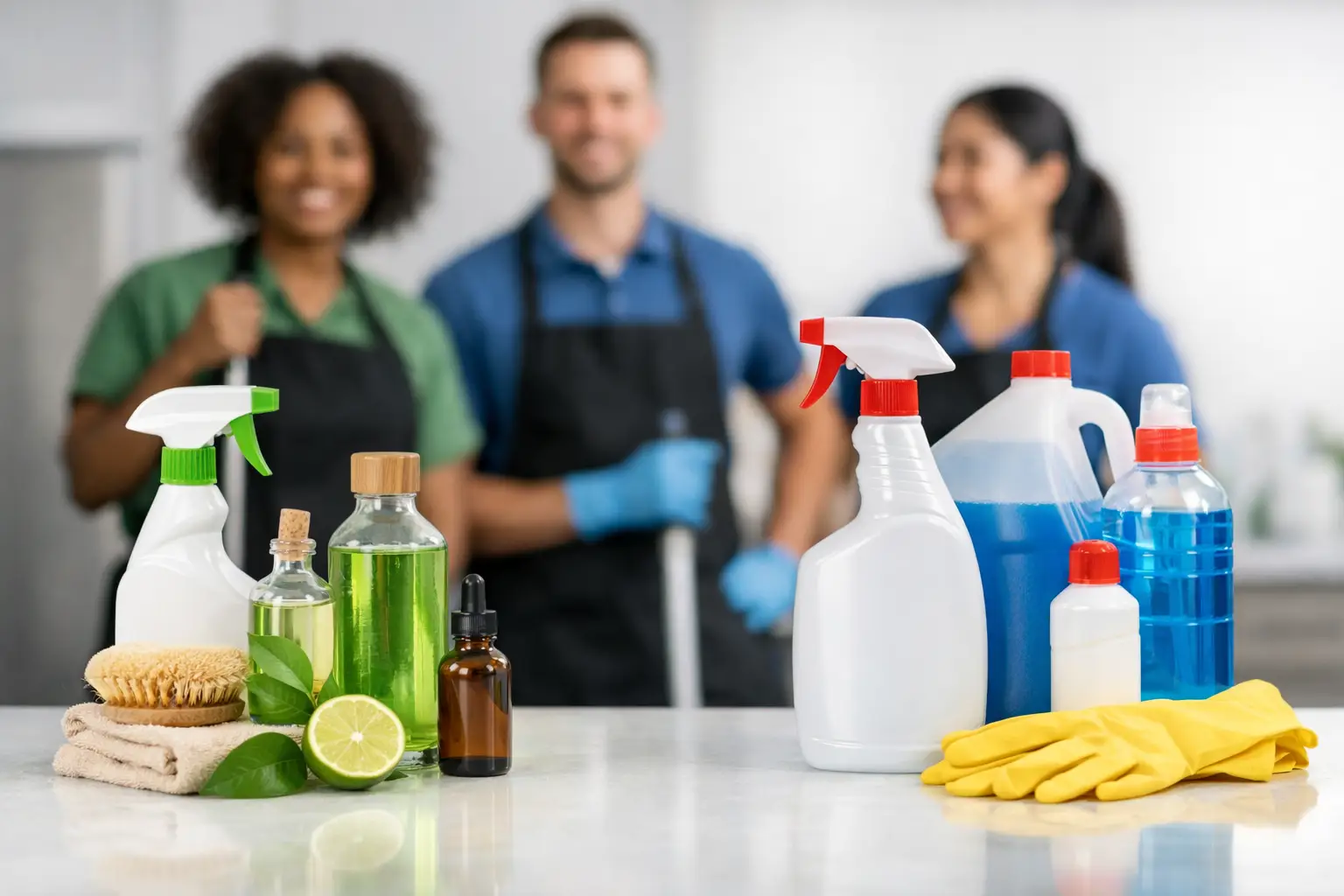
When an airport gate turnaround, production shift, or patient-care schedule leaves little room for error, the debate over green disinfectants vs traditional chemicals becomes an operational decision, not a branding exercise. Facility leaders need products that control pathogens as directed, protect personnel and surfaces, support documentation requirements, and fit the realities of daily cleaning.
Thank you for reading this post, don't forget to subscribe!The right choice is rarely as simple as “green is safer” or “traditional is stronger.” A disinfectant’s performance depends on its active ingredient, Environmental Protection Agency registration, label claims, contact time, soil load, application method, and the discipline of the cleaning program behind it. Environmental considerations matter, but they must be evaluated alongside efficacy and compliance.
Green Disinfectants vs Traditional Chemicals: The Operational Difference
Traditional disinfectants often rely on familiar active chemistries such as sodium hypochlorite, quaternary ammonium compounds, hydrogen peroxide, alcohol, or phenolics. These formulations can be highly effective when used according to their EPA-approved labels. They are common in institutional cleaning because they have established use patterns, broad availability, and, in many cases, targeted pathogen claims.
Green disinfectants are not one uniform chemical category. The term generally refers to products designed to reduce environmental or human-health concerns through ingredient selection, lower volatile organic compound content, reduced corrosivity, biodegradable components, concentrated packaging, or other lifecycle considerations. Some use active ingredients such as hydrogen peroxide, citric acid, or thymol. Others may pair conventional antimicrobial actives with a formulation designed for a better safety or environmental profile.
That distinction matters. A product can be environmentally preferable in some respects and still require gloves, ventilation, controlled storage, and strict label compliance. Conversely, a conventional product may be the best fit for a specific high-risk application because its label supports the required pathogen claim or material compatibility profile.
For procurement teams, the question is not whether a product sounds green. The question is whether it meets the facility’s cleaning specification with the lowest practical risk to people, assets, and operations.
Efficacy Starts With the Label, Not the Marketing Claim
For disinfectants used in commercial, government, healthcare, aviation, and industrial environments, EPA registration is a central verification point. The label identifies the organisms a product is approved to control, the surfaces it can be used on, dilution instructions, personal protective equipment requirements, and the contact time needed for disinfection.
Contact time is frequently where programs fail. A surface must remain visibly wet for the full labeled period. If a product is wiped dry after 30 seconds but requires several minutes of contact time, the team may be cleaning the surface without achieving the claimed disinfection result. This risk applies to both green and traditional formulations.
Organic soil also changes the equation. Grease, dust, biofilm, and visible debris can shield microorganisms from the disinfectant. In manufacturing areas, food-adjacent spaces, transportation facilities, and high-touch public environments, cleaning before disinfection is often essential. Some products are designed to clean and disinfect in one step under defined conditions, but the label determines what those conditions are.
Facilities should avoid assuming that one disinfectant can cover every task. A restroom, patient-care area, aircraft cabin surface, maintenance bay, and office workstation may have different exposure risks, surface materials, and soil loads. Matching the product to the task is more reliable than treating any chemistry as universal.
Safety Has Direct Operational Value
Chemical exposure affects more than worker comfort. It can influence injury risk, absenteeism, training burden, storage controls, ventilation needs, and the durability of facility surfaces. Highly corrosive or strongly fragranced products may create avoidable problems when used broadly or incorrectly.
Green chemistry can provide meaningful advantages when it reduces harsh fumes, corrosive effects, residue, or unnecessary ingredient hazards. Lower-odor options may be particularly useful in occupied offices, public-facing government buildings, schools, transportation terminals, and areas where cleaning occurs during operating hours. Products with favorable material-compatibility profiles can also help protect finished floors, fixtures, electronics-adjacent surfaces, and high-value equipment.
However, “less harsh” does not mean “risk-free.” Concentrates still require accurate dilution. Hydrogen peroxide-based products can irritate eyes and skin at certain strengths. Plant-derived ingredients can trigger sensitivities. Any disinfectant can become a workplace hazard when workers lack training or when secondary containers are not properly labeled.
A sound program uses the Safety Data Sheet alongside the product label. The SDS helps safety teams assess handling, storage, emergency response, and personal protective equipment. The label governs legal use and disinfection claims. Both documents should be readily available to supervisors, employees, auditors, and contracting personnel.
Environmental Claims Need Documentation
Environmental responsibility is increasingly part of institutional purchasing, but broad claims should withstand scrutiny. Procurement officers may need to support supplier selection with technical specifications, SDS documentation, ingredient disclosures where available, packaging information, and relevant third-party certifications.
It is useful to separate three questions: Is the product registered and labeled for the intended disinfection task? Does it have credible evidence supporting environmental or safer-chemistry attributes? Does it fit the facility’s waste, water, ventilation, and worker-safety requirements?
A disinfectant should not be selected solely because it uses words such as natural, nontoxic, biodegradable, or eco-friendly. Those terms can describe part of a product’s profile without confirming antimicrobial efficacy or regulatory status. Likewise, a product with a respected environmental certification may not automatically be appropriate for every infection-control need.
For government and regulated buyers, documentation is part of performance. Product selection should produce a clear file: EPA registration details when applicable, technical data, SDS sheets, approved use instructions, certifications or standards cited by the manufacturer, and internal approval records. This discipline helps support inspections, contract requirements, and consistent use across shifts.
Where Traditional Chemistry May Be the Better Fit
There are situations where conventional disinfectants remain the operationally sound choice. A facility may require a specific pathogen claim, a short contact time, a particular dilution system, or compatibility with an established sanitation protocol. High-consequence areas may also have infection-prevention or customer requirements that narrow the list of acceptable products.
Bleach-based products, for example, can be effective and economical for certain applications, but their odor, corrosivity, surface impact, and mixing hazards can limit where they should be used. Quaternary ammonium products may offer convenient daily-use options, yet teams should evaluate residue, surface requirements, and any facility-specific exposure concerns. The correct answer depends on the label and the environment, not on a simplistic good-versus-bad chemistry comparison.
Traditional products also may be appropriate when a facility needs continuity with existing equipment, dispenser systems, training procedures, or approved standard operating procedures. Changing chemistry without validating workflow can create more risk than it removes.
How to Build a Defensible Selection Process
Start with the risk profile of each area. Identify the surfaces, expected soil, occupancy level, target pathogens or sanitation objectives, cleaning frequency, and material-compatibility concerns. A loading dock and a clinic waiting room should not necessarily receive the same product or process.
Next, compare candidates against the label claims that matter to your operation. Verify required contact times under real working conditions. If teams cannot realistically keep surfaces wet for the labeled duration, the product may be a poor operational fit even if its environmental profile is attractive.
Then assess worker and facility impact. Review PPE needs, odor, ventilation, dilution accuracy, storage, disposal, and potential effects on surfaces or equipment. Include the workers who use the products every day. Their experience often reveals practical issues that do not appear in a specification sheet.
Finally, document the decision and train to the selected process. Standardize dispensing, application tools, dwell-time expectations, and inspection methods. A well-chosen green disinfectant used inconsistently will not deliver the intended outcome. Neither will a traditional chemical applied without cleaning first or without adequate contact time.
A Better Standard Than “Green” or “Strong”
The most responsible disinfectant program is one that reduces preventable chemical burden without compromising sanitation performance. For some facilities, that will mean moving daily, general-purpose work toward lower-harshness formulations while reserving specialized traditional chemistry for defined high-risk tasks. For others, a single documented product system may be the most controllable option.
Veteran Commercial Cleaning approaches this decision through performance, compliance, and practical implementation. The objective is not to replace every conventional chemical on principle. It is to give facilities a defensible path to safer, environmentally responsible cleaning chemistry where it performs, while maintaining the institutional standards that protect people, operations, and mission-critical spaces.
A product earns its place in a facility when its label claims match the task, its documentation withstands review, and the cleaning team can use it correctly every time.