A missed sanitation step can halt a production line, trigger an audit finding, expose employees to preventable hazards, or damage public confidence in a facility. A practical guide to industrial sanitation programs starts with that operational reality: sanitation is not a housekeeping task. It is a controlled system for reducing contamination risk, protecting people, and documenting that critical work was completed correctly.
Thank you for reading this post, don't forget to subscribe!For manufacturing plants, healthcare environments, airports, government buildings, and military facilities, the standard cannot be “it looks clean.” Teams need defined methods, appropriate chemistry, trained personnel, verification records, and a supply plan that holds up under daily use and formal review.
Start With Risk, Not a Product List
Industrial sanitation programs should be built around the facility’s actual contamination and safety risks. A food-adjacent manufacturing area, for example, may require frequent attention to residues, drains, shared tools, and high-touch control surfaces. A healthcare support area may prioritize disinfecting high-contact surfaces and preventing cross-contamination between spaces. An aviation maintenance operation may need to manage oils, hydraulic residues, and confined work areas without creating surface compatibility issues.
Begin by mapping the facility according to use, traffic, contamination potential, and consequences of failure. Walk the operation with facilities, safety, quality, and frontline personnel. The people performing the work often know where soils accumulate, where cleaning access is poor, and where procedures are routinely delayed by production demands.
A useful assessment identifies four conditions:
- What soils, residues, or contaminants are present
- Which surfaces, tools, and touchpoints create the greatest risk
- How often each area must be cleaned, sanitized, or disinfected
- What proof the facility needs to demonstrate completion and effectiveness
This assessment prevents a common failure: applying one cleaner, one schedule, and one expectation across areas that have entirely different operating conditions.
Cleaning, Sanitizing, and Disinfecting Are Different Controls
These terms are often used interchangeably, but a compliant program treats them as separate actions. Cleaning removes visible soil and residues. Sanitizing reduces certain microorganisms on appropriate surfaces to a level considered safe under the product label and applicable requirements. Disinfecting is intended to destroy or inactivate specified pathogens on hard, nonporous surfaces when used according to label directions.
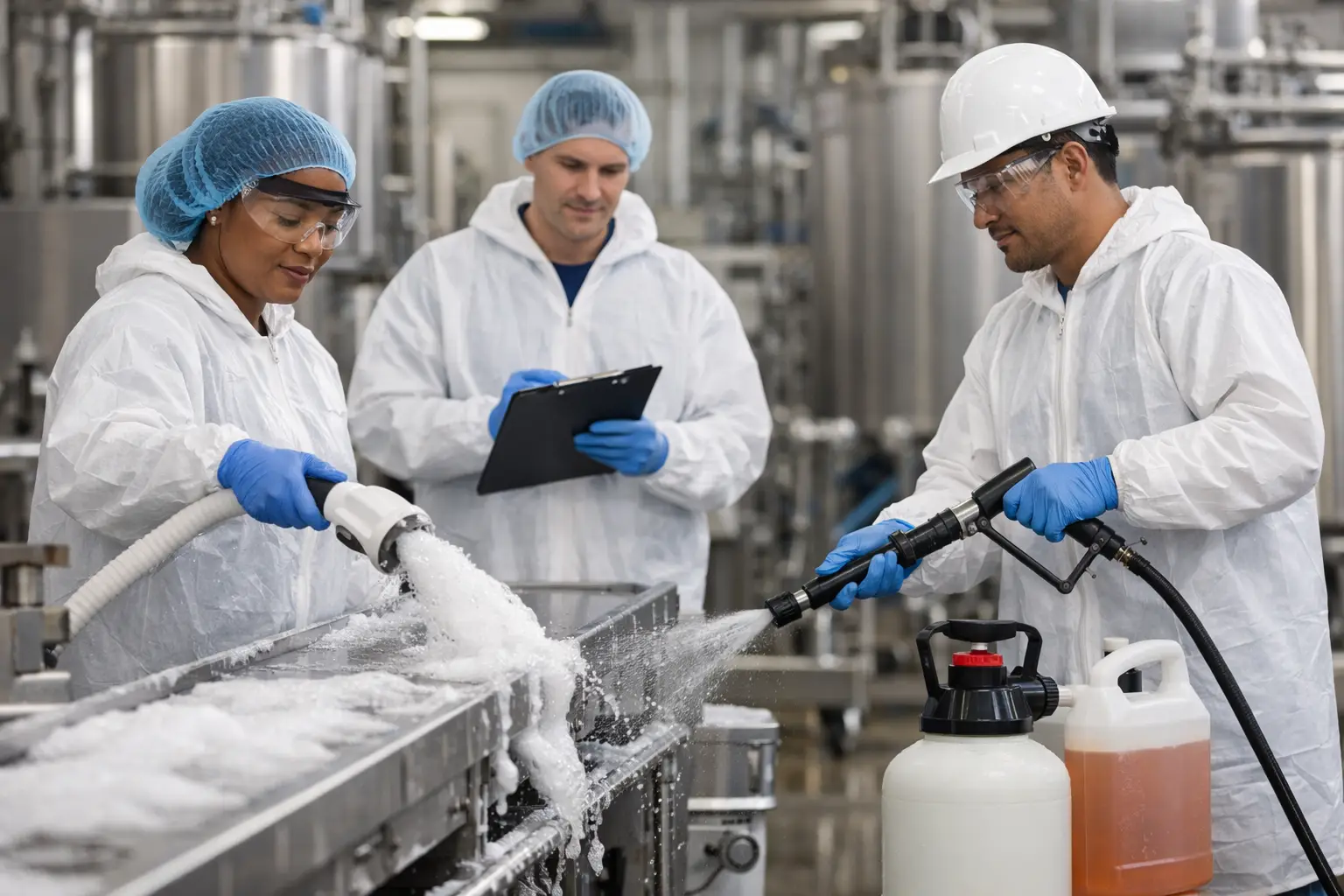
The sequence matters. Soil can shield microorganisms and reduce the performance of a sanitizer or disinfectant. In most situations, a surface should be cleaned first, then treated with the appropriate sanitation or disinfection product. Staff also need to follow the stated dilution, contact time, surface-use limitations, and personal protective equipment requirements. A product that is wiped away too early may leave the facility with paperwork showing a task was completed but no confidence that the treatment performed as intended.
Chemistry selection should balance performance with worker safety, material compatibility, odor concerns, ventilation, waste handling, and environmental goals. More aggressive chemistry is not automatically a better choice. The right product is the one that addresses the identified soil or microbial risk while supporting safe, repeatable use in that specific environment.
Build the Program Around Zones and Frequencies
A written sanitation program should clearly define what happens, where it happens, who performs it, and how often. Vague directions such as “sanitize as needed” create inconsistent outcomes and make verification difficult.
Most facilities benefit from separating work into operational zones. High-risk or high-touch zones may require action during each shift or between users. Production-adjacent zones may follow pre-operational and post-operational schedules. Warehousing, offices, break rooms, restrooms, loading areas, and exterior access points each need schedules that reflect real traffic and exposure, not a generic calendar.
Frequency should change when conditions change. Seasonal illness activity, staffing fluctuations, construction work, spill events, increased production, or a known contamination concern may justify temporary adjustments. Conversely, adding unnecessary tasks without a risk basis can exhaust personnel, increase chemical exposure, and cause critical steps to be treated as routine paperwork.
Write Procedures People Can Execute Under Pressure
Standard operating procedures should be specific enough for a trained employee to perform the task consistently during a busy shift. Identify the area or equipment, required supplies, preparation steps, soil-removal method, application method, contact time, PPE, disposal requirements, and completion record.
Use plain language. If a procedure requires a particular dilution or dwell time, state it directly. If equipment must be shut down or protected before cleaning, include that instruction. If a surface cannot tolerate certain chemistry, flag the restriction at the point of use. Procedures should also establish when employees must stop and report an issue, such as damaged equipment, a recurring leak, an unknown spill, or inadequate stock.
Visual work instructions can help in multilingual or high-turnover environments, but they do not replace training. Supervisors should observe work in real conditions and correct technique before poor habits become the accepted process.
Select Supplies With Compliance in Mind
Procurement decisions affect sanitation performance long after an order is placed. Facilities should maintain current safety data sheets, technical specifications, product labels, and any relevant regulatory or certification documentation for the products in use. These records support employee training, hazard communication, audit readiness, and informed decisions when a product or process changes.
Standardizing approved products can reduce confusion and prevent incompatible or duplicate chemistry from entering the supply room. That does not mean every facility should use a single formula everywhere. It means the approved assortment should be intentional: an industrial degreaser for appropriate heavy soils, a disinfectant used according to its label, sanitation systems that support controlled application, and wipes where portability and immediate access are operationally justified.
Dispensing and storage deserve the same discipline. Clearly labeled secondary containers, controlled dilution, secure storage, inventory rotation, and separation of incompatible products reduce avoidable safety and quality problems. A program can fail quietly when crews substitute an unapproved product because the specified item was unavailable.
Verify the Work Beyond a Signed Checklist
Checklists are necessary, but they are only one layer of control. A supervisor’s visual inspection can identify missed areas, residue, damaged surfaces, and improper storage. Periodic process audits can confirm whether personnel are following the written procedure. Depending on the environment, facilities may also use environmental testing or other verification methods defined by their quality and regulatory requirements.
The goal is not to create paperwork for its own sake. It is to find gaps early. If a recurring issue appears in one location, investigate the cause: insufficient frequency, difficult access, wrong equipment, poor product fit, inadequate training, production interference, or an underlying maintenance condition. Corrective action should address the cause, then document what changed and whether the change worked.
Digital logs can improve traceability, especially across multiple shifts or buildings, but paper records can still be effective when controlled consistently. What matters is legibility, accountability, retention, and the ability to demonstrate that deviations were addressed.
Train for Safety, Consistency, and Accountability
Training should cover more than how to spray and wipe. Employees need to understand why pre-cleaning matters, how to read product labels, required contact times, dilution controls, PPE, chemical storage, cross-contamination prevention, and escalation procedures. They should also know which tasks they are authorized to perform and when to request supervisory support.
Refresher training is especially valuable after new products are introduced, procedures change, audit findings occur, or incident trends emerge. Training records should identify the employee, topic, date, trainer, and competency confirmation. For critical tasks, observation-based validation is stronger than a simple attendance signature.
Leadership has a role as well. If sanitation crews are routinely rushed, denied access to needed areas, or asked to work with inadequate supplies, even a well-written program will break down. Operational planning must protect the time and resources assigned to sanitation.
Keep Improving the Program as Operations Change
A facility’s sanitation plan should be reviewed at defined intervals and whenever significant changes occur. New equipment, revised layouts, different raw materials, expanded shifts, construction, new regulatory requirements, and changes in product chemistry can all affect the program’s suitability.
Veteran Commercial Cleaning supports facilities that need industrial cleaning and sanitation solutions backed by the documentation and procurement discipline expected in high-compliance environments. The strongest sanitation programs pair that kind of supply readiness with clear procedures and accountable execution on the floor.
A sanitation program earns trust when it works during an ordinary shift, not only when an inspection is scheduled. Keep the process practical, verify the critical steps, and treat every recurring gap as useful operational intelligence rather than a reason to simply add another box to the checklist.