A missed cleaning task in a patient room is not just an operational inconvenience. It can affect infection prevention, survey readiness, staff confidence, and the facility’s ability to demonstrate control over its environment. That is why healthcare cleaning automation trends are receiving serious attention from environmental services leaders, facilities managers, and procurement teams. The question is no longer whether automation belongs in healthcare. The question is where it can improve consistency without creating new compliance, safety, or workflow problems.
Thank you for reading this post, don't forget to subscribe!Automation is changing routine floor care, disinfection documentation, supply management, and quality assurance. But technology does not replace a disciplined environmental services program. It works best when it supports trained teams, approved procedures, validated chemistry, and clear accountability.
Why Healthcare Facilities Are Automating Cleaning
Healthcare facilities face a difficult combination of pressures: persistent labor constraints, increasing documentation requirements, high patient turnover, complex building layouts, and heightened expectations around infection prevention. Manual cleaning remains essential, particularly for high-touch surfaces, isolation areas, restrooms, and clinical spaces that require judgment and careful attention to detail. Yet many repetitive tasks can be better scheduled, measured, or supported through automation.
The strongest business case is usually consistency. A robotic floor scrubber can follow a defined route repeatedly. A digital task platform can record when a room was serviced, by whom, and whether required steps were completed. Automated dilution equipment can help maintain the correct chemical concentration. These controls reduce variation, which is often where sanitation programs lose reliability.
For procurement leaders, automation also creates a clearer record of operational performance. Instead of relying only on paper logs or verbal confirmation, teams can use service data to identify missed zones, recurring equipment issues, supply consumption patterns, and labor bottlenecks. That information can support more defensible staffing, purchasing, and compliance decisions.
Healthcare Cleaning Automation Trends That Matter
Not every new device or software platform is a fit for a hospital, outpatient center, long-term care facility, or government clinic. The most useful trends address defined risks in the cleaning process rather than adding technology for its own sake.
Autonomous Floor Care Is Moving Beyond Pilot Programs
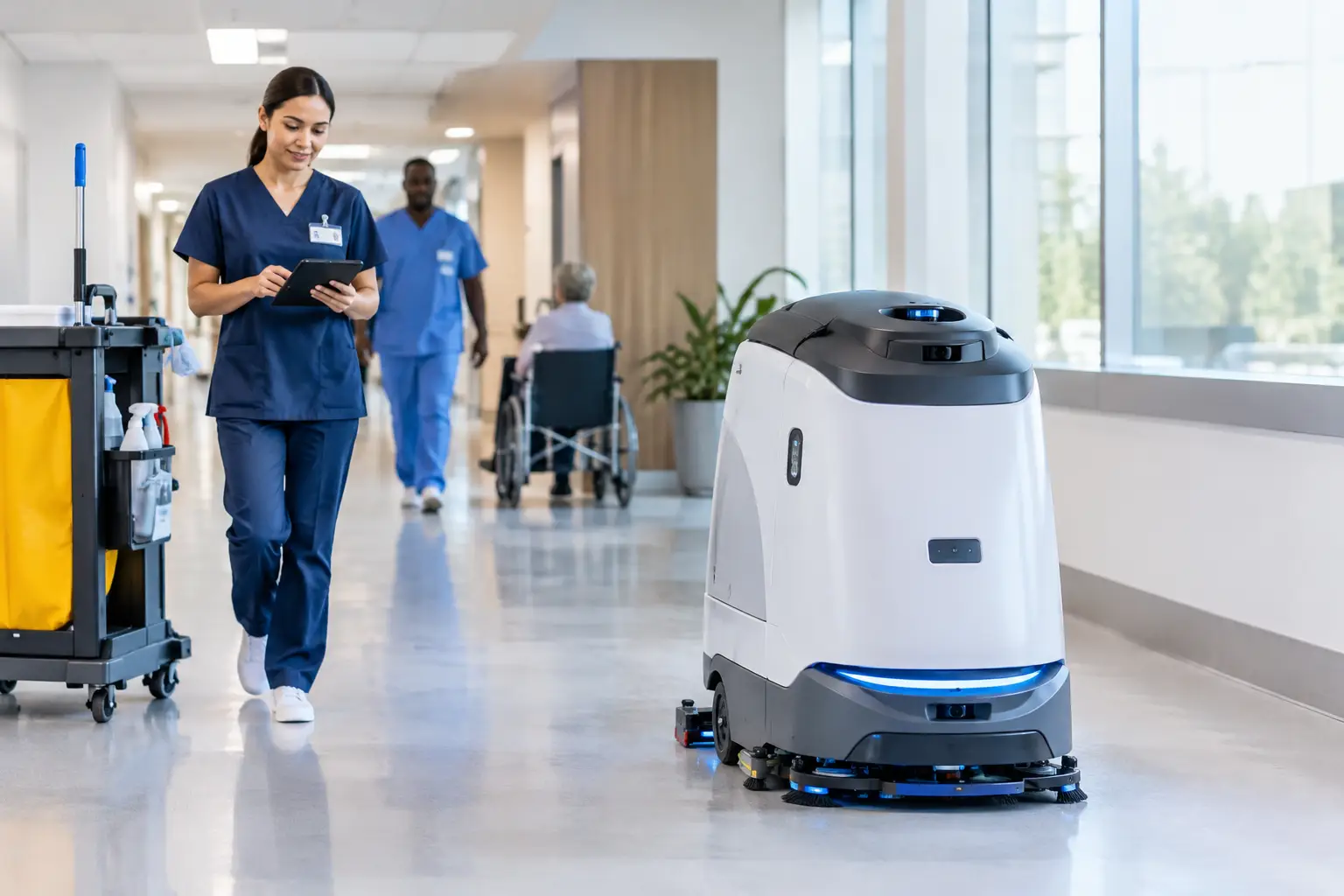
Autonomous floor scrubbers and vacuums are increasingly being used in large, predictable areas such as corridors, lobbies, cafeterias, administrative wings, parking structures, and certain public waiting spaces. These machines can handle repeatable floor maintenance while environmental services staff focus on patient rooms, spills, touchpoint disinfection, and other tasks requiring human judgment.
The trade-off is that autonomous equipment depends on disciplined operating conditions. Floor layouts must be mapped, routes need to be maintained, and teams need a process for charging, filling, emptying, inspecting, and storing the equipment. It may be less effective in crowded spaces, changing clinical environments, narrow pathways, or areas with frequent obstructions. A facility should evaluate a machine based on real traffic patterns, not an idealized demonstration route.
Digital Workflows Are Becoming a Compliance Tool
Cleaning software and mobile task systems are shifting from simple scheduling tools to operational control systems. Environmental services supervisors can assign room turnover tasks, document completion, record exceptions, and review performance by area or shift. Some systems can integrate occupancy status, asset data, or maintenance alerts to help prioritize work.
This trend matters because cleaning documentation is only useful when it reflects actual operations. Digital records can improve traceability, but only if workflows are simple enough for staff to use consistently. A burdensome system may produce incomplete or inaccurate entries, creating a false sense of control. The right platform should make the compliant action easier, not turn every cleaning task into a data-entry exercise.
Automated Chemical Dispensing Supports Safer Standardization
Chemical dilution and dispensing systems help facilities deliver consistent concentrations for approved cleaning and disinfecting products. This can reduce waste, lower the risk of overconcentrated solutions, and support safer handling for employees. It also helps standardize procedures across departments, shifts, and multiple locations.
However, dispensing equipment does not eliminate the need to follow product labels. Contact time, compatible surfaces, application method, personal protective equipment requirements, and storage practices still matter. Facilities should maintain current Safety Data Sheets, technical documentation, staff training records, and clear procedures for responding to spills or equipment failures.
Environmentally responsible chemistry can be part of this strategy when it meets the required performance standard for the application. The goal is not to use the harshest formulation available. The goal is to use appropriate chemistry, correctly diluted and applied, to achieve the required cleaning or disinfection outcome while supporting worker and occupant safety.
Data Is Improving Quality Assurance
Quality assurance is becoming more measurable. Facilities are using inspection applications, barcode or QR-based asset checks, occupancy signals, and performance dashboards to confirm that recurring work is completed. In some settings, sensor data may help identify restroom usage, fill levels, or service needs before a complaint is logged.
This creates an opportunity to move from complaint-driven cleaning to risk-based cleaning. High-traffic areas can receive more frequent attention, while lower-use spaces can be scheduled more efficiently. Still, data should guide supervisor decisions rather than replace them. A sensor can indicate traffic, but it cannot determine whether a surface has visible soil, whether a spill presents a hazard, or whether an isolation-room procedure was followed correctly.
Disinfection Technologies Require Careful Validation
Ultraviolet devices, electrostatic application equipment, and other supplemental disinfection technologies continue to attract interest. These tools may have a role in defined protocols, especially where a facility has identified a specific infection prevention objective and can validate the process.
They are not substitutes for manual cleaning. Soil and organic material can interfere with disinfection outcomes, and equipment performance depends on proper use, coverage, room setup, safety controls, and documented procedures. Before adopting any supplemental technology, facilities should involve environmental services, infection prevention, safety, clinical leadership, and procurement. The operating protocol matters as much as the equipment itself.
What Procurement Teams Should Evaluate Before Adoption
Healthcare cleaning automation should be evaluated as part of a complete cleaning program, not as an isolated capital or supply purchase. A vendor demonstration can show what a system can do under controlled conditions. Procurement and operations teams need to determine whether it can perform reliably in their own facility, with their own staff, surfaces, shifts, and compliance requirements.
A practical evaluation should address five areas:
- Operational fit: Confirm where the technology will be used, who will operate it, and how it fits into daily environmental services workflows.
- Safety and compliance: Review Safety Data Sheets, product labels, equipment instructions, training requirements, certifications, and required documentation.
- Cleaning performance: Define the expected outcome, whether that is soil removal, floor appearance, approved disinfection application, turnaround speed, or inspection performance.
- Service continuity: Identify battery, charging, water, chemical, maintenance, repair, consumable, and backup procedures before deployment.
- Data ownership and security: For connected equipment and platforms, confirm who can access operational data, how it is protected, and how records can be retained or exported.
Facilities should also establish a baseline before implementation. Measure current labor hours, room turnover times, inspection findings, chemical usage, slip incidents, equipment downtime, and complaint patterns. Without baseline data, it is difficult to determine whether automation has improved the program or simply changed how the work is performed.
Automation Changes the Role of Environmental Services
A common concern is that automation removes the human element from healthcare cleaning. In practice, the better model is role redesign. Technology can reduce repetitive travel, manual reporting, or routine floor care so trained personnel can focus on complex work where observation, judgment, communication, and infection prevention discipline are essential.
That shift requires training. Staff need to understand not only how to operate equipment, but also when not to use it. They need clear escalation procedures for spills, isolation precautions, damaged surfaces, equipment malfunctions, and areas that require manual intervention. Supervisors need to know how to interpret data without treating dashboards as a replacement for inspections and coaching.
Successful programs also involve frontline environmental services staff early. Their experience reveals practical obstacles that may not appear in a procurement specification: elevator access, hallway congestion, storage limitations, noise concerns, shift handoffs, and the realities of cleaning around patients and clinicians.
Build Automation Around Accountability
The most durable healthcare cleaning automation trends are not about replacing people with machines. They are about building more reliable systems around the people responsible for clean, safe facilities. Automation can standardize repeatable work, strengthen documentation, and give leaders better visibility into performance. It cannot compensate for unclear procedures, unapproved chemistry, inadequate training, or weak supervision.
For facilities evaluating the next investment, start with a specific operational problem and require evidence that the solution fits the environment. A well-designed cleaning program remains the foundation. Automation should make that foundation easier to execute, verify, and sustain when the stakes are high.