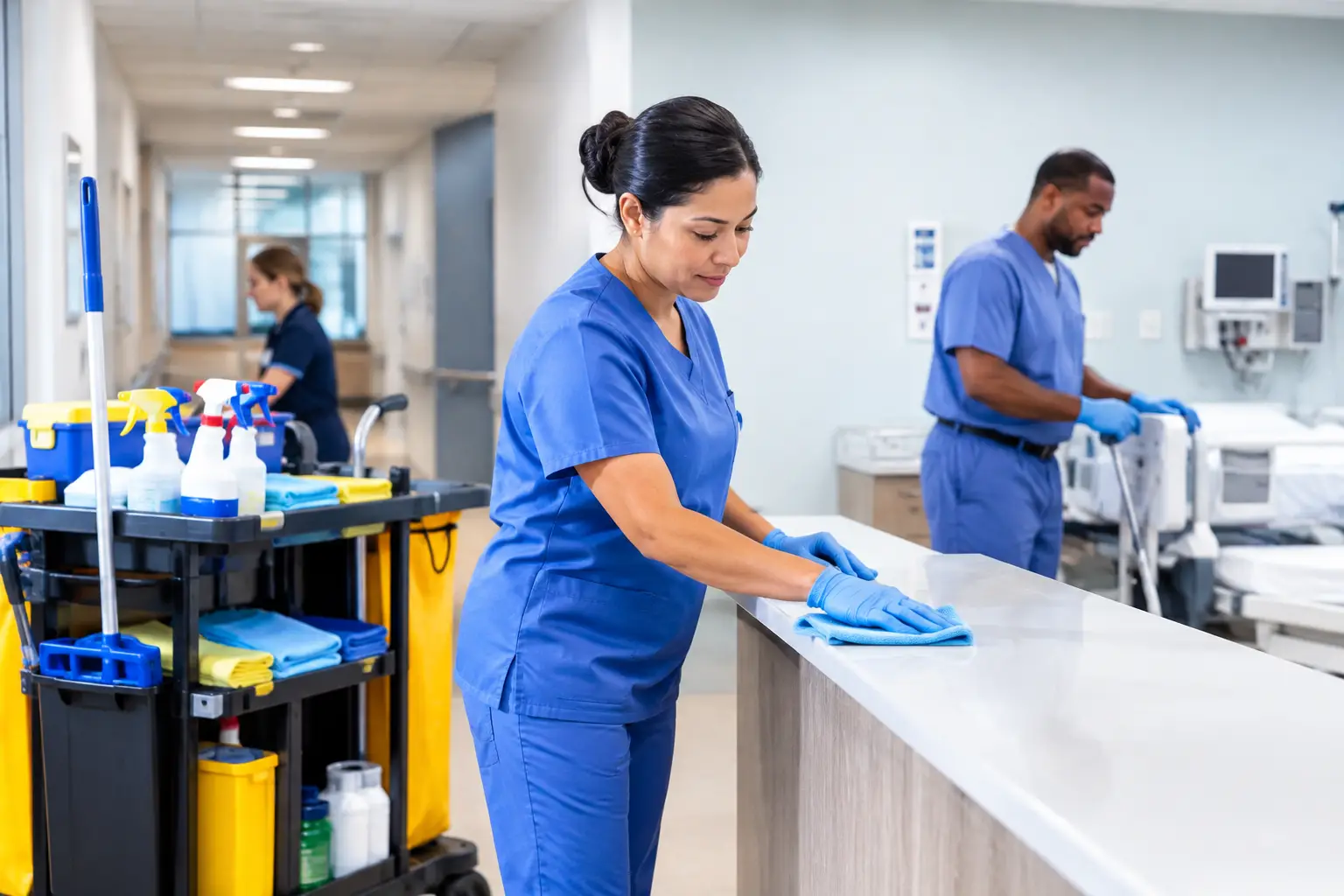
A missed high-touch surface, an undocumented terminal clean, or a supply cart that moves from an isolation room into a public corridor can create risk far beyond an untidy appearance. The strongest healthcare cleaning workflow examples show how environmental services teams control that risk through defined sequences, trained personnel, approved chemistry, and reliable documentation.
Thank you for reading this post, don't forget to subscribe!For facilities managers, infection prevention teams, and procurement leaders, a workflow is more than a checklist. It establishes who cleans, when they clean, which products and tools they use, how they prevent cross-contamination, and how the facility verifies completion. The right workflow also has to fit the care setting. A routine outpatient clinic turnover is not the same as a post-discharge patient-room clean or a response to a bloodborne-pathogen spill.
What a Healthcare Cleaning Workflow Must Control
Every effective workflow begins with risk assessment. The facility should identify the room’s use, patient population, expected soil load, isolation status, and frequency of contact with staff or visitors. From there, the workflow should specify the required level of cleaning and disinfection, the assigned team member, the approved products, and the verification method.
Cleaning and disinfecting are related but different tasks. Cleaning removes visible soil and organic material that can reduce a disinfectant’s effectiveness. Disinfection is performed according to the product label, including required wet contact time. A workflow that skips the cleaning step when soil is present, or allows surfaces to dry before contact time is complete, may look complete on paper while leaving a real compliance gap.
Tools require the same discipline. Color-coded microfiber, dedicated carts, controlled dilution systems, and clear dirty-to-clean movement patterns reduce the opportunity for cross-contamination. Environmental services teams should also have ready access to safety data sheets, technical specifications, and documented training for the chemicals they use.
1. Routine Patient Room Cleaning Workflow
A routine occupied-room workflow supports patient comfort while focusing effort where microbial transfer is most likely. The cleaner begins by performing hand hygiene, reviewing room precautions, placing appropriate signage, and gathering only the supplies needed for that room. Bringing excess materials inside increases the chance that clean supplies become contaminated.
The work should move from cleaner areas to dirtier areas, from high surfaces to low surfaces, and from the room entrance toward the bathroom. High-touch points deserve deliberate attention: bed rails, call buttons, light switches, door handles, overbed tables, visitor chairs, remote controls, faucets, and toilet flush handles. Linens and waste are removed according to facility protocol before final floor care.
Documentation can be as simple as a room status record integrated into the facility’s existing system, but it should confirm completion and exceptions. If a room cannot be fully cleaned because a patient is receiving care, the workflow should identify what was completed and trigger a return visit.
2. Discharge and Terminal Cleaning Workflow
Terminal cleaning requires a higher level of control because the room must be prepared for the next patient. Once the patient has left and the room is released for environmental services, the team member verifies isolation or enhanced precautions, dons required personal protective equipment, and removes waste, disposable items, and soiled linen safely.
All reachable surfaces, furnishings, equipment assigned to environmental services, and bathroom fixtures are cleaned and disinfected according to the facility’s approved scope. This typically includes areas that may receive less attention during occupied-room service, such as bed frames, mattress surfaces where applicable, privacy curtains under facility policy, wall-mounted dispensers, and the exterior surfaces of cabinets and drawers.
A practical terminal-cleaning workflow includes a final inspection before the room is released. Some facilities use fluorescent marking or adenosine triphosphate testing as a quality-assurance tool. These methods can identify training needs, but they do not replace proper technique or product label compliance. The verification method should match the facility’s risk profile and infection-prevention program.
3. Operating and Procedure Area Turnover Workflow
Operating rooms and procedure spaces demand precise timing, but speed cannot override cleaning sequence. Between cases, the workflow begins only after the clinical team has completed its responsibilities and the room is safe for environmental services access. Staff remove visible soil promptly, clean and disinfect high-touch surfaces, address the operating table and associated surfaces within their assigned scope, and manage floors according to protocol.
The critical distinction is between between-case turnover and end-of-day terminal cleaning. A turnover workflow focuses on surfaces and areas affected by the completed procedure, while terminal cleaning is broader and more detailed. Attempting to use one checklist for both can lead to missed tasks or unrealistic turnover expectations.
Clear role boundaries matter. Clinical personnel, sterile processing, anesthesia staff, and environmental services may each own different tasks. The workflow should make these boundaries explicit so no area is assumed to be someone else’s responsibility.
4. Isolation Room Cleaning Workflow
Isolation workflows are built around containment. Before entry, the cleaner reviews posted precautions and confirms the required personal protective equipment. Whenever possible, the team uses dedicated or disposable equipment for the room. Reusable tools should be contained and sent for proper laundering or decontamination rather than returned directly to a general cart.
The room is cleaned from least contaminated areas toward more contaminated areas, with the bathroom generally completed last. High-touch surfaces receive special attention, and the selected disinfectant must be appropriate for the organism or precaution category identified by the facility. Product claims, dilution instructions, and contact time must be followed exactly.
The exit process is as important as the cleaning process. Safe doffing of personal protective equipment, hand hygiene, waste handling, and cart decontamination prevent contamination from traveling into hallways, supply rooms, and subsequent patient areas.
5. Outpatient Clinic Exam Room Workflow
In an outpatient setting, the fastest workflow is often the most disciplined one. After each patient, the assigned staff member removes disposable barriers, manages waste, cleans visible soil, and disinfects high-touch and patient-contact surfaces. Exam tables, chairs, countertops, door handles, diagnostic equipment exteriors, and sink fixtures should be addressed based on the clinic’s approved matrix of responsibilities.
The trade-off is that a rapid turnover can become inconsistent during peak appointment periods. Clinics reduce this risk by standardizing room layouts, placing approved supplies at point of use, and using a short, visible checklist for recurring tasks. When multiple teams use the same space, supervisors should establish exactly who owns room turnover and who performs daily or periodic detail cleaning.
6. Emergency Spill Response Workflow
A spill involving blood or other potentially infectious material requires immediate control, not improvisation. The first step is to secure the area, post warning signage if needed, and select the personal protective equipment required by the facility’s exposure-control plan. Staff then use an approved response kit and follow the disinfectant label for the relevant application.
The workflow should distinguish between containing the spill, removing absorbent material or debris safely, cleaning the affected surface, disinfecting it for the required contact time, and disposing of waste according to facility policy. Reusable tools used in the response must be decontaminated before returning to service.
Incident documentation is especially valuable when the event creates an exposure concern, disrupts operations, or reveals a gap in supplies or staff readiness. A well-stocked response station and routine training are more dependable than relying on staff to assemble materials during an incident.
7. Waiting Room and Common-Area Workflow
Lobbies, elevators, public restrooms, check-in counters, and waiting rooms create a different challenge: high traffic with less control over who touches what. The workflow should use risk-based frequency rather than a once-per-day assumption. During high-volume periods, frequent attention to door hardware, seating arms, kiosks, elevator buttons, counters, and restroom touchpoints may be necessary.
Public spaces also require appearance standards. Floors, glass, waste receptacles, and reception surfaces influence patient confidence, but appearance should not pull staff away from high-risk touchpoints. A documented route schedule helps supervisors balance visible service with infection-prevention priorities.
Build Workflows That Teams Can Execute
A workflow succeeds when it is usable during a demanding shift. Keep instructions specific, use consistent room categories, provide approved products with complete compliance documentation, and train teams on the reason behind each sequence. Audit results should lead to coaching and process correction, not merely a completed form.
Veteran Commercial Cleaning supports facilities that need institutional-grade cleaning solutions aligned with performance, safety, and procurement requirements. The most reliable program is the one your team can execute consistently, verify confidently, and adjust quickly when patient care conditions change.