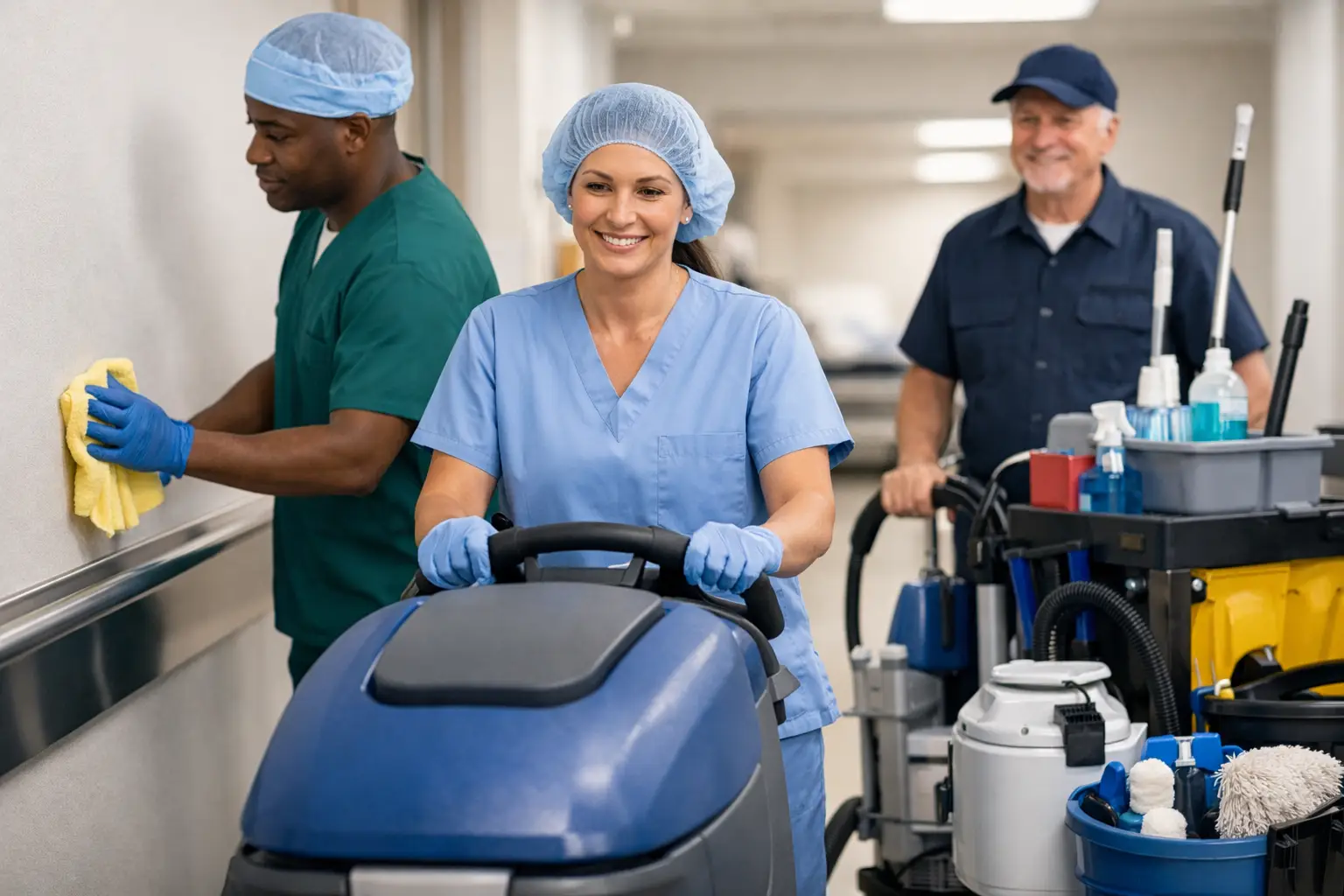
A missed high-touch surface in an occupied patient room is not a minor housekeeping issue. In a healthcare setting, it can affect infection prevention, survey readiness, staff confidence, and patient trust all at once. That is why a healthcare environmental services guide needs to go beyond cleaning basics and address how EVS supports clinical operations, regulatory expectations, and risk control every day.
Thank you for reading this post, don't forget to subscribe!Environmental services in healthcare sits at the intersection of sanitation, safety, and documentation. Teams are expected to deliver visibly clean spaces, reduce pathogen transmission risk, manage waste correctly, support room turnover, and do it without disrupting care. For facilities managers, procurement teams, and EVS leaders, success depends on more than choosing a disinfectant or assigning a task. It depends on building a system that is consistent, defensible, and practical under real operating pressure.
What a healthcare environmental services guide should actually cover
Too many guides stop at task lists. That is useful at the unit level, but not enough for leaders responsible for performance across departments or buildings. A workable healthcare environmental services guide should define cleaning responsibilities, product criteria, training requirements, documentation standards, audit methods, and escalation procedures.
It also needs to account for the fact that healthcare is not one environment. An outpatient clinic, surgical center, long-term care facility, and acute care hospital do not carry identical risks. Even within one hospital, the expectations for an emergency department, administrative office, waiting room, and isolation room are different. If the guide treats every area the same, teams either overapply chemistry where it is unnecessary or underperform where precision matters most.
The strongest EVS programs are built around risk stratification. In practical terms, that means cleaning frequency, dwell times, tools, PPE, and oversight are aligned to the type of space, surface contact level, patient population, and likelihood of contamination. That approach supports both compliance and efficiency.
Healthcare environmental services guide for daily operations
Daily operations are where policy either holds up or falls apart. A sound EVS program starts with clear separation between routine cleaning, discharge cleaning, enhanced disinfection, and terminal cleaning. When those categories are poorly defined, frontline staff are left to interpret expectations on the fly, which creates inconsistency and avoidable gaps.
Routine cleaning should focus on maintaining sanitary conditions in occupied and common areas, with close attention to high-touch points such as bed rails, overbed tables, call buttons, door hardware, light switches, restroom fixtures, and shared equipment surfaces. Discharge and terminal cleaning require a higher level of detail because the room condition is changing, and the next patient should not inherit contamination risk from the previous occupant.
Standardization matters, but so does workflow design. EVS teams need room-by-room sequencing that reduces cross-contamination risk, minimizes backtracking, and supports proper contact time for disinfectants. Color-coded tools, dedicated equipment by area, and clear dirty-to-clean progression can make the difference between a program that looks good on paper and one that performs during a busy shift.
There is also a recurring trade-off between speed and assurance. Fast room turnover supports patient flow, but rushed disinfection can compromise dwell time or surface coverage. Facilities that perform well over time are usually the ones that treat throughput as an operational planning issue, not a reason to cut cleaning corners.
High-touch surfaces deserve disproportionate attention
Not every surface carries equal risk. Floors matter, especially for overall sanitation and appearance, but many transmission concerns center on the surfaces hands touch repeatedly throughout the day. A disciplined EVS plan identifies those points by department and verifies they are cleaned at the right frequency with the right chemistry.
This is where staff training needs to be specific. Saying clean all touchpoints is too vague. Teams need to know which surfaces are included in each room type, how to handle shared mobile equipment, and when a visual check is not enough. In healthcare, assumptions are expensive.
Product selection is about compatibility, not just kill claims
A disinfectant can have a strong efficacy profile and still be a poor fit for a facility. Healthcare environments require products that align with surface compatibility, required contact times, application method, ventilation realities, and staff safety considerations. Harsh chemistry can create its own problems, especially if it damages equipment finishes, increases respiratory irritation, or discourages proper use.
That is one reason many facilities are reexamining product selection through both performance and occupational safety. Environmentally responsible chemistry does not mean lowering standards. It means looking for formulations that meet disinfection requirements while reducing unnecessary chemical burden where possible. The right choice depends on the use case, and procurement teams should expect complete technical documentation to support that decision.
Compliance, documentation, and survey readiness
In healthcare, a cleaning program is only as defensible as its documentation. If a facility cannot show what was cleaned, how staff were trained, what products were used, and how performance was verified, it becomes harder to demonstrate control during inspections, internal reviews, or incident investigations.
Documentation should cover product SDS sheets, technical data, usage instructions, training logs, competency records, cleaning schedules, and audit results. This is not paperwork for its own sake. It creates traceability. When there is a concern about process failure, traceability helps leaders determine whether the issue was staffing, product misuse, training drift, or an unrealistic workflow standard.
Survey readiness also depends on alignment between written procedures and actual practice. Inspectors and accreditors can identify when a protocol exists only in a binder. If room signage, storage conditions, dilution controls, PPE use, and team responses do not match the stated standard, the gap becomes obvious quickly.
Facilities with stronger outcomes usually keep EVS involved in broader compliance discussions rather than treating the department as a downstream function. Infection prevention, facilities, nursing leadership, and procurement should all have visibility into the same operating standard.
Training and accountability in healthcare EVS
An effective healthcare environmental services guide does not assume staff will learn through repetition alone. Healthcare cleaning requires task precision, situational judgment, and awareness of why steps matter. Training should be structured, documented, and refreshed regularly, especially when products, protocols, or regulatory expectations change.
Initial onboarding needs to cover chemical handling, dilution and dispensing where applicable, PPE, bloodborne pathogen procedures, waste stream segregation, and room-specific cleaning sequences. After that, competency validation should move beyond attendance records. Supervisors need a way to verify that team members can perform the work correctly in live settings.
Accountability works best when it is visible and fair. Random audits, fluorescent marker programs, checklist reviews, and supervisor rounds can all help, but they need to feed into coaching rather than paperwork alone. If a unit consistently underperforms, leadership should look at staffing patterns, cart setup, tool availability, and communication with clinical teams before assuming the issue is individual effort.
That is especially true in healthcare environments where EVS is often asked to absorb added responsibilities without corresponding process redesign. A disciplined organization respects the workload math.
Procurement decisions that strengthen EVS performance
For procurement teams, the wrong cleaning supply decision can create operational issues long after the purchase order is closed. Product substitutions, missing documentation, inconsistent packaging, and unclear use instructions all slow down execution on the floor. In healthcare, that friction shows up quickly.
A dependable supplier should be able to support healthcare buyers with consistent product specifications, SDS access, technical support, and documentation that fits a regulated environment. Procurement readiness matters because healthcare facilities are not buying for convenience. They are buying for compliance, continuity, and control.
It also helps to evaluate products and programs based on total operational fit. Does the chemistry support the surfaces in use? Are instructions clear enough for shift-level execution? Will the product simplify standardization across departments, or add another exception to manage? A lower-friction system is usually a safer system.
For organizations balancing sustainability goals with strict sanitation requirements, this is where disciplined sourcing becomes valuable. Veteran Commercial Cleaning reflects that approach by focusing on institutional-grade cleaning solutions built for compliance-focused facilities that need both performance and responsible chemistry.
Where healthcare EVS programs usually break down
Most failures are not dramatic. They are cumulative. A missed retraining cycle, unclear responsibility for shared equipment, inconsistent dwell times, unlabeled secondary containers, or a product change that never reaches frontline staff can all weaken the program over time.
Another common problem is treating EVS as separate from patient care support. In reality, environmental services is part of the care environment. When nursing, infection prevention, and EVS do not communicate clearly about isolation status, discharge timing, or equipment cleaning responsibility, sanitation reliability suffers.
The fix is rarely adding more policy. Usually it is clarifying ownership, tightening training, simplifying approved products, and auditing the work in a way that reflects actual risk. Better systems beat longer manuals.
A healthcare facility does not need a perfect cleaning program on paper. It needs one that holds up on a busy day, with real staff, real turnover pressure, and real compliance expectations. That is the standard worth building toward.