A failed cleaning supply order rarely begins with an empty shelf. It usually begins weeks earlier, when a buyer accepts a product description instead of verifying the documentation, packaging, replenishment capability, and safety requirements behind it. Knowing how to source contract ready cleaning supplies means building a supply decision that can withstand an audit, support frontline staff, and continue performing when demand changes.
Thank you for reading this post, don't forget to subscribe!For facilities in healthcare, aviation, manufacturing, government, and military environments, the product itself is only one part of the requirement. The supplier must also be prepared to provide the records, consistency, and operational support that formal purchasing processes demand.
Define “Contract Ready” Before You Issue a Request
Contract ready does not simply mean a supplier can sell cleaning chemicals in bulk. It means the supplies, documentation, and vendor processes are suitable for a formal agreement, purchase order, or regulated facility environment.
Start by translating the scope of work into specific cleaning outcomes. A manufacturing plant may need degreasers that address oils and production soils without creating unnecessary exposure concerns. A healthcare setting may require disinfectants appropriate for defined surfaces and dwell times. An airport or government building may need sanitation products that work across high-touch public areas while supporting a documented safety program.
Be precise about where and how products will be used. “General-purpose cleaner” is not a sufficient specification when crews are cleaning food-contact areas, restrooms, production floors, equipment exteriors, or sensitive public spaces. Each use case affects the chemistry, application method, dilution needs, PPE expectations, and records the facility should request.
A practical scope identifies product categories, expected quantities, delivery cadence, storage constraints, and service conditions. It should also identify who approves substitutions. Without that control, a supply disruption can turn into an unreviewed chemistry change on the floor.
Build Your Compliance File Alongside Your Product List
The strongest procurement decisions begin with documentation, not marketing claims. Before approving any cleaner, disinfectant, wipe, or sanitation system, establish the file your organization needs to keep on hand.
At minimum, request current Safety Data Sheets, technical data sheets, manufacturer instructions, dilution guidance where applicable, and product identifiers that match what will arrive at the facility. These documents should be easy for environmental health and safety teams, supervisors, and employees to access. A document that is outdated, incomplete, or disconnected from the delivered product creates unnecessary risk.
For disinfectants and sanitizers, confirm that the labeled use aligns with your intended application. Review contact time, compatible surfaces, directions for use, and any required pre-cleaning steps. A disinfectant cannot deliver its intended result if staff do not have the time, tools, or training to follow its label directions.
Certifications and regulatory statements should be evaluated against the actual contract requirement. Do not assume that a broad environmental claim, a general safety statement, or a familiar brand name satisfies a facility standard. Ask what the certification means, which product configuration it applies to, and whether the supplier can provide supporting records when requested.
Documentation must match the delivered item
This point is easy to miss in multi-location procurement. A supplier may provide a technically acceptable document for one formula, size, or package, while a different item is shipped later. Require clear manufacturer part numbers and maintain a process for reviewing substitutions before they reach staff.
That discipline matters during inspections, incident reviews, and inventory transitions. It also prevents a common operational failure: teams continuing to use old instructions after a product has changed.
Evaluate Chemistry for Performance and Worker Safety
High-compliance cleaning does not require defaulting to the harshest available formulation. The right chemistry is the one that performs against the target soil or sanitation need while fitting the facility’s ventilation, surface materials, employee exposure controls, and waste practices.
Assess compatibility before committing to a product. Strong cleaners can damage finishes, corrode sensitive materials, leave residues, or interfere with equipment if they are used outside their intended setting. Conversely, a milder product may be a better operational choice if it is effective for the soil load and can be used consistently by staff.
Consider the full task, not just the chemical. A concentrated product may reduce packaging and storage demand, but it requires reliable dilution equipment, trained workers, and verification that mixing is done correctly. Ready-to-use products can simplify use and reduce dilution errors, though they may require more storage space and more frequent replenishment.
The same trade-off applies to wipes, dispensers, and sanitation systems. Convenience supports compliance when it places the correct product at the point of use. It becomes a problem when the format creates excessive waste, encourages improper surface use, or is not available when crews need it.
Qualify the Supplier’s Operational Readiness
A contract-ready supplier should be prepared to answer practical procurement questions clearly. This includes product availability, packaging configurations, lead-time expectations, order tracking, replacement procedures, documentation access, and communication protocols.
Ask how the supplier manages product changes and discontinued items. A dependable supplier gives advance notice when possible, provides equivalent-product documentation for review, and does not treat substitutions as an afterthought. For critical facilities, continuity is a safety and compliance issue, not merely a purchasing inconvenience.
Review whether the supplier understands public-sector and institutional procurement requirements. Depending on the organization, that may include vendor registration, contract vehicle access, insurance or compliance records, domestic sourcing requirements, and formal quote or purchase-order workflows. A supplier that is familiar with these expectations can reduce administrative friction without bypassing your internal controls.
Veteran Commercial Cleaning supports this type of evaluation by pairing institutional-grade cleaning solutions with procurement-oriented documentation and a service model built for compliance-sensitive operations.
Test responsiveness before the contract is urgent
Supplier responsiveness is best measured before an emergency. During the sourcing phase, observe whether requests for SDS sheets, specifications, or clarification are answered accurately and promptly. Notice whether the contact can explain a product’s limitations as well as its benefits.
A supplier that overpromises during evaluation can create larger problems after award. Clear, disciplined communication is usually a better indicator of long-term reliability than a broad catalog alone.
Use a Controlled Trial Instead of a Broad Rollout
For a new product or supplier, a limited trial can reveal issues that paperwork cannot. Select a representative area, identify the cleaning task, and define what success looks like before products are deployed. Include the staff members who will use the product, along with facilities, safety, and purchasing stakeholders when appropriate.
Evaluate performance under normal conditions. Does the product remove the intended soil? Can workers follow the instructions during a real shift? Are dispensers practical? Does the product leave residue, create odor concerns, or affect surfaces? Are containers and labels easy to identify in storage?
Document the trial results and the approved use conditions. This creates a defensible record for the purchasing file and gives supervisors a clearer foundation for training. If a product works only when applied in a way that crews cannot realistically sustain, it is not the right operational choice.
Standardize the Order, Training, and Inventory Controls
Once products are approved, turn the sourcing decision into a repeatable system. Assign approved product names and part numbers, define reorder points, and limit purchasing to authorized items wherever possible. This reduces duplicate products, prevents unreviewed chemical substitutions, and makes SDS management more manageable.
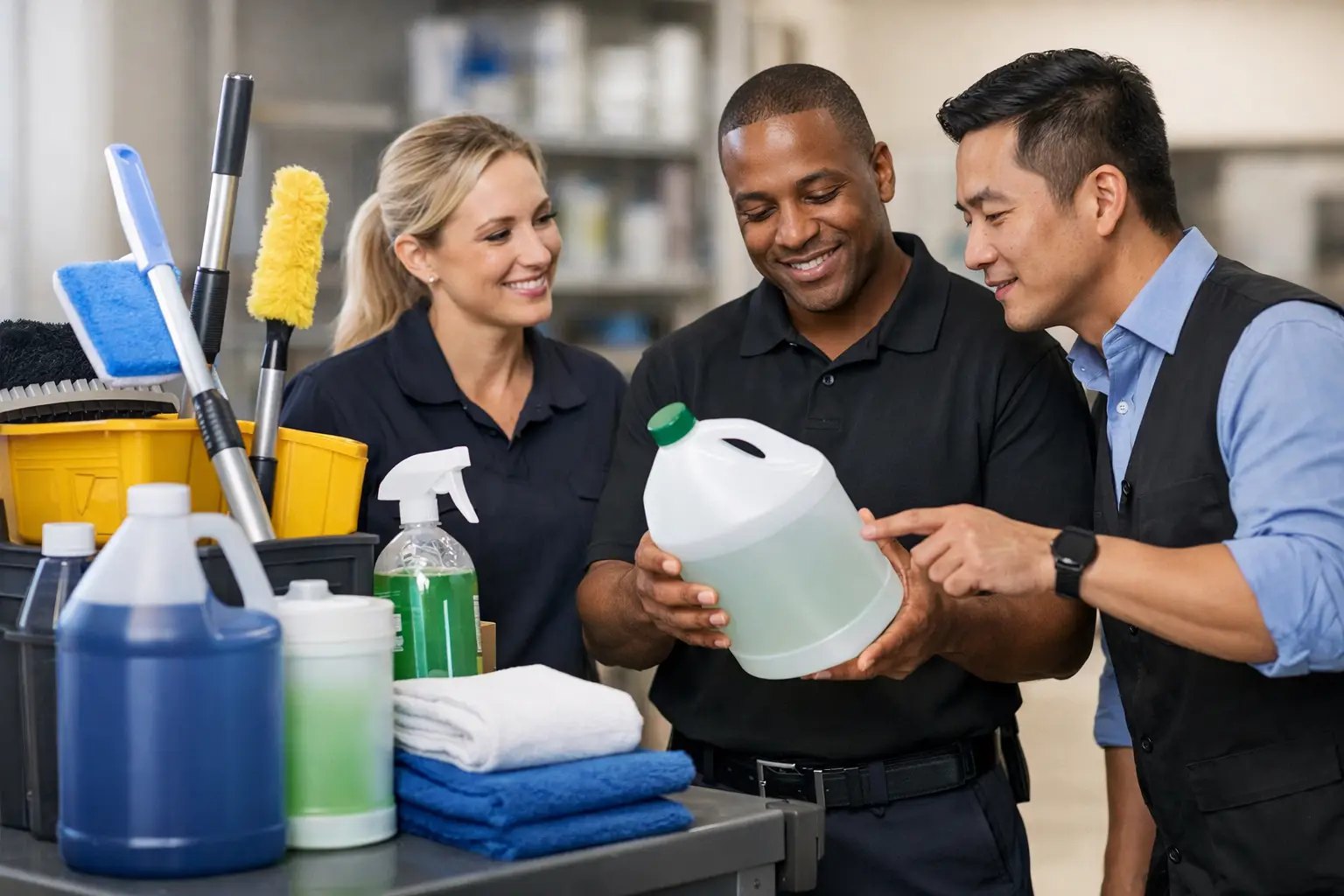
Training should cover the product’s intended use, dilution or application method, contact time when relevant, required PPE, storage, and what to do if a label is damaged or a product is spilled. Training is not an administrative add-on. It is the point where a compliant specification becomes an actual cleaning outcome.
For large or multi-site operations, review usage patterns regularly. Higher-than-expected consumption may indicate increased demand, but it can also signal overuse, improper dilution, leakage, ineffective dispensing, or a product that is poorly matched to the task. Inventory data should inform both future orders and operational coaching.
Create a Sourcing Standard That Holds Up
The best cleaning supply contracts do more than move cases of product. They establish a controlled system for safer work, consistent results, and documented accountability. When buyers define the job, verify the records, test real-world use, and qualify the supplier’s processes, they reduce the chance that a routine order becomes a facility-wide problem.
Treat every cleaning supply decision as part of your facility’s operating standard. The products that earn approval should make it easier for people to clean correctly, prove what was used, and keep critical spaces ready for the work they support.