A parts washer catches fire at the end of a shift, or a technician develops respiratory irritation after repeated wipe-downs in a poorly ventilated cell. In manufacturing, those incidents rarely come from one dramatic mistake. They usually come from routine degreasing done without enough controls. This manufacturing degreasing safety guide is built for facilities that need clean equipment, compliant processes, and fewer avoidable risks.
Thank you for reading this post, don't forget to subscribe!Why degreasing creates outsized safety risk
Degreasing sits at the intersection of chemical exposure, fire prevention, environmental management, and production uptime. The job sounds simple – remove oils, machining fluids, carbon soils, and residue from equipment or parts. The reality is more demanding. The chemistry that cuts heavy contamination can also affect skin, eyes, lungs, coated surfaces, electrical components, and waste streams if it is chosen or handled poorly.
That is why degreasing safety cannot be treated as a label-reading exercise alone. A compliant operation looks at the full chain: what soil is being removed, what substrate is being cleaned, how the product is applied, what ventilation exists, what residue remains, and how workers are trained. Procurement, EHS, maintenance, and operations all have a role here.
A common failure point is assuming a stronger product is automatically a better product. In practice, unnecessarily aggressive chemistry can increase hazard classification, damage parts, and create disposal complications without improving cleaning outcomes. Many facilities get better results by matching the chemistry to the soil load and process conditions instead of defaulting to the harshest option available.
Manufacturing degreasing safety guide for chemical selection
The safest degreasing program starts before the first spray bottle or automated unit is deployed. It starts with chemical selection. Buyers and plant leaders should evaluate a degreaser on performance and exposure profile at the same time.
Flash point matters when degreasing occurs near heat, sparks, or energized equipment. Vapor generation matters when cleaning takes place in enclosed areas, pits, cabinets, or lines with limited air movement. pH matters because highly alkaline or acidic products may clean effectively but create compatibility issues with aluminum, painted components, seals, or sensitive finishes. Fragrance and volatile ingredients may also matter more than expected in facilities where repeated daily use drives cumulative worker exposure.
SDS review should be standard, but it should not be the only review. Technical data, dilution guidance, required dwell time, rinse requirements, and material compatibility all affect safety. A product that works at lower use concentrations or shorter contact times can reduce handling exposure. A formulation designed for institutional performance without excessive harshness may also simplify training and routine use.
This is where trade-offs matter. Water-based degreasers can reduce flammability concerns, but they may require rinse steps or longer dwell times depending on the soil. Solvent-based options may deliver faster breakup on certain petroleum soils, but the exposure and fire-control burden may be higher. There is no universal best choice. The right choice depends on the process, the contamination, and the controls around it.
Process design matters as much as the product
Many degreasing injuries come from bad process habits, not just bad chemical choices. Open containers left at workstations, unlabeled secondary bottles, wiping parts by hand when a contained application would work better, and cleaning energized equipment are all common examples.
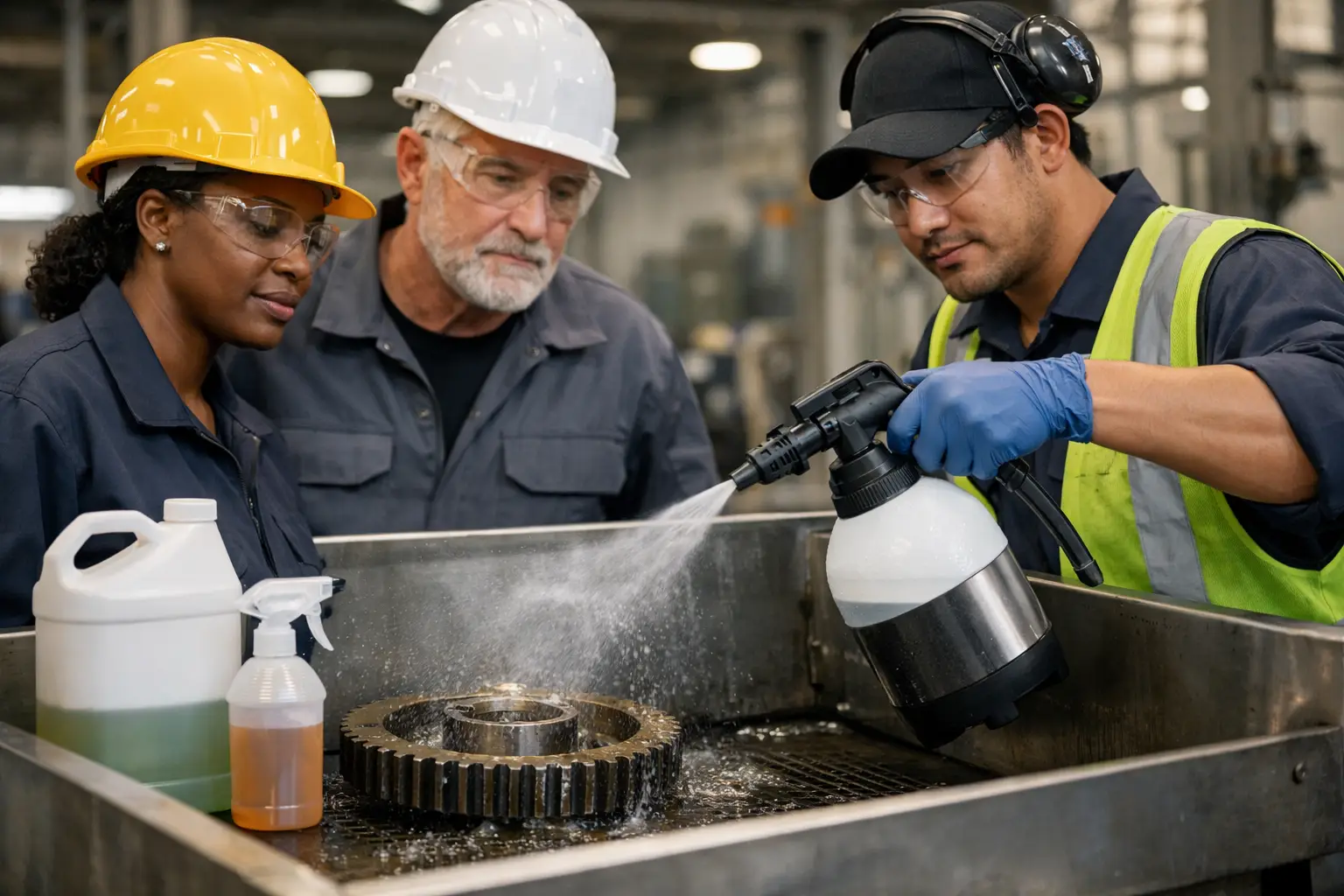
The safest process is usually the one that reduces aerosolization, splashing, and unnecessary manual contact. Foaming systems, controlled dispensing, closed parts-washing equipment, pre-measured dilution methods, and standardized application tools can all reduce variation. They also make it easier to audit compliance.
Facilities should decide in advance how degreasing will be performed for each task category. Cleaning a CNC enclosure, preparing metal components for assembly, removing grease from conveyors, and cleaning around electrical housings should not all follow the same method. Task-specific instructions reduce improvisation, and improvisation is where incidents begin.
Lockout and tagout must also be part of the conversation when degreasing is performed near moving equipment or energized systems. Cleaning cannot be separated from machine safety. If workers are reaching behind guards, cleaning under tension, or spraying around electrical components, the process has already drifted into a higher-risk zone.
Ventilation, PPE, and exposure control
A reliable manufacturing degreasing safety guide must treat exposure control as a layered system. PPE is one layer, not the whole plan. Facilities should first ask whether the task can be changed to reduce exposure. Can the product be dispensed in a closed system? Can the part be moved to a better ventilated cleaning area? Can the amount of chemistry used per task be reduced?
When engineering and administrative controls are not enough on their own, PPE selection becomes critical. Gloves should be chosen for chemical compatibility, not convenience. Eye protection should reflect splash risk, and in some applications a face shield may be warranted. Protective garments may be necessary where repeated contact is likely. Respiratory protection is more complicated and should only be implemented under a proper program when required by the hazard assessment.
Ventilation deserves more attention than it usually gets. General building airflow is not the same as local exhaust. If a degreaser produces noticeable vapors or mist in a fixed area, the facility should evaluate whether source capture is needed. This is especially true around dip tanks, enclosed work cells, maintenance rooms, and areas where multiple operators perform cleaning across a shift.
Training should include the reason for each control. Workers are more likely to follow glove, eyewear, and ventilation rules when they understand what the chemistry can do during repeated exposure, not just during a spill or splash event.
Storage, labeling, and spill readiness
Chemical safety often breaks down after receiving. Once a degreaser is transferred to daily-use containers or moved onto the floor, labeling discipline becomes essential. Secondary containers should be identified clearly, and storage should align with the product’s hazard profile and compatibility requirements.
Segregation matters. Degreasers should not be stored casually near oxidizers, ignition sources, or incompatible chemicals. Even in well-run plants, maintenance closets and point-of-use cabinets can become mixed-storage areas over time. Periodic audits help catch this drift before it becomes a fire or exposure issue.
Spill readiness should also be task-specific. A maintenance team cleaning hydraulic residue needs immediate access to absorbents, containment materials, PPE, and clear reporting instructions. The response for a small controlled spill is different from the response for a release in a drain-sensitive area or near active production. Those differences should be written down, trained, and easy to follow under pressure.
Documentation and compliance in real operations
For procurement teams and facility leadership, degreasing safety is not only about preventing injury. It is also about documentation discipline. SDS access, written procedures, training records, hazard communication, waste handling protocols, and compatibility documentation all support compliance and audit readiness.
This is where many organizations benefit from suppliers that understand institutional requirements. In manufacturing, healthcare-adjacent production, aviation support, and government environments, documentation is part of product performance. If a facility cannot verify what a product contains, how it should be used, and what controls it requires, that product creates administrative risk even before it creates operational risk.
A documented review process also helps standardize decision-making across sites. If one plant allows uncontrolled transfer into unmarked bottles while another uses compliant dispensing and task instructions, the organization has created inconsistency that will eventually show up in safety metrics. Consistency is not bureaucracy for its own sake. It is how high-compliance facilities keep routine work from becoming incident work.
Building a safer degreasing program over time
The best degreasing programs are not static. They are reviewed when a new soil type appears, when a line changes, when injury patterns emerge, or when a safer chemistry can deliver equal results. That review should involve operations, EHS, and the people doing the cleaning every day.
Start with the jobs that create the highest exposure or the most variation. Watch how they are actually done, not how they are described on paper. If workers are overapplying product, skipping PPE, or cleaning in spaces with poor airflow, the process needs redesign, not just retraining.
Veteran Commercial Cleaning works with organizations that need that level of discipline – performance, documentation, and safer chemistry aligned with the realities of regulated facilities. For manufacturing teams, that approach matters because degreasing is not a side task. It affects worker safety, equipment condition, environmental handling, and production continuity.
A cleaner part or machine is only a good outcome when the process that got you there is controlled, repeatable, and safe enough to stand up to daily use.