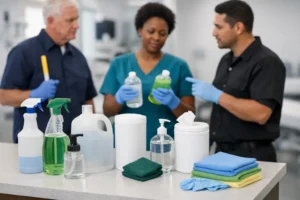
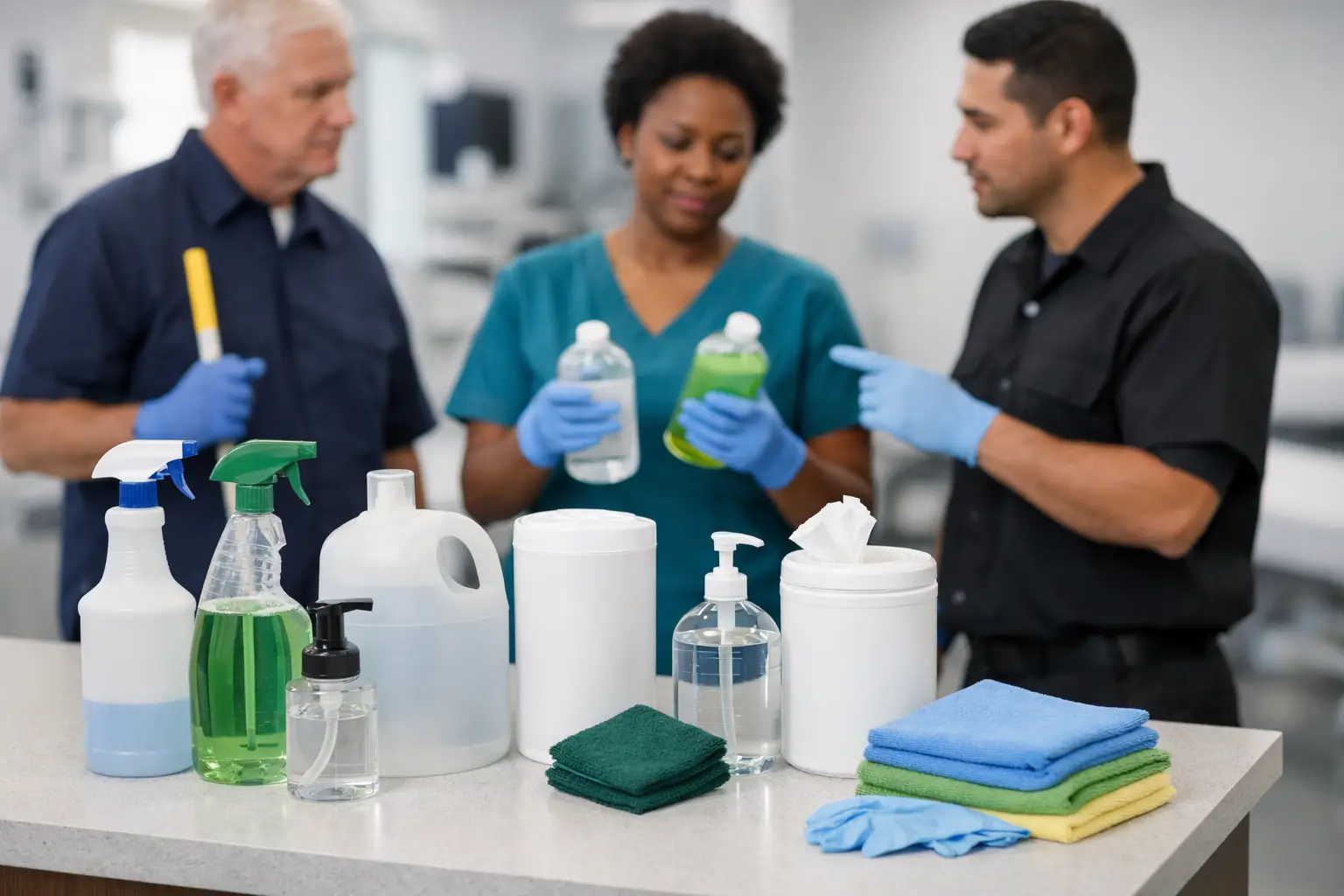
A medical cleaning products comparison should begin with the surfaces, soil loads, and compliance requirements in your facility – not a search for the strongest chemical on the shelf. In healthcare and other high-compliance environments, an ineffective or poorly matched product can leave contamination behind, damage critical surfaces, create employee exposure concerns, or fail a documentation review.
Thank you for reading this post, don't forget to subscribe!For procurement teams and environmental services leaders, the right decision is usually a system decision. Cleaning chemistry, disinfectants, wipes, dispensing practices, staff training, and technical records all have to work together. A product that performs well in a laboratory but is difficult to dilute, incompatible with equipment, or impractical for staff to use consistently may not perform well in the field.
Medical Cleaning Products Comparison: Start With the Job
“Medical cleaning product” is a broad purchasing category, not a single performance standard. A daily floor cleaner, a neutral detergent for patient-area surfaces, and a hospital disinfectant may all support a healthcare operation, but they solve different problems. Comparing them as substitutes leads to poor purchasing decisions.
Start by separating the required task into cleaning, disinfecting, sanitizing, or a combined process. Cleaning removes visible soil and organic material. Disinfection is intended to inactivate specified microorganisms on hard, nonporous surfaces when used according to the product label. Sanitizing reduces certain bacteria to public-health standards, commonly in food service or lower-risk settings. Some products combine cleaning and disinfecting claims, but that does not remove the need to follow dilution, wet-contact time, and pre-cleaning instructions.
The surface also matters. High-touch hard surfaces such as bed rails, door hardware, restroom fixtures, counters, and shared equipment may require a disinfectant with an appropriate labeled claim. Large floor areas may call for a low-residue cleaner that supports routine soil removal without leaving a slippery film. Specialty equipment, touchscreens, coated metals, plastics, and sensitive finishes require a compatibility review before facility-wide use.
Compare Product Categories by Operational Fit
Detergents and neutral cleaners
Detergents are the foundation of routine cleaning. They loosen and remove dirt, oils, and other soils so surfaces can be maintained safely and prepared for disinfection where needed. In many settings, a neutral or low-odor cleaner is the practical choice for daily use because it is less likely to dull finishes, leave residue, or create an unpleasant work environment.
A detergent is not automatically a disinfectant. If the product label does not carry an antimicrobial claim for the target use, it should not be represented or deployed as one. This distinction is especially important when cleaning teams work across offices, public areas, restrooms, production spaces, and clinical environments with different risk profiles.
Hospital disinfectants
For high-touch and patient-care environments, buyers should evaluate disinfectants by their EPA registration, labeled organism claims, contact time, dilution requirements, and compatibility with facility surfaces. “Hospital disinfectant” is a regulatory label category, but the specific organisms listed on a product label still matter. A facility’s infection prevention plan and risk assessment should guide which claims are required.
Contact time is one of the most common operational failures. A surface must remain visibly wet for the full label-specified period to support the disinfectant claim. A product with a shorter contact time can improve workflow, but only if staff can apply enough solution to keep the surface wet. Conversely, a longer contact time may be acceptable for terminal cleaning or low-traffic areas but less practical for rapid room turnover.
Ready-to-use disinfectant wipes
Disinfectant wipes are useful for point-of-use cleaning and disinfection on smaller, high-touch surfaces. They reduce mixing errors and make it easier to place product where staff need it. Their limitations are equally important: wipes are not always efficient for large areas, can dry out if containers are left open, and may not keep a broad surface wet for the full required contact time.
When comparing wipes, verify the labeled use sites, contact time, wipe material, dispenser design, and compatibility with common surfaces. A wipe should be selected for the actual task, not simply because it is convenient. For larger areas, a liquid product and appropriate application method may provide more consistent coverage.
Degreasers and specialty cleaners
Medical and institutional facilities often include kitchens, maintenance rooms, loading areas, mechanical spaces, and other locations with heavier soils. Degreasers are designed to address oils and grease that routine cleaners may not remove effectively. They should be evaluated separately from disinfectants because soil removal and antimicrobial performance are different functions.
The strongest chemistry is not always the best choice. Highly aggressive products can affect finishes, coatings, seals, and worker comfort. A professional-grade product should match the soil type while supporting safe handling and clear use procedures.
Documentation Is Part of Product Performance
In regulated facilities, purchasing a product without reviewing its documentation is incomplete due diligence. Procurement and operations teams should maintain the product label, Safety Data Sheet, technical data, dilution instructions when applicable, and manufacturer guidance on surface compatibility. These records support employee training, hazard communication, incident response, audit readiness, and consistent use across shifts.
For disinfectants, confirm that the EPA registration number and labeled claims align with the facility’s intended application. Do not rely on general marketing language such as “medical grade,” “professional strength,” or “eco-friendly” as evidence of a specific antimicrobial claim. The label and supporting technical documentation are the controlling references.
Environmentally responsible chemistry should also be evaluated with discipline. Lower odor, reduced harshness, concentrated packaging, and safer-use characteristics can be meaningful advantages, particularly in occupied facilities. They do not replace the need for proven cleaning performance, appropriate regulatory claims, or safe use practices. The goal is to reduce unnecessary chemical burden without compromising the required outcome.
Evaluate Total Workflow, Not Just the Container
A product comparison becomes more useful when it accounts for how the product will be used across the facility. Consider whether the product is ready to use or requires dilution, whether staff have access to proper dispensing equipment, and whether the application method supports complete coverage. Concentrated products can reduce storage volume and simplify bulk procurement, but only when dilution control is reliable.
Training requirements deserve the same attention. A simple, clearly labeled system can reduce variability between shifts and locations. Teams should understand the difference between cleaning and disinfecting, the need to observe contact time, appropriate personal protective equipment, and what surfaces should not be treated with a given chemistry.
Storage is another operational factor. Products should be organized to prevent incompatible chemicals from being stored together and to keep labels visible. Inventory practices should account for shelf life, rotation, and availability during high-demand periods. A dependable supply program is more valuable than a collection of disconnected products that require staff to improvise.
A Practical Medical Cleaning Products Comparison Framework
Before approving a product, facilities teams should be able to answer four questions. First, what soil or contamination risk is the product intended to address? Second, does its label support that exact use? Third, can staff apply it correctly in the available time and with current equipment? Fourth, do the SDS, technical specifications, and compatibility guidance support safe institutional deployment?
That framework prevents a common mistake: buying one product to solve every cleaning problem. Most compliant facilities need a coordinated assortment that may include routine cleaners, targeted disinfectants, wipes for rapid high-touch cleaning, and specialty products for heavier soil conditions. The mix depends on the facility’s risk assessment, surfaces, traffic patterns, and operating procedures.
Veteran Commercial Cleaning supports this disciplined approach by focusing on institutional-grade cleaning solutions backed by the documentation and procurement readiness serious facilities require. The best product choice is not the harshest formula or the broadest claim. It is the product your team can verify, use correctly, and rely on every day when cleanliness directly affects safety and operations.