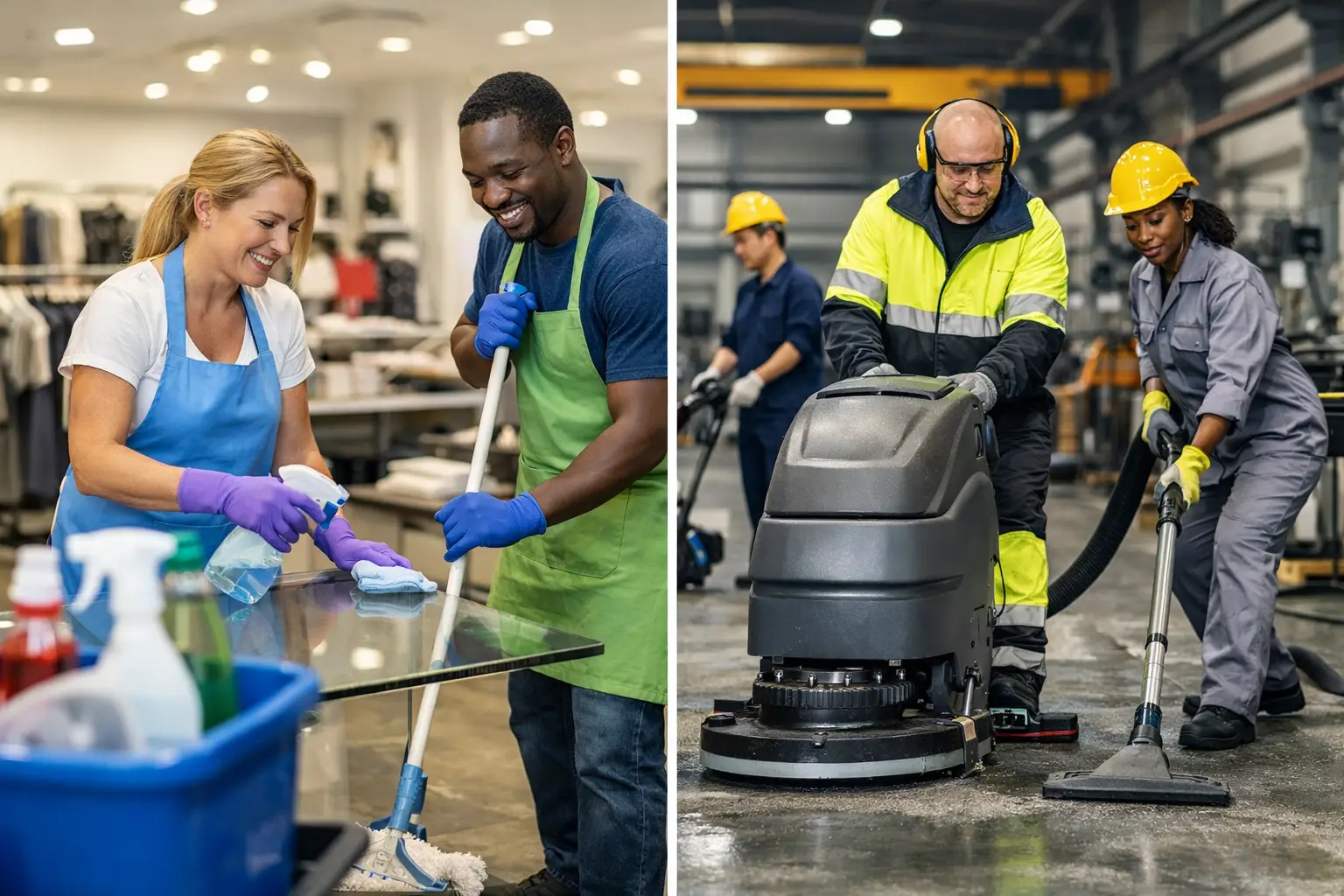
A spray bottle that works well on a kitchen counter can fail fast on a production floor, in a patient area, or inside a high-traffic public facility. That is the real issue behind retail cleaners vs industrial cleaners. The question is not which category sounds stronger. It is which one is built for the soil load, contact requirements, documentation standards, and operational risk inside your facility.
Thank you for reading this post, don't forget to subscribe!For procurement teams and facility leaders, the wrong choice creates more than a cleaning problem. It can lead to inconsistent disinfection, residue on equipment, worker safety concerns, failed audits, and avoidable downtime. For smaller businesses and direct buyers, the gap is often simpler but still serious – a retail product may be easier to recognize, while an industrial product may be better suited to repeated, higher-demand use.
What retail cleaners vs industrial cleaners really means
Retail cleaners are generally formulated, packaged, and marketed for consumer or light commercial use. They are designed to be understandable at a glance, easy to store, and practical for routine jobs like spot cleaning, bathroom upkeep, glass cleaning, or light degreasing. In many cases, they are effective within that intended scope.
Industrial cleaners are built for more demanding environments where contamination loads are heavier, cleaning frequencies are higher, and performance has to hold up under process pressure. That can mean removing grease in manufacturing, supporting sanitation protocols in healthcare-adjacent settings, maintaining restrooms in public facilities, or cleaning surfaces in regulated environments where documentation matters as much as the result.
The difference is not just strength. It is formulation purpose, use conditions, application method, compatibility with equipment and surfaces, and the level of support behind the product. An industrial cleaner is more likely to come with technical data, SDS documentation, dilution guidance where applicable, and a clearer fit within a formal cleaning program.
Performance starts with the environment
A retail cleaner usually assumes lower soil volume and more forgiving conditions. A homeowner cleaning a sink, or a small office wiping a breakroom counter, is not dealing with the same conditions as an airport restroom, a machine shop, or a government facility with strict custodial standards. The chemistry may still be sound, but the expected workload is different.
Industrial cleaners are engineered for repeatability under stress. In a manufacturing setting, for example, oils, carbon soils, and embedded grime can overwhelm products designed for cosmetic cleaning. In healthcare and institutional settings, surface sanitation is tied to procedure, dwell time, and compatibility with established infection prevention practices. In those environments, a cleaner must perform consistently across shifts, staff teams, and larger square footage.
That does not mean every industrial environment requires the most aggressive chemistry available. In fact, that assumption often creates its own problems. Harsh products can increase exposure concerns, damage surfaces, and complicate storage and handling. The better standard is fitness for purpose – enough cleaning power to meet the facility requirement, with safer chemistry where possible.
Compliance is often the dividing line
For many institutional buyers, the most important difference in retail cleaners vs industrial cleaners is not what happens during application. It is what happens before and after purchase. Can the product be supported with SDS sheets, technical specifications, and regulatory documentation? Does it align with internal safety review? Can it stand up to contractor oversight, public-sector procurement review, or facility audit requirements?
Retail products are not usually sold around those needs. They may have acceptable labels for general use, but they are rarely the center of a compliance-driven cleaning program. Industrial products, by contrast, are selected with documentation, use protocols, and operational accountability in mind.
That matters in government buildings, military facilities, aviation operations, and healthcare-related environments where buyers need more than a recognizable brand name. They need defensible product selection. They need to know what the chemistry is designed to do, how it should be used, and what records support that use.
Safety is not the same as being mild
A common mistake is to assume retail cleaners are safer because they are familiar, or that industrial cleaners are automatically riskier because they are professional grade. Neither assumption holds up well in practice.
Safety depends on formulation, concentration, application method, ventilation, training, and surface compatibility. Some retail products can still be irritating or misused. Some industrial cleaners are specifically designed to reduce unnecessary harshness while delivering the level of sanitation or soil removal required in commercial settings.
This is where environmentally responsible chemistry deserves attention. A well-designed industrial product does not need to be excessive to be effective. For facilities that want to reduce worker exposure concerns and support broader environmental goals, the strongest option on paper is not always the best operational choice. The better option is often the one that balances cleaning performance with safer handling characteristics and clear use guidance.
Where retail cleaners still make sense
Retail cleaners are not the wrong choice in every case. They can be appropriate for light-duty cleaning, front-of-house maintenance, low-risk office spaces, or households that want a professional feel without managing institutional inventory. They are often suitable when use volume is modest, documentation requirements are minimal, and the consequences of performance variation are low.
A small business owner cleaning a boutique, studio, or office suite may not need a facility-scale sanitation system. A retail-ready product can be practical if the soils are routine and the environment is not governed by high-compliance cleaning standards.
The key is to avoid using a retail cleaner outside its intended lane. Once cleaning becomes process-critical, high-frequency, safety-sensitive, or documentation-driven, the limits become clear.
Where industrial cleaners justify the switch
Industrial cleaners earn their place when the environment leaves little room for guesswork. That includes production facilities with grease and residue buildup, public spaces with constant traffic, institutions where sanitation affects health outcomes, and facilities where procurement decisions must align with safety and regulatory expectations.
In these settings, product consistency matters because labor consistency is never perfect. Teams rotate. Shifts change. Usage patterns vary. A cleaner that is more tolerant of real-world operating conditions and backed by technical support gives managers a more stable result.
Industrial products also make sense when surface and equipment protection matter. The wrong chemistry can shorten the life of finishes, create buildup, interfere with equipment performance, or leave behind films that attract more soil. A product selected for institutional use is typically chosen with those operational realities in view.
How buyers should evaluate the difference
The best way to compare retail cleaners vs industrial cleaners is to start with the facility, not the label. Ask what is being cleaned, what kind of soil is present, how often the task occurs, what standard must be met, and what happens if the product underperforms.
Then look at support factors. Is there documented guidance for safe use? Is the product suitable for the surfaces involved? Does it fit your sanitation protocol, your staff training level, and your reporting requirements? Can it scale across the building or across multiple sites without introducing confusion?
This is also where procurement readiness matters. Institutional buyers are rarely selecting a single bottle. They are evaluating whether a supplier can support repeat orders, provide documentation, and understand the demands of regulated or high-visibility facilities. That is one reason companies like Veteran Commercial Cleaning position product supply around both performance and compliance support rather than consumer-style convenience alone.
The trade-off is simplicity versus control
Retail cleaners often win on familiarity. Industrial cleaners usually win on suitability for demanding operations. The trade-off is not always about strength. It is often about how much control your environment requires.
If your goal is occasional cleaning with simple decision-making, retail products may be enough. If your goal is documented, repeatable, safety-conscious cleaning across a serious facility, industrial products are usually the better fit. The more your environment involves public trust, worker safety, regulatory oversight, or operational continuity, the less room there is for a one-size-fits-all cleaner.
A good purchasing decision does not start with the loudest claim on the label. It starts with the conditions on the ground, the standards your team has to meet, and the confidence that the chemistry you choose can do the job without creating new problems. That is the point where cleaner selection stops being routine and starts being part of facility readiness.