Aviation terminals, hospitals, manufacturing floors, and government buildings cannot treat chemical selection as a branding exercise. A cleaner that creates avoidable worker exposure, damages surfaces, complicates waste handling, or fails an audit creates an operational problem. That is why safer chemistry adoption trends are moving beyond general sustainability commitments and into procurement specifications, cleaning standard operating procedures, and supplier evaluations.
Thank you for reading this post, don't forget to subscribe!For facilities with demanding sanitation requirements, the objective is not to replace every strong chemical with the mildest available option. It is to use the least hazardous chemistry that can reliably perform the required task, under real site conditions, with the documentation and controls the facility needs.
Safer Chemistry Adoption Trends Are Becoming Operational
The most meaningful shift is that buyers are evaluating cleaning products as part of a larger risk-management system. Environmental services leaders, safety teams, and procurement officers are asking more detailed questions: What hazards are identified on the Safety Data Sheet? Is the dilution process controlled? Does the product meet the required disinfecting or cleaning standard? What training is needed? Can the supplier provide current technical documentation when a contract administrator asks for it?
This changes the conversation from “green versus industrial” to performance, exposure, and total operational fit. A product may have a favorable environmental profile but still be the wrong choice if it cannot remove production soils, maintain required contact time, or work with the facility’s dispensing equipment. The reverse is also true: a highly aggressive formulation can be unnecessary when a safer alternative performs the same function.
Facilities are increasingly looking for chemistry that reduces avoidable hazards without creating a second problem in labor time, rework, equipment compatibility, or sanitation outcomes. That practical standard is driving adoption.
Worker safety is a leading business case
Frontline cleaning personnel are closest to daily chemical exposure. Ready-to-use products, closed-loop dilution systems, lower-odor formulations, and clear labeling can reduce opportunities for mixing errors, splash incidents, and overapplication. These controls do not remove the need for training or personal protective equipment, but they can make correct use more achievable across shifts and staffing changes.
For managers, the value is broader than incident prevention. Easier-to-use chemistry supports consistent execution. When a product has a manageable dilution process, defined dwell time, and instructions that crews can follow in a fast-paced environment, the facility is more likely to get the result it specified.
Documentation now influences product selection
Compliance-ready documentation has become a purchasing requirement, particularly in healthcare, government, military, aviation, and regulated manufacturing environments. Buyers need current SDS sheets, product labels, technical data, applicable certifications, and accurate use instructions. They may also need information that supports internal environmental reporting, hazardous-material reviews, or contract file requirements.
Safer chemistry claims should stand up to this level of review. Vague terms such as “non-toxic” or “chemical-free” are not procurement standards and can create confusion. Professional buyers should assess the actual formulation information, intended use, hazard communication, third-party certifications where relevant, and the product’s performance claims. A credible supplier makes this information available before the purchase order becomes urgent.
Where Adoption Is Moving Fastest
Adoption does not occur at the same pace in every facility. The strongest movement appears where exposure, public visibility, regulatory oversight, or material sensitivity make chemical choices especially consequential.
Healthcare and long-term care environments are balancing infection prevention with concerns about respiratory irritation, staff exposure, and high-frequency use. The correct disinfectant depends on the target organism, surface, contact time, and site protocol. Safer adoption in this setting often means improving product selection and application discipline, not lowering disinfection standards.
Manufacturing facilities are addressing a different mix of demands. Degreasing, floor care, parts cleaning, and sanitation can involve heavy soils that require serious performance. Here, concentrated products with managed dilution, formulations designed for lower hazard profiles, and task-specific chemistry can help reduce unnecessary chemical burden. Compatibility testing matters because a product that affects coatings, seals, metals, or sensitive production equipment is not a successful substitution.
Airports, public venues, and government buildings face high traffic, varied surfaces, and public expectations for visibly clean spaces. Low-odor and lower-residue options can be valuable in occupied areas, while custodial teams still need products that work within limited turnaround windows. Product standardization across sites can also simplify training, stocking, and documentation, provided local needs have been validated.
The Trade-Offs Procurement Teams Must Address
Safer chemistry is not a single product category. A purchasing decision must account for the job being performed, the people using the product, the surface being treated, and the conditions of use.
A lower-hazard cleaner may require more mechanical action or additional dwell time on heavy soil. A concentrated product can reduce packaging and transportation volume but introduces dilution-control requirements. Fragrance-free options may support occupied-space comfort, while certain applications may require a formulation with specialized cleaning characteristics. There is no universal best choice.
The most reliable approach is to define the required outcome first. Is the task cleaning, disinfecting, sanitizing, deodorizing, degreasing, or removing a specific residue? What soil load is expected? Is the area occupied during service? Are there food-contact, aviation, healthcare, or federal facility requirements? Once these questions are answered, teams can compare products against the same operational standard.
This is also where total cost of use deserves attention. A product’s purchase cost alone does not show the full impact of dilution accuracy, labor time, re-cleaning, storage, training, worker complaints, surface damage, or disposal obligations. Safer chemistry can provide a meaningful advantage when it reduces these downstream pressures without compromising the task.
How to Adopt Safer Chemistry Without Losing Performance
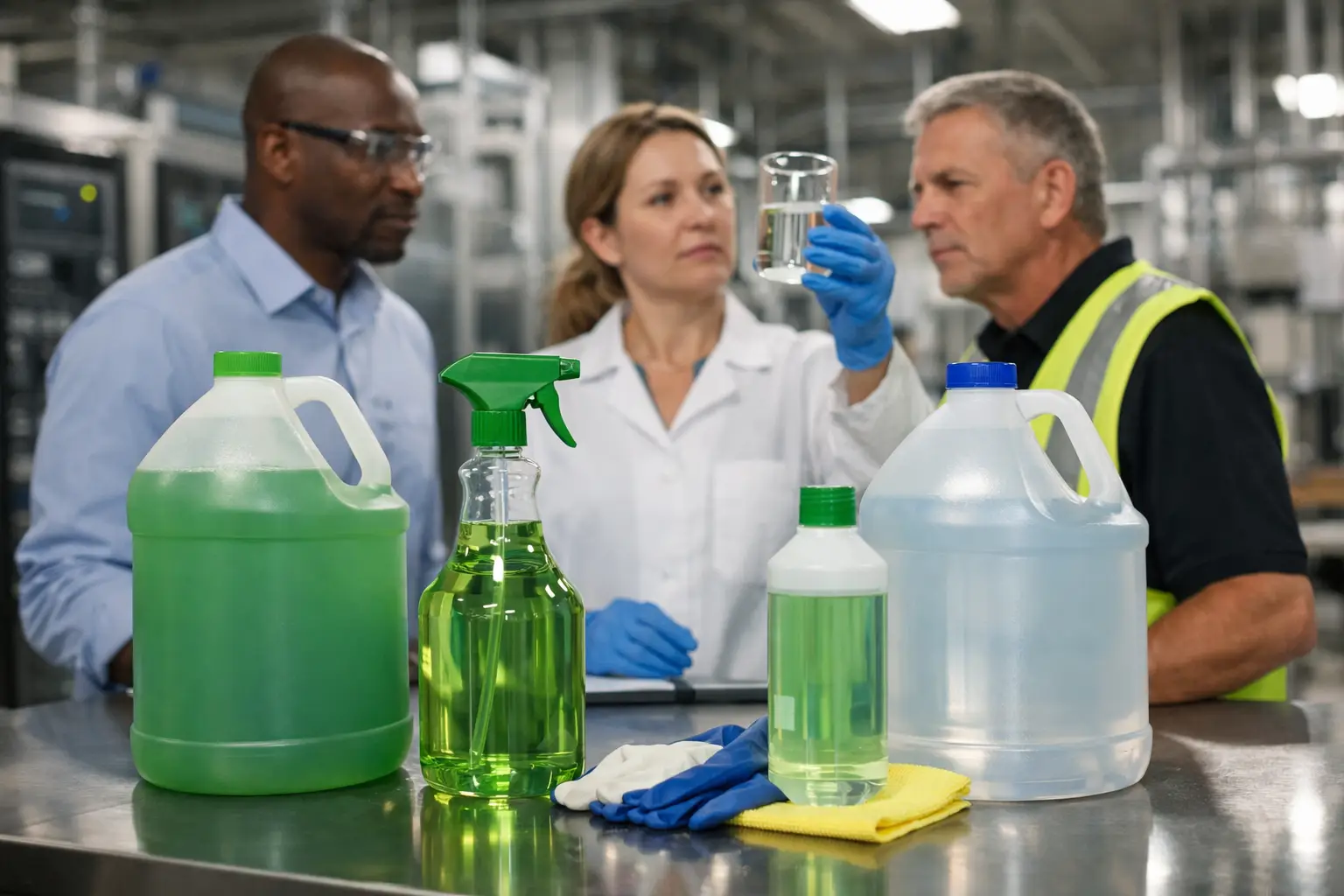
A controlled pilot is more useful than a broad product swap. Select a high-use task or a defined area, establish baseline expectations, and test the alternative under normal operating conditions. Involve the people who will use it, including environmental services staff, maintenance teams, safety personnel, and the facility manager responsible for results.
During the pilot, assess cleaning effectiveness, required labor, user acceptance, odor, residue, surface compatibility, dilution accuracy, and documentation completeness. For disinfectants and sanitizers, verify that use follows the label, including pre-cleaning requirements and contact time. A product cannot deliver its registered claim if it is applied or removed incorrectly.
If the pilot succeeds, standardize only what the team can support. Update written procedures, train crews, maintain product labels at point of use, and ensure SDS access is current. Purchasing should also confirm supply continuity and verify that the supplier can provide consistent technical support. Substitution becomes more durable when it is built into the facility’s operating system rather than treated as a one-time sustainability project.
Questions to ask suppliers
Procurement teams should expect direct answers about intended applications, dilution methods, compatibility considerations, storage guidance, and supporting documents. They should also ask whether a product is appropriate for their particular soil type and surface, rather than relying on broad marketing language.
Veteran Commercial Cleaning supports this evaluation approach by pairing institutional-grade cleaning chemistry with the documentation and procurement readiness critical facilities require. The goal is to help buyers make choices that are defensible in the field, in the supply room, and during a compliance review.
What Will Shape the Next Phase
The next phase of adoption will be shaped less by slogans and more by measurable controls. Organizations will continue to favor suppliers that can demonstrate product performance, provide clear hazard communication, support responsible use, and maintain dependable documentation. Cleaning programs will increasingly connect chemical decisions with worker safety goals, indoor environment considerations, waste reduction efforts, and contract compliance.
For facility leaders, the practical opportunity is clear: review the chemicals used most often, identify where hazards or inefficiencies are unnecessary, and test better-fit alternatives against real operating requirements. The strongest safer chemistry program is not the one with the most labels. It is the one that gives crews a safer, documented, reliable way to keep critical spaces clean.