A disinfectant can fail a workplace long before it fails a laboratory test. It may be used at the wrong dilution, wiped away before its required contact time, stored without an accessible Safety Data Sheet, or selected without regard for the surfaces and people exposed to it. For facility leaders asking which disinfectants support safer workplaces, the answer is not a single active ingredient or label claim. It is a product-and-process decision built around verified efficacy, practical use, worker protection, and documentation.
Thank you for reading this post, don't forget to subscribe!In healthcare, aviation, manufacturing, government, and commercial facilities, cleaning chemistry has to support the operation rather than create a new set of risks. The right choice addresses the organisms and surfaces relevant to the site while fitting the realities of shift schedules, ventilation, training, and supply control.
Which disinfectants support safer workplaces?
Workplace-ready disinfectants begin with a valid EPA registration and a label that matches the intended use. EPA registration confirms that the product has been evaluated for its labeled antimicrobial claims when used according to directions. It does not mean every product is appropriate for every facility, surface, or exposure scenario.
A sound selection process asks four questions at the same time: What organisms or public-health concerns must be addressed? Where will the product be used? Can employees apply it correctly and safely? Can the facility document its use and maintain a reliable supply?
The most suitable disinfectant is often the one that meets required efficacy claims with the lowest reasonable burden on workers, materials, indoor air, and daily operations. That may mean using one product in a patient-care area and another in a heavy-use restroom, food-adjacent space, production floor, or equipment room.
EPA-registered products with relevant claims
Start with the label, not marketing language. A product should be EPA-registered for disinfection and carry claims relevant to the facility’s risk assessment. During a specific outbreak or public-health event, facilities may need to verify whether a product appears on the applicable EPA guidance list and follow current agency and local requirements.
Broad-spectrum claims can be useful in multi-purpose commercial environments, but they are not a substitute for reading directions. Claims may differ by organism, surface type, dilution, and contact time. Procurement teams should retain the product label, technical data, and Safety Data Sheet in a location that supervisors and employees can access without delay.
Chemistry that matches the application
Quaternary ammonium compounds, hydrogen peroxide-based disinfectants, alcohol-based formulations, chlorine-based products, and other registered chemistries each have valid roles. The trade-off is that their performance and operational demands are different.
Quaternary ammonium disinfectants are commonly used on many hard, nonporous environmental surfaces and may offer a practical fit for routine facility programs. However, users must follow dilution and dwell-time instructions precisely, and facilities should confirm compatibility with any sensitive surfaces or equipment.
Hydrogen peroxide-based products can provide effective disinfection with a chemistry profile many organizations consider when reducing harsh residues or odors. Formulation matters, however. Concentration, surface compatibility, and required contact time can vary substantially between products.
Alcohol-based products are valuable for limited, appropriate applications, particularly where fast drying is needed, but they may not be suitable for broad routine coverage or for every soil condition. Chlorine-based disinfectants can be appropriate for certain high-risk situations and specific protocols, yet they can present corrosion, odor, bleaching, and worker-exposure concerns if used without controls.
There is no universal “best” active ingredient. A disinfectant that is highly effective in one setting may be disruptive to materials, ventilation, workflows, or user acceptance in another.
Contact time is a safety requirement, not a detail
A disinfectant only performs as claimed when the treated surface stays visibly wet for the full contact time on its label. This is one of the most common gaps in workplace disinfection programs. A team may wipe a surface immediately after spraying, or use too little product to maintain wetness, effectively turning a disinfection step into a light cleaning step.
Shorter contact times can improve operational consistency in fast-turn environments such as terminals, offices, schools, and restrooms. Yet a shorter dwell time should never be the sole purchasing criterion. Facilities should weigh it alongside efficacy claims, worker safety directions, surface compatibility, and the time needed to clean soil before disinfecting.
For visibly dirty surfaces, cleaning usually comes first. Soil can shield microorganisms and interfere with disinfectant performance. In high-compliance environments, standard operating procedures should clearly distinguish cleaning, sanitizing, and disinfecting rather than treating the terms as interchangeable.
Safer use depends on the complete system
A lower-harshness formulation can support a safer work environment, but safer chemistry does not eliminate the need for control measures. Chemical safety depends on how products are received, stored, dispensed, applied, and documented.
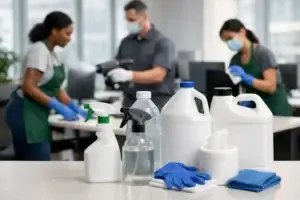
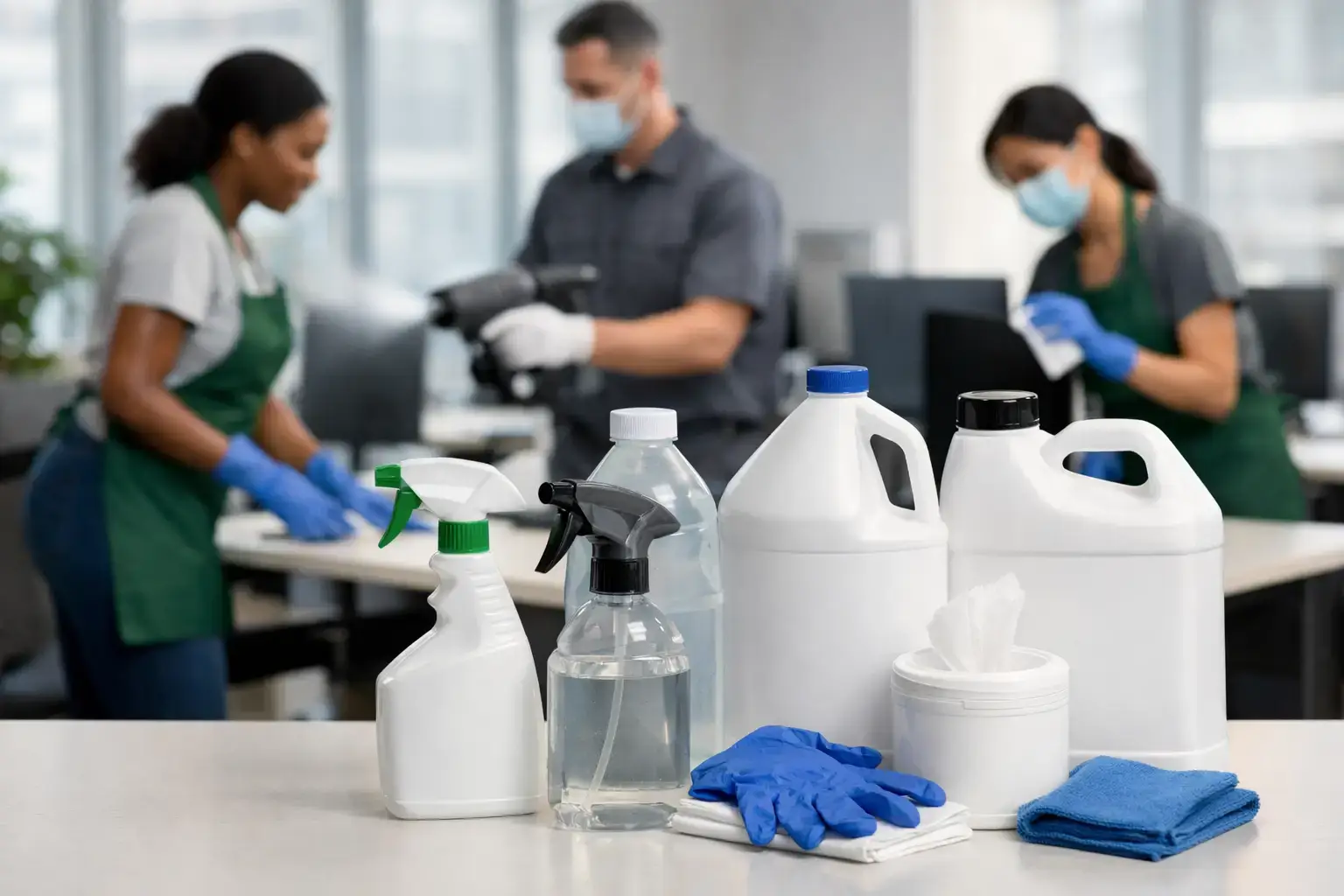
A reliable program includes labeled secondary containers, controlled dilution when concentrates are used, employee training, appropriate personal protective equipment, ventilation assessment, and clear spill-response procedures. Teams should never mix disinfectants or combine them with other cleaning chemicals unless the manufacturer specifically directs it. Improvised mixing can create dangerous reactions and invalidates the controlled conditions behind a product’s label directions.
Ready-to-use products can reduce dilution errors in smaller facilities or high-turnover work areas. Concentrates can support storage efficiency and standardized dilution systems in larger operations. Neither approach is automatically safer. The better option is the one the facility can manage consistently with its staffing, equipment, and training resources.
Material compatibility protects the facility
Disinfection programs should protect assets as well as people. Repeated exposure to an incompatible product can dull finishes, damage screens, corrode metal, weaken seals, or shorten the service life of high-value equipment. This is especially relevant in aviation, manufacturing, healthcare, and government environments where surface specifications and equipment reliability carry operational consequences.
Before deploying a new disinfectant across a facility, review manufacturer guidance for the substrate and test it in an inconspicuous area when appropriate. Pay close attention to touchscreens, electronics, polished metals, acrylics, coated flooring, upholstery, and food-contact surfaces. Some applications may also require a potable-water rinse after the required contact time. The label and equipment guidance should govern the procedure.
Documentation makes selection defensible
For procurement officers and compliance teams, a disinfectant purchase is not complete when the cases arrive. It must be supported by documentation that enables safe deployment and audit readiness. At a minimum, the facility should be able to locate the current Safety Data Sheet, EPA registration information, technical specifications, dilution directions if applicable, and training instructions tied to the product’s intended use.
This recordkeeping is particularly valuable when facilities operate under contract requirements, internal environmental health and safety standards, infection-prevention protocols, or customer audits. It also reduces the risk of unauthorized substitutions. A replacement product may look similar, but a different active ingredient, dwell time, or hazard classification can require a different procedure.
Veteran Commercial Cleaning supports buyers who need institutional-grade cleaning solutions backed by the practical documentation required for organized facility programs. The objective is not to apply more chemistry than necessary. It is to apply the correct product correctly, with a process that workers can execute every shift.
Build a selection standard employees can follow
The strongest purchasing decision becomes weak if frontline teams cannot carry it out under normal conditions. Include operations personnel, environmental services leaders, safety staff, and maintenance representatives when evaluating disinfectants. Their feedback exposes issues that a specification sheet may not show, such as residue complaints, unclear spray-and-wipe steps, difficult dispensing, or disruption to equipment use.
Then translate the selection into a concise site procedure. Identify the approved product, designated surfaces, required pre-cleaning, application method, contact time, PPE, rinse requirements, and documentation expectations. Review the procedure after changes in facility use, disease-control guidance, equipment, or workforce conditions.
A safer workplace is supported by disinfectants that deliver verified performance without asking employees to guess. Choose chemistry with the right claims, train to the label, protect the surfaces that keep the operation moving, and keep the documentation close to the work. That discipline is what turns a disinfectant into a dependable part of workplace safety.