A missed restroom service, an empty sanitizer dispenser, or an undocumented disinfection cycle can become more than a housekeeping issue in a high-compliance facility. It can interrupt operations, create audit exposure, and weaken confidence among employees, visitors, patients, passengers, or inspectors. That is why workplace hygiene automation trends are moving beyond novelty equipment and toward accountable systems that help facilities verify what was cleaned, when it happened, and whether conditions require action.
Thank you for reading this post, don't forget to subscribe!For facilities managers, environmental services leaders, and procurement teams, automation is not a replacement for disciplined cleaning personnel. It is a way to direct skilled labor where it matters most, reduce avoidable gaps, and create documentation that supports safety and compliance requirements.
Automation Is Shifting From Convenience to Verification
Early automation often focused on reducing touchpoints: automatic soap dispensers, sensor-operated faucets, touch-free towel dispensers, and hands-free waste receptacles. Those tools still matter. They can reduce cross-contamination opportunities and improve the user experience in high-traffic spaces.
The more consequential shift is the use of connected equipment and digital workflows to verify service delivery. A dispenser that reports low inventory, a cleaning cart that records route completion, or a digital checklist tied to a room or asset can provide operational visibility that paper logs cannot reliably deliver.
This distinction matters in airports, healthcare settings, manufacturing plants, government buildings, and military facilities. Leaders do not simply need to know that a cleaning schedule exists. They need defensible evidence that required tasks were completed using approved procedures and appropriate chemistry.
Automation should support the cleaning program, not become a separate technology project. The strongest deployments connect equipment, staff routines, chemical selection, safety documentation, and corrective action into one manageable process.
The Workplace Hygiene Automation Trends That Matter Most
Demand-Based Restroom and Common-Area Servicing
Fixed schedules remain necessary for many facilities, particularly where regulations, shift changes, or occupancy patterns require defined service intervals. But a restroom cleaned every two hours may still be under-serviced during a surge or over-serviced when traffic is light.
Occupancy sensors, dispenser-use data, door counters, and waste-level monitoring are increasingly being used to prioritize cleaning rounds. Rather than sending staff to every location on a rigid loop, supervisors can direct teams toward spaces showing the highest use or the clearest need.
The operational benefit is not simply fewer labor hours. It is better allocation of labor. A facilities team can respond faster to high-demand locations while maintaining required scheduled tasks elsewhere. In public-facing environments, that can improve both hygiene conditions and customer perception.
There are limits. Sensor data can indicate use, but it cannot determine whether a surface requires a particular disinfecting process or whether a spill needs immediate intervention. Human judgment remains essential, especially where soil load, contamination risk, or safety hazards vary by area.
Touchless Systems With Maintenance Intelligence
Touchless fixtures are becoming more practical when they include maintenance signals. Soap, sanitizer, towel, and paper dispensers that flag low levels can reduce the familiar failure point of an empty unit at the wrong time. Connected equipment may also identify repeated battery issues, dispensing faults, or unusually high consumption that deserves investigation.
For procurement teams, the key question is not whether a dispenser is “smart.” It is whether the system supports reliable replenishment, works with the facility’s approved consumables, and produces data that staff can actually use. A sophisticated dashboard has little value if it creates another portal that no one monitors.
Facilities should also account for continuity. Manual backup procedures, readily available replacement components, and clear service responsibility are necessary when devices lose power, connectivity, or calibration. Automation should improve resilience, not introduce a single point of failure.
Digital Cleaning Verification and Audit Trails
Digital task management is one of the most useful forms of hygiene automation because it addresses a recurring compliance problem: proving that required work occurred. Mobile checklists, QR-coded locations, time-stamped inspections, and exception reporting can create a clearer record than handwritten logs.
A well-designed system documents the task, responsible team member, completion time, inspection outcome, and corrective action when standards are not met. In regulated or contract-driven environments, this information can support internal quality reviews, client reporting, and audit readiness.
However, digital verification only has value when the underlying standard is specific. “Clean restroom” is not a measurable instruction. A stronger task definition identifies the surfaces or assets to be addressed, the approved product category, required contact time where applicable, necessary personal protective equipment, and the acceptance criteria for inspection.
This is also where supplier documentation matters. Safety Data Sheets, technical specifications, use directions, and relevant regulatory or certification documentation should be readily available to the teams responsible for implementation. Automation records cannot compensate for incorrect chemical use or poorly defined procedures.
Autonomous Equipment for Repetitive Floor Care
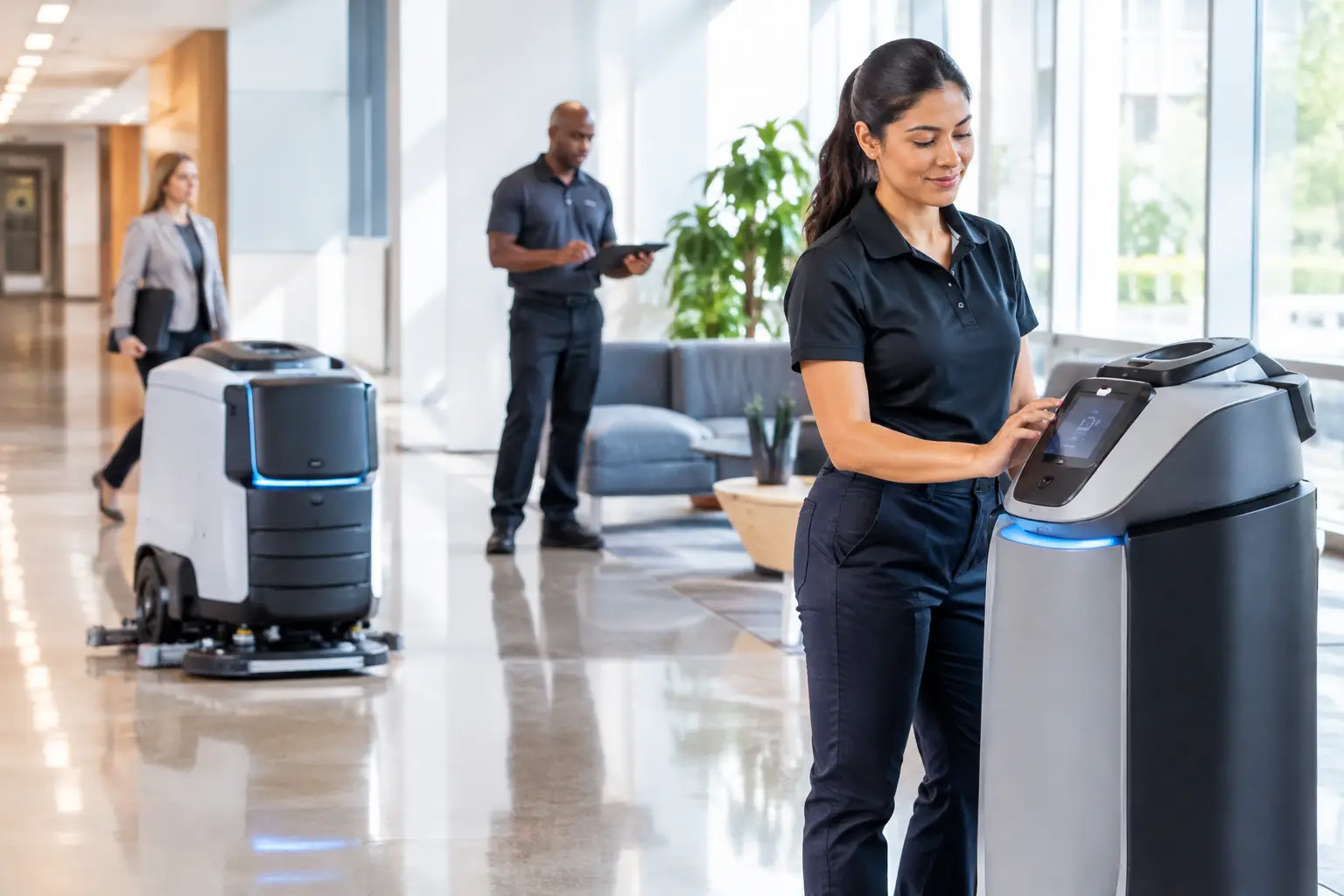
Autonomous scrubbers and robotic vacuums are gaining traction in large, predictable areas such as corridors, terminals, warehouses, lobbies, and production-adjacent spaces. Their best use case is repetitive floor maintenance where routes are stable, obstacles are manageable, and manual teams can be reassigned to detail work, high-touch surfaces, restrooms, or response cleaning.
These machines are not a universal answer. Complex layouts, active loading zones, crowded public spaces, and areas with frequent spills may require closer supervision or conventional equipment. A robot can maintain a route, but it cannot replace a trained employee’s ability to identify a safety concern, address an unexpected contamination event, or make a judgment call around sensitive operations.
Before investing, evaluate floor type, square footage, traffic patterns, charging requirements, water access, recovery capacity, staffing model, and service support. The right question is not whether autonomous equipment is advanced. It is whether it fits the facility’s actual cleaning workflow.
Data-Led Chemical and Inventory Control
Automation is also improving the back end of hygiene operations. Dilution-control equipment, inventory monitoring, barcode tracking, and digital replenishment records can help facilities reduce product waste, prevent stockouts, and maintain greater consistency across shifts and locations.
For institutional buyers, consistency has direct safety and compliance value. Approved disinfectants, degreasers, sanitation products, wipes, and related supplies should be identifiable by use case, with clear directions and accessible documentation. Tracking consumption can reveal issues that deserve action, such as overuse from incorrect dilution, unusually frequent refill needs, or a supply pattern that does not match occupancy.
Environmentally responsible chemistry belongs in this conversation as well. Lower-harshness formulations can support safer working conditions and sustainability goals, but product selection must remain grounded in the facility’s required performance standard. A product should be chosen for the specific soil, surface, pathogen-control requirement, and operational setting – not because an environmental claim is broad or fashionable.
How to Evaluate Automation Without Creating New Risk
A disciplined evaluation starts with the risk profile of the space. Healthcare treatment areas, food-related operations, aircraft interiors, secure government spaces, manufacturing lines, and general office areas do not share the same sanitation requirements. The level of automation, verification, and documentation should reflect the consequence of failure.
Next, define the decision that each technology will improve. If a sensor will not change how a supervisor schedules labor, replenishes supplies, or responds to an exception, it may be collecting data without producing value. If a digital checklist cannot be aligned with existing standard operating procedures, it can create duplicate work and inconsistent records.
Integration deserves attention as well. The most effective systems fit existing maintenance workflows, quality assurance processes, and procurement controls. They should have clear ownership, practical training requirements, and a process for reviewing alerts. Data access and cybersecurity should be evaluated, especially in government, military, healthcare, and other sensitive environments.
Finally, pilot before broad deployment. Select a representative area, establish baseline measures, train the team, and review results after a defined period. Useful measures may include missed-service reports, supply outages, inspection scores, response time, labor redeployment, chemical consumption, and documentation completion rates. A pilot should reveal whether the technology improves the operation, not merely whether it functions.
The Human Standard Still Defines Hygiene Performance
The most reliable workplace hygiene automation trends are those that make disciplined teams more effective. Sensors can identify demand. Software can record completion. Autonomous machines can handle defined, repetitive work. None of them replaces training, approved chemistry, clear procedures, supervisory inspection, and accountability.
For critical facilities, the objective is straightforward: build a cleaning operation that can respond quickly, perform consistently, and demonstrate compliance when asked. Veteran Commercial Cleaning supports that standard with institutional-grade cleaning solutions and the documentation-focused approach serious facilities require. Choose automation that strengthens your existing hygiene program, then hold every tool, process, and service record to the same operational standard.