A disinfectant can be EPA-registered, used at the correct dilution, and still fail to protect patients if it is applied to a device that was never cleaned first. For facilities that disinfect medical equipment, the result depends on the full process: device classification, manufacturer instructions, product compatibility, contact time, staff technique, and documentation.
Thank you for reading this post, don't forget to subscribe!This is not a housekeeping detail. In healthcare settings, emergency response areas, laboratories, occupational health clinics, and other clinical environments, an incomplete disinfection process can create infection-control exposure, damage expensive equipment, and place a facility out of alignment with its own policies. The right approach is disciplined, repeatable, and matched to the equipment in front of the team.
Start With the Device’s Intended Use
Before selecting a disinfectant, determine how the item is used and what level of processing it requires. Medical equipment is commonly grouped by the risk associated with patient contact. A blood pressure cuff used on intact skin does not carry the same processing requirements as an instrument that contacts mucous membranes or sterile tissue.
Noncritical equipment generally contacts intact skin. Examples may include exam tables, monitor leads, some external diagnostic devices, wheelchairs, and blood pressure cuffs. These items typically require cleaning followed by low-level disinfection when indicated by facility policy and the manufacturer’s instructions for use, often called the IFU.
Semicritical items contact mucous membranes or nonintact skin. Critical items enter sterile tissue or the vascular system. These categories may require high-level disinfection or sterilization, not routine surface disinfection. A general-purpose disinfectant wipe or spray is not a substitute for the validated reprocessing method required for those devices.
The practical rule is straightforward: never choose a product solely because it is labeled as a disinfectant. Start with the device IFU, identify the required level of processing, and confirm that the selected chemistry is approved for the item’s materials and use case.
Cleaning Comes Before Disinfection
Soil, residue, bodily fluids, lubricants, and organic matter can shield microorganisms from a disinfectant. They may also reduce the performance of the chemistry or leave residue that affects sensors, seams, touchscreens, and moving parts. When visible soil is present, cleaning is not optional.
Use the cleaning method specified in the device IFU. For many noncritical devices, that means removing soil with a compatible cleaner or detergent and a low-lint cloth before applying the disinfectant. Pay close attention to high-touch areas such as buttons, handles, rails, cords, control panels, and crevices around attachments.
Avoid spraying liquids directly into openings, ports, fans, or electronic controls unless the manufacturer specifically permits it. Apply the product to a cloth when appropriate, then wipe the approved exterior surfaces. Excess liquid can migrate into equipment, compromise electronics, and create a failure that is far more costly than the time saved by aggressive application.
Select Chemistry Based on the Label and IFU
A compliant disinfection program depends on two documents working together: the disinfectant label and the equipment manufacturer’s IFU. The disinfectant label establishes where and how a product may be used, which organisms it is effective against, required dilution, and surface contact time. The IFU establishes what the device can tolerate.
For noncritical medical equipment, facilities often evaluate disinfectants for broad-spectrum efficacy, ease of use, material compatibility, odor, residue, worker exposure considerations, and operational speed. Faster contact times can support room turnover, but only if staff can keep the surface visibly wet for the full labeled duration. A one-minute product is not effective if it dries in 20 seconds.
Compatibility deserves particular attention. Some disinfectant chemistries can cloud plastics, degrade rubber, corrode metals, weaken adhesives, or damage display coatings over time. The risk increases when teams use concentrated products incorrectly, mix chemicals, or apply a product beyond its labeled use. Never mix disinfectants with other cleaners unless the product instructions explicitly direct it.
Environmentally responsible chemistry can be a sound operational choice when it meets the required efficacy claims and device compatibility requirements. The objective is not to use the harshest product available. It is to use a documented, effective product that supports infection control, worker safety, equipment longevity, and facility standards.
How to Disinfect Medical Equipment Correctly
The procedure should be simple enough to execute under pressure and specific enough to be audited. Staff should follow the device IFU and the disinfectant label at every step.
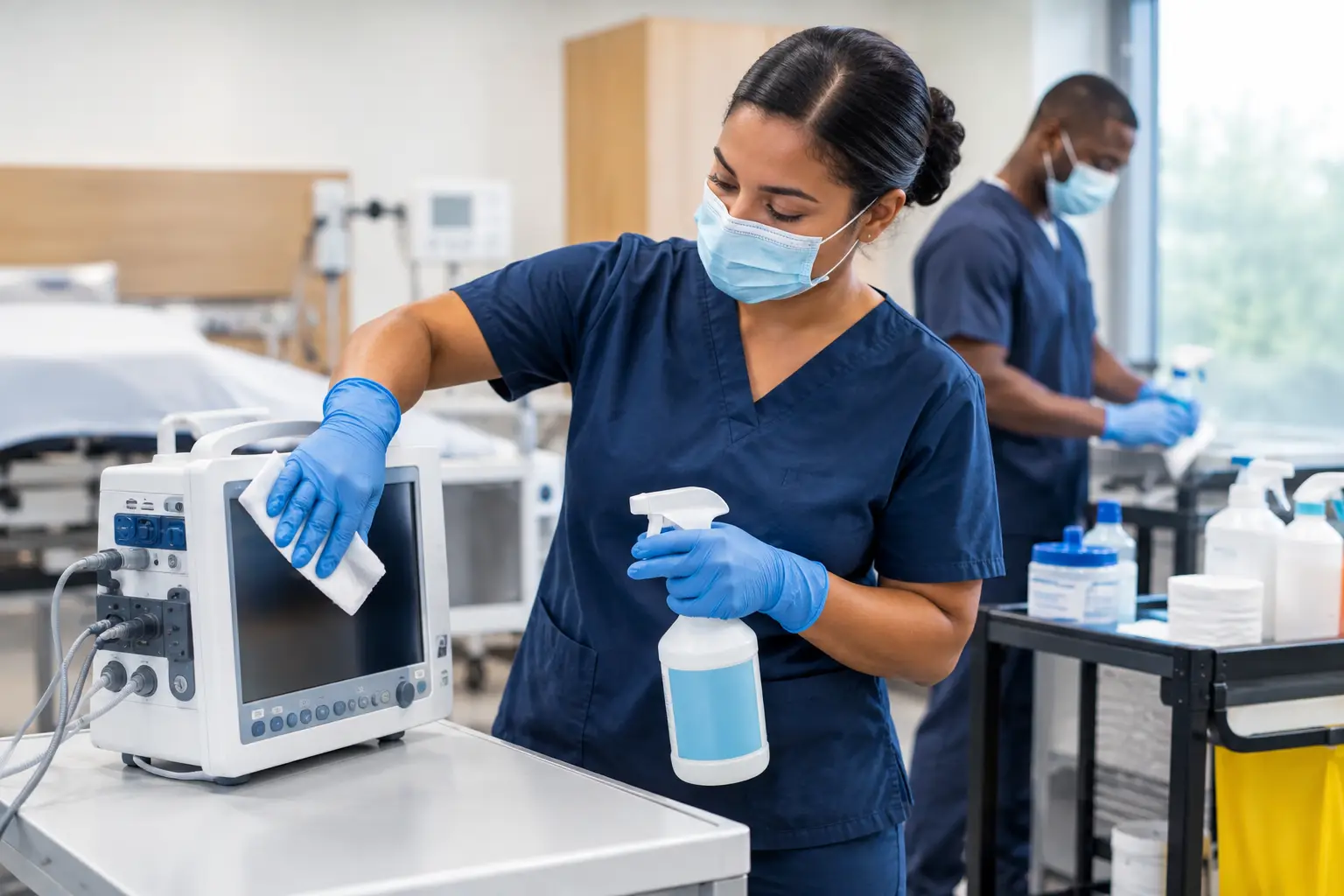
First, wear the personal protective equipment required by the product label and the facility’s exposure-control procedures. Inspect the equipment for visible contamination, damage, and components that require special handling. Remove disposable covers or single-use accessories according to established waste procedures.
Next, clean the item if soil or residue is present. Use a fresh compatible cloth or wipe as needed rather than transferring contamination from one surface to another. Work from cleaner areas toward dirtier areas, and change materials when they become visibly soiled.
Then apply the disinfectant in a manner that fully covers the approved surfaces. Wipes must remain sufficiently wet to leave the surface wet. For liquid products, use the dilution and application method specified on the label. Do not guess at concentrate ratios or assume that more chemical produces better disinfection.
Maintain the labeled contact time. This is the period the surface must remain visibly wet for the product to achieve its stated antimicrobial claim. If the surface dries before that time, reapply the product as directed. Do not wipe it dry early merely to speed turnover.
After the required contact time, allow the equipment to air dry unless the label or IFU directs otherwise. Some items may need a potable-water rinse after disinfection, particularly when the equipment contacts skin or when residue could affect performance. Reassemble, store, or return the device to service only after it is dry and ready for safe use.
Protect Electronics, Shared Devices, and Soft Surfaces
Modern care environments rely on equipment that is difficult to disinfect with a one-size-fits-all routine. Tablets, touchscreen monitors, handheld scanners, portable diagnostic equipment, and powered mobility devices may have specific restrictions on alcohol concentration, quaternary ammonium compounds, oxidizing agents, or liquid exposure.
Build equipment-specific instructions into the workflow rather than expecting staff to recall every restriction. A short point-of-use procedure can identify approved products, prohibited application methods, contact time, and responsible staff. This is especially valuable for shared devices that move between patient rooms, departments, shifts, or field locations.
Soft surfaces require separate attention. Upholstery, straps, foam supports, privacy curtains, and fabric-covered accessories may not tolerate the same chemistry used on hard, nonporous surfaces. If a surface cannot be adequately cleaned and disinfected according to its instructions, the facility should evaluate whether a cleanable alternative is more appropriate for the care setting.
Build a Documented, Auditable Process
A disinfectant program is only as dependable as the system supporting it. Procurement teams should retain safety data sheets, technical data, product labels, dilution instructions where applicable, and relevant efficacy documentation. Operations leaders should confirm that products are stored safely, dated when required, and available where staff actually perform cleaning.
Training should cover more than product names. Staff need to understand why cleaning precedes disinfection, how contact time works, when an item requires higher-level processing, and when to remove damaged equipment from service. Demonstration and observation are more useful than a sign-off sheet alone.
Quality checks should focus on real workflow conditions. Are reusable devices cleaned between patients? Are high-touch components being missed? Is the selected product causing visible material damage? Are staff using enough product to meet wet contact time? These questions identify process gaps before they become an incident, a failed inspection, or a preventable equipment replacement.
For multi-site organizations, standardization can reduce variation, but it should not override the IFU for a specific device. A core approved-product list paired with equipment-specific exceptions gives teams a practical balance between purchasing control and safe use.
Veteran Commercial Cleaning supports facilities that need institutional-grade cleaning chemistry and the documentation required to evaluate it responsibly. The strongest programs treat product selection, staff practice, and compliance records as one operating system rather than separate tasks.
When equipment must be ready for the next patient, the right process is not the fastest-looking wipe-down. It is the one that consistently delivers the required level of disinfection without compromising the device, the people using it, or the standards your facility is trusted to uphold.