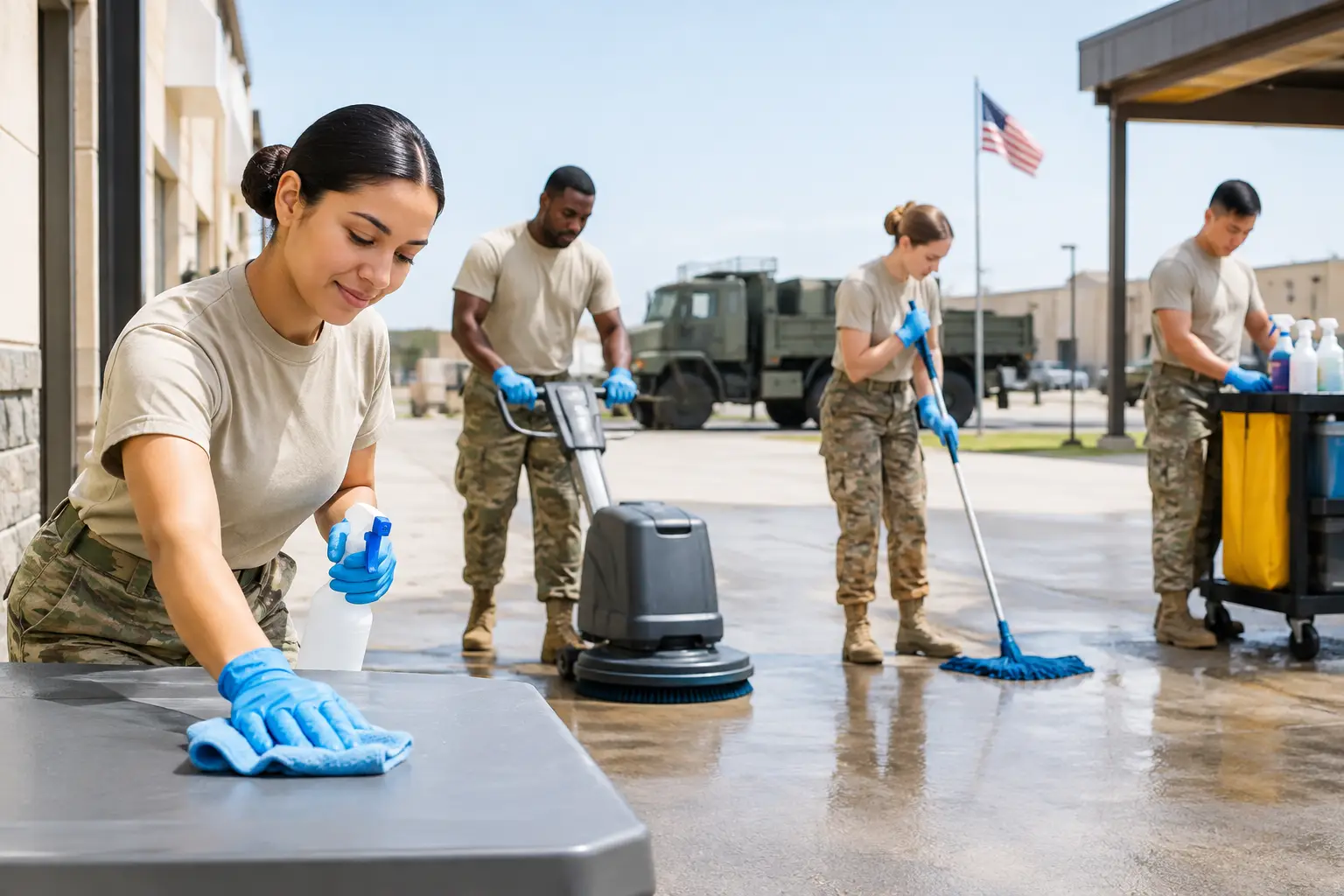
A credible military base sanitation example is not a custodial checklist with a military label. It is an operational control system designed to protect personnel, preserve facilities and equipment, meet command requirements, and keep daily missions moving. When sanitation breaks down, the consequences can range from preventable illness and failed inspections to reduced morale, restricted access, and lost training time.
Thank you for reading this post, don't forget to subscribe!For installation leaders and facility managers, the goal is not to apply the same cleaning routine everywhere. A barracks shower, a clinic waiting area, a dining facility, an aircraft support space, and an administrative office have different contamination risks, traffic patterns, surfaces, and documentation demands. A successful program recognizes those differences while maintaining one accountable standard.
Military Base Sanitation Example: Start With Zones
Consider a midsize installation with barracks, a dining facility, a medical clinic, administrative buildings, maintenance support areas, fitness facilities, and public restrooms. The sanitation plan begins by dividing those locations into risk-based zones rather than assigning identical frequencies across the base.
High-risk zones include restrooms, locker rooms, shower areas, clinic spaces, food-service touchpoints, and high-traffic entry areas. These locations need frequent attention because moisture, body fluids, food residue, and constant contact create conditions where contamination can spread quickly. Cleaning teams should remove visible soil before applying an appropriate disinfectant or sanitizer according to its labeled use and contact time.
Moderate-risk zones often include offices, classrooms, conference rooms, fitness spaces, and common rooms. These areas still require routine cleaning, but the scope should focus on high-touch surfaces, floors, waste handling, and any shared equipment. Frequency should increase during training cycles, outbreaks, major events, or periods of heavy occupancy.
Controlled maintenance areas require a different approach. Oils, greases, carbon residue, metal shavings, and tracked-in soil are not solved with a restroom disinfectant. They may require industrial degreasing, targeted floor care, spill response procedures, and waste-stream controls. The objective is to remove the soil that creates slip hazards, equipment issues, and contamination risks without introducing chemistry that is incompatible with surfaces or facility procedures.
A zone plan turns sanitation from a vague expectation into an assignable mission. It defines what must be cleaned, how often, which chemistry is approved, who verifies completion, and what triggers an escalation.
Build the Work Sequence Around Risk
A disciplined sanitation process follows a repeatable order. Teams start with dry debris removal and waste collection, then clean surfaces to remove dirt and organic material. Disinfection or sanitization follows only where required by the area, the product label, and the facility’s infection-control or food-safety procedures. Floors and touchpoints are completed in a sequence that avoids carrying contamination from higher-risk spaces into cleaner areas.
That distinction matters. Cleaning and disinfecting are related, but they are not interchangeable. A disinfectant may not perform as expected on a visibly soiled surface. Conversely, applying disinfectant throughout an entire facility without a risk-based purpose can waste labor, increase chemical exposure, and create inconsistent results.
For example, a dining facility may require frequent sanitation of food-contact surfaces under its established food-service procedures, while a barracks common area may need scheduled cleaning of tables, door hardware, light switches, remote controls, and shared appliances. A clinic may add stricter protocols for exam rooms, reception areas, and isolation-related spaces. The correct workflow depends on the function of the space, not on a one-size-fits-all product claim.
Use Chemistry That Supports Safety and Performance
Product selection is a procurement and safety decision, not merely a janitorial preference. Each product used on base should have accessible Safety Data Sheets, technical specifications, clear dilution instructions where applicable, and documented compatibility with the intended surface.
Environmentally responsible chemistry can be a strong fit for institutional sanitation when it is selected for verified performance, appropriate use, and worker safety. “Green” should never mean vague or underpowered. The evaluation should focus on whether the product can address the soil load, meet the required sanitation or disinfection standard, support indoor air quality goals, and reduce unnecessary harshness for the people applying it.
The trade-off is straightforward: stronger is not always better, but milder is not automatically suitable. A maintenance bay with heavy petroleum soil needs a different solution than a medical waiting room. Procurement teams should standardize products where practical, while avoiding the mistake of forcing one chemical into every task.
Chemical controls also protect personnel. Staff need training on dilution, required personal protective equipment, labeling, storage, and incompatibilities. Never mix cleaning chemicals unless a manufacturer specifically directs it. A sanitation program is only as safe as its daily handling practices.
Make High-Touch Cleaning Measurable
High-touch cleaning is often where facilities claim consistency but struggle to prove it. Door handles, rails, switches, restroom fixtures, shared keyboards, counters, vending controls, gym equipment, and common-area appliances should be included in area-specific task cards.
A practical method is to define four elements for every high-touch task: the surface, the approved product, the required frequency, and the verification method. This gives supervisors a clear basis for inspection and helps crews understand that completion means more than checking a box.
Visual inspection remains useful, particularly for restrooms, floors, waste areas, and food-service spaces. However, visual inspection alone does not always show whether a high-touch surface was addressed. Depending on the facility’s requirements, supervisors may use documented rounds, spot checks, supply consumption review, fluorescent marking systems, or other approved verification tools. The best choice depends on the risk level and the installation’s quality-control process.
Documentation Is Part of the Sanitation Standard
In high-compliance facilities, sanitation without documentation is difficult to defend. A complete program should maintain cleaning schedules, inspection records, corrective-action logs, training records, product SDS sheets, technical data, and any relevant certification information.
This recordkeeping is not paperwork for its own sake. It helps leaders identify repeat failures, confirm that staff received training, demonstrate product suitability, and support audits or contract oversight. It also makes transition periods easier when facility staff, contractors, or unit responsibilities change.
A useful corrective-action log records the issue, location, date, responsible party, immediate remedy, and follow-up verification. For example, repeated restroom odor may point to a missed drain-cleaning task, poor ventilation, an equipment problem, or an inadequate cleaning frequency. Documentation turns that problem from a recurring complaint into an assignable root-cause review.
Veteran Commercial Cleaning approaches institutional sanitation with this same emphasis on documented performance, safer chemistry, and operational accountability. For buyers, the key question is not simply whether a product cleans well. It is whether the full system can be specified, trained, supplied, and verified under real facility conditions.
Prepare for Surge Conditions and Inspections
Military installations rarely operate at a fixed baseline. Exercises, incoming personnel, weather events, command visits, public activities, and illness outbreaks can sharply change sanitation needs. The plan should include surge procedures for labor coverage, supply staging, waste removal, restroom servicing, and higher-frequency cleaning in designated zones.
Supply resilience matters here. Critical items should be identified in advance, with controlled storage and inventory levels appropriate to the site’s operating needs. Excess stock can create storage and shelf-life issues, while insufficient stock can leave teams improvising during a high-demand period. A facility-specific par level, reviewed regularly, is more useful than a generic supply target.
Inspections should not be treated as isolated events. Daily sanitation standards must be credible on ordinary days, not assembled hurriedly before an inspection. Leaders who conduct routine walkthroughs, review logs, and close corrective actions will be better prepared because the system is already operating.
The Standard Is Mission Readiness
The strongest sanitation programs make clean facilities predictable. Personnel should enter a restroom, dining area, clinic, or common space and see evidence of controlled processes: clean surfaces, stocked supplies, safe floors, clear records, and rapid correction when standards slip.
That is the value of a well-designed military base sanitation example. It connects the right chemistry, trained people, risk-based schedules, and documented verification to the daily conditions of the installation. When sanitation is managed as a readiness function rather than an afterthought, it protects the people and places that every mission depends on.