A floor failure rarely starts as a dramatic event. It begins with fine dust at a loading dock, oil tracked from a production line, standing water near a restroom, or a cleaner used at the wrong dilution. This industrial floor care guide is designed for facilities that cannot treat floor maintenance as a cosmetic task. In manufacturing, aviation, healthcare, government, and military environments, floor conditions affect worker safety, sanitation outcomes, equipment reliability, inspections, and public confidence.
Thank you for reading this post, don't forget to subscribe!A dependable program does more than make a facility look orderly. It controls soils before they become slip hazards or damage finishes, uses chemistry appropriate for the surface and contamination type, and creates records that support accountable operations.
Start With the Floor, the Soil, and the Risk
The right process depends on three factors: what the floor is made of, what is landing on it, and what failure would mean for the operation. A warehouse aisle with sealed concrete has different needs than an aircraft hangar, a hospital corridor, or a food-adjacent manufacturing area.
Concrete is durable, but it can retain oils, absorb stains, and generate dust if it is not properly sealed or maintained. Epoxy and other coated surfaces are easier to clean when the coating is intact, yet aggressive chemistry, abrasive pads, or improper equipment can dull or weaken them. Tile, resilient flooring, and polished surfaces can require different pH ranges, pad selections, and moisture controls.
Before selecting a cleaner or machine, identify the soil. Dry particulate, tire marks, hydraulic fluid, grease, salts, mineral deposits, biological residue, and adhesive transfer do not respond to the same method. Applying a general cleaner to a heavy petroleum-based spill may leave residue and waste labor. Using a high-strength degreaser where a neutral cleaner would suffice may affect a finish or create unnecessary exposure concerns.
Risk also changes the maintenance standard. In a low-traffic office area, appearance may be the main driver. In a production area, poor floor traction can contribute to injuries and downtime. In healthcare or public-facing government facilities, soil control supports a broader environmental hygiene program. The goal is not to use the strongest chemistry available. It is to use an effective, documented process that fits the facility’s surface, use case, and safety requirements.
Build an Industrial Floor Care Guide Around Zones
Treating an entire facility as one cleaning zone creates blind spots. A practical industrial floor care guide divides the building by traffic, contamination, and operational criticality.
Entryways and public corridors collect moisture, grit, and outside debris. Loading docks, maintenance bays, and manufacturing cells may receive oil, metal shavings, dust, and vehicle traffic. Break rooms and restrooms require dependable soil removal and moisture control. Controlled-access areas may require additional procedures to prevent cross-contamination from carts, footwear, or equipment.
Each zone should have a defined cleaning frequency, approved chemistry, equipment assignment, and inspection point. High-traffic locations often need repeated dry soil removal throughout the day, while periodic machine scrubbing may be appropriate for larger hard-surface areas. Use matting, walk-off systems, and prompt spot response to reduce how much contamination reaches the main floor.
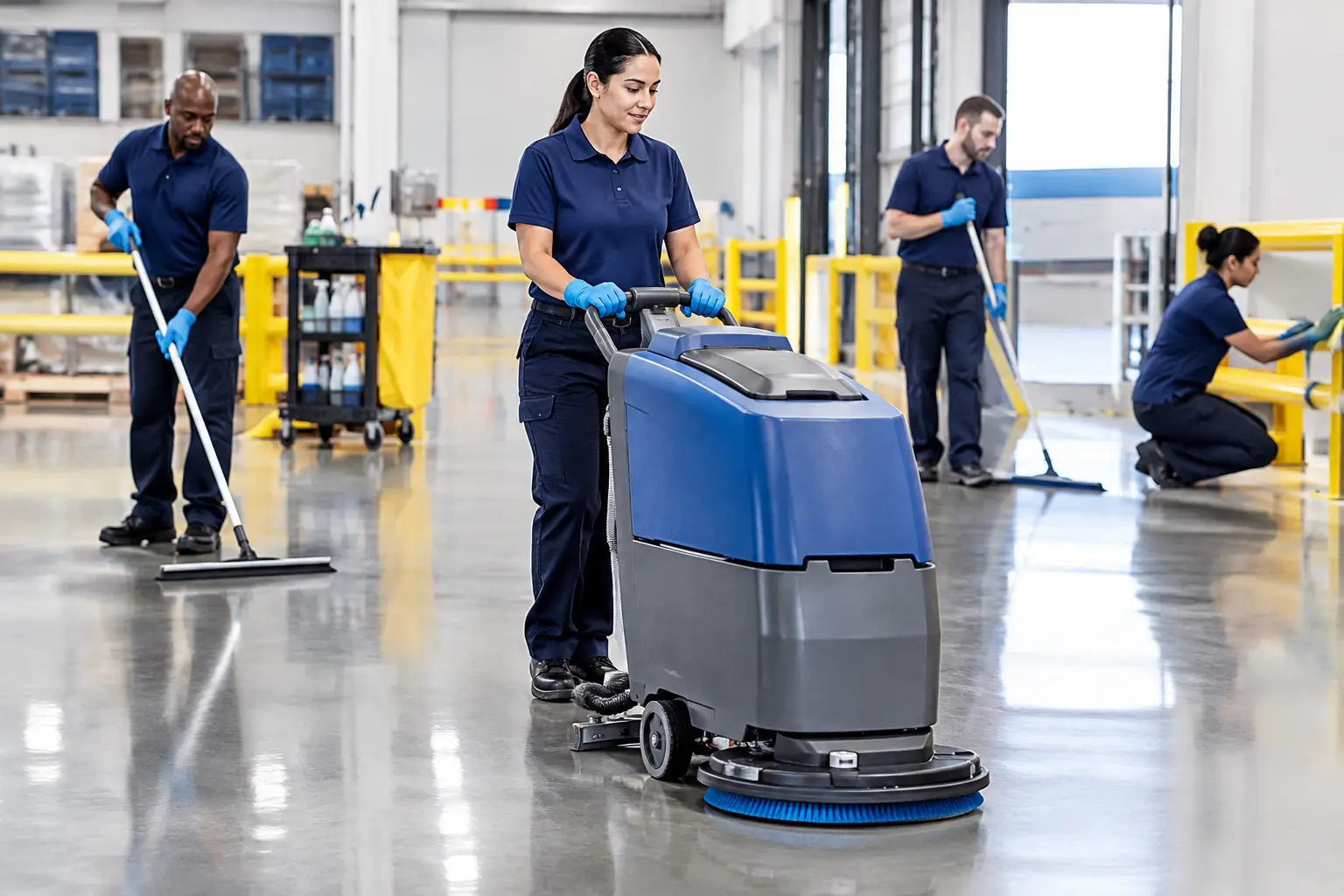
This zoning approach also makes labor planning more realistic. A floor scrubber may be the best tool for an expansive warehouse aisle, but it may not be appropriate around sensitive equipment, tight corners, drains, or areas where water recovery is difficult. Mechanical cleaning should supplement detail work, not eliminate it.
Define Daily, Periodic, and Corrective Work
Daily work generally focuses on dry debris removal, spill response, spot cleaning, and maintaining safe walking conditions. Periodic work may include machine scrubbing, edge cleaning, burnishing where appropriate, and inspection of coatings or finishes. Corrective work addresses unusual contamination, repeated staining, loss of traction, damaged floor coatings, or persistent odor sources.
A schedule should reflect actual operating conditions rather than a calendar copied from another building. A facility with two shifts, forklift traffic, or weather-driven debris may need adjustments after observing soil loads for several weeks. If inspections repeatedly find dirty grout lines, oily corners, or water near an entrance, the process needs revision, not just another reminder to staff.
Match Chemistry and Equipment to the Job
Floor care chemistry should be selected with safety data, technical specifications, and surface compatibility in mind. Procurement teams and facility managers should maintain current SDS documentation and ensure employees understand dilution, dwell time, personal protective equipment requirements, storage, and disposal instructions.
Concentrated products can improve operational efficiency, but only when dilution controls are reliable. Over-concentration can leave residue, create avoidable exposure risks, and add cost without improving results. Under-concentration may fail to remove soil. Closed-loop dispensing systems, labeled secondary containers, and measured dilution procedures reduce guesswork.
For oily soils, use a degreasing process appropriate for the surface and contaminant, followed by complete soil recovery. Leaving emulsified grease behind can create a deceptively slick floor. For routine maintenance on compatible surfaces, environmentally responsible cleaners can support safer daily operations without relying on unnecessarily harsh formulations. Performance still has to be verified in the actual facility environment.
Equipment matters just as much as chemistry. Select pads, brushes, squeegees, and vacuum recovery tools based on floor type and soil load. Worn squeegee blades can leave moisture behind. Dirty recovery tanks can redeposit contamination and create odor issues. Pads that are too aggressive can damage coatings, while pads that are too mild may not remove embedded soil.
Control Water and Slip Hazards
Water is one of the most common preventable floor hazards. A clean-looking floor is not necessarily a safe floor if it remains wet, has detergent residue, or receives tracked-in moisture faster than staff can remove it.
Place wet-floor warnings before work begins, not after an incident. Use entrance matting during wet weather, recover cleaning solution thoroughly, and inspect transition areas near docks, restrooms, ice machines, and exterior doors. Where operations allow, schedule larger wet-cleaning tasks during lower-traffic periods. For continuous operations, use smaller controlled work sections and maintain clear traffic management practices.
Do not assume a product alone determines slip resistance. Surface wear, floor texture, contamination, moisture, cleaning residue, footwear, drainage, and traffic patterns all contribute. Repeated slip concerns should trigger a documented review of the full system.
Make Documentation Part of the Cleaning Process
For high-compliance facilities, documentation is operational evidence. It shows what was cleaned, when the work occurred, which materials were used, who completed the task, and whether corrective action was necessary. This information supports internal quality control, contractor oversight, safety investigations, and procurement accountability.
Floor care procedures should identify approved products, dilution instructions, equipment settings where applicable, PPE requirements, spill response steps, and escalation contacts. Keep SDS sheets and technical documentation accessible to the personnel who use the products. If a facility has environmental, infection prevention, safety, or quality teams, their requirements should be reflected in the procedure rather than managed separately.
Training should cover the reason behind the process. Staff are more likely to follow a dwell-time instruction, change a soiled pad, or report a damaged coating when they understand the consequence of skipping the step. Supervisors should use inspections to coach against specific conditions, such as residual film, missed edges, poor water recovery, or cross-use of tools between zones.
Measure Results Beyond Appearance
A bright floor can still be poorly maintained. Better performance indicators include slip and trip reports, inspection findings, repeat spill locations, floor coating condition, equipment downtime, chemical consumption, and rework frequency. These measures help leaders distinguish between a staffing issue, an equipment issue, an unsuitable product, or a process design problem.
When reviewing vendors or cleaning supplies, prioritize reliable documentation, consistent availability, clear technical guidance, and chemistry that aligns with facility requirements. Veteran Commercial Cleaning supports this procurement-focused approach with professional-grade cleaning solutions and documentation-minded service for demanding environments.
The strongest floor program is the one employees can execute correctly under real operating conditions. Keep the process clear, inspect it consistently, and adjust it when the floor tells you the current standard is not enough.